

America was not built only by presidents, wars, railroads, highways, satellites, and inventors. It was also built in gymnasiums, swimming pools, summer camps, church basements, locker rooms, after-school programs, and neighborhood leagues where ordinary people learned how to belong.
That is why the YMCA deserves a place in the America 250 story.
For generations, Americans have known the Y not as an abstract institution, but as a place. A place to swim in the summer. A place to play basketball when it was too hot or too cold outside. A place where parents could drop off kids and trust that something healthy would happen. A place where teenagers found coaches, counselors, structure, and friends.
The YMCA helped teach America how to play together.
And that is no small thing.
A Christian beginning
The YMCA began in London in 1844, when George Williams and a group of young Christian men created an association to support young workers facing the pressures of industrial city life. Their concern was not only social, but spiritual. They believed young men needed fellowship, discipline, prayer, moral formation, and a community strong enough to help them resist the loneliness and temptations of a rapidly changing world.
That origin matters because it explains what the YMCA eventually became. It was not created merely to sell memberships or fill buildings. It was created because Christians believed community could form people.
The Y’s mission still reflects that inheritance: putting Christian principles into practice through programs that build healthy spirit, mind, and body for all. That phrase — spirit, mind, and body — is the key to the whole story. It explains why the YMCA’s influence reached beyond religion into sports, fitness, camps, swimming, youth programs, and local civic life.
The YMCA carried a Christian idea into daily life: the soul mattered, the body mattered, the mind mattered, and community could help shape all three.
More than a gym
Modern Americans often think of the YMCA as a gym, pool, or childcare center. That is understandable, but incomplete. The YMCA became one of the country’s great civic institutions because it treated recreation as formation.
In the YMCA world, the gym was never just a gym. The pool was never just a pool. The campfire was never just a campfire. These were places where children and adults learned habits: showing up, listening, competing fairly, helping teammates, respecting authority, and discovering that health is often built in groups.
That was the genius of the institution. The Y took physical activity and placed it inside a larger vision of character. Play became practice. Recreation became responsibility. Fitness became part of a moral and social life.
Where America learned games
The YMCA’s role in American sports history is deeper than many people realize.
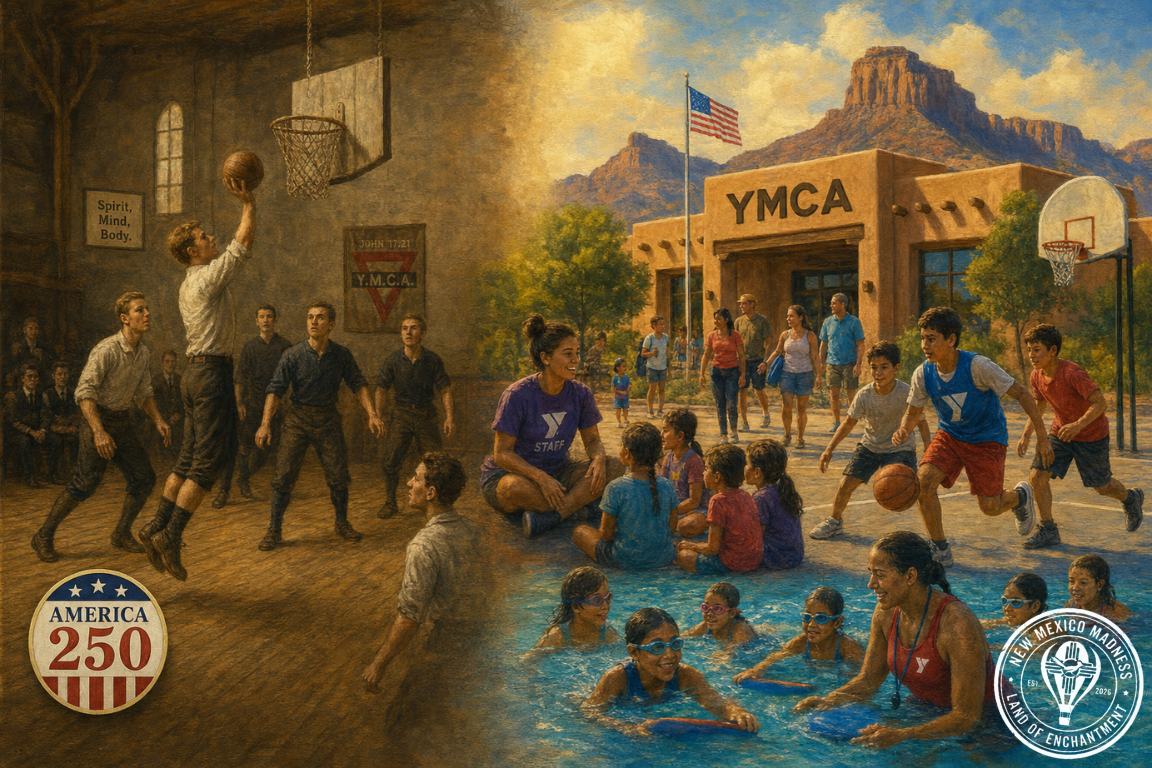
Basketball was invented in 1891 by James Naismith at the International YMCA Training School in Springfield, Massachusetts, after he was asked to create an indoor winter game for future Y directors. Using a soccer ball and peach baskets, Naismith created a sport that would become one of America’s greatest gifts to the world.
Volleyball also grew out of the YMCA world. William Morgan, a YMCA instructor in Holyoke, Massachusetts, created the game in the 1890s as a less strenuous alternative to basketball. What began as “mintonette” became volleyball, another sport that spread far beyond its original gym.
The Y also helped shape group swim lessons, exercise classes, and summer camping traditions. Camp Dudley, founded at Orange Lake, New York, in 1885, became one of America’s earliest and most enduring summer camp examples.
These are not small footnotes. Basketball, volleyball, swimming instruction, summer camps, fitness classes, and youth sports are now ordinary parts of American life. The YMCA helped plant many of those seeds.
The youth league model
If the YMCA’s historical contribution was invention, its everyday contribution was repetition.
The Y helped make local recreation normal. Children did not have to be elite athletes to play. Families did not have to chase prestige for a kid to learn teamwork. A child could join a league, put on a shirt, listen to a volunteer coach, run the wrong direction once or twice, learn the rules, and still come home better for it.
That model matters.
In an age when youth sports can feel increasingly professionalized, expensive, and specialized, the YMCA’s older vision still has something to teach. Recreational sports were never supposed to be only a pipeline to scholarships, rankings, or trophies. They were supposed to help young people grow.
That is the part that matches so many American memories. Summer at the Y. Basketball in a loud gym. Swim lessons that felt terrifying at first and normal by July. Day camps full of crafts, games, sunscreen, snacks, and organized chaos. Parents trying to keep kids busy and safe while school was out.
Sports commentator Jason Whitlock has argued in recent years that Americans often overlook the Christian and civic roots beneath organized sports culture. Whether one agrees with every part of his commentary or not, the broader point is worth considering here. The YMCA’s own history shows that sports were not originally treated as entertainment alone. They were treated as tools for forming people.
Community infrastructure
The first America 250 pieces in this series recognized the interstate system, GPS, and the Wright brothers. Those were stories about movement, navigation, and flight. The YMCA represents a different kind of American infrastructure.
It is human infrastructure.
The Y is the coach who teaches a child to pass the ball. The lifeguard who helps someone learn to swim. The counselor who remembers a kid’s name. The volunteer who gives up evenings for a league. The building where families from different backgrounds share the same court, pool, hallway, and rules.
America needs that kind of infrastructure too.
A country is not held together by technology alone. It also needs places where people can practice citizenship at a human scale. The YMCA helped provide those places. It gave millions of Americans a setting where health, friendship, discipline, service, and play could become part of ordinary life.
That is why the YMCA still belongs in the national conversation. YMCA of the USA is marking 175 years of strengthening communities in America during the same era that the country is preparing to celebrate its 250th anniversary. The timing is fitting. One anniversary celebrates the nation. The other reminds us that nations are strengthened locally.
What Christians planted
There is a temptation to flatten the YMCA into a generic nonprofit story. That would miss the heart of it.
The YMCA began because Christians believed young people needed formation. They believed faith should be lived through service. They believed a healthy body could support a healthy moral life. They believed association itself — people gathering around a shared purpose — could protect, teach, and strengthen.
That belief produced more than a membership organization. It produced a civic model.
The fruit of that model can be seen in gyms, pools, camps, youth leagues, fitness classes, childcare programs, and community centers across the country. Not every participant needed to understand the theology behind it. The structure still carried the idea: people are more than consumers, children are more than future workers, and communities are responsible for forming the next generation.
That is a deeply American story, and also a deeply Christian one.
A place worth remembering
The YMCA deserves recognition because it helped America build habits that are easy to take for granted.
It helped turn play into practice. It helped turn recreation into character formation. It helped turn local buildings into community anchors. It helped make sports available to ordinary kids, not just gifted athletes. It helped parents survive long summers and helped children discover what they could do with their bodies, their courage, and their friends.
That is why this America 250 recognition matters. America’s greatness has never come only from its largest achievements. It has also come from the institutions that quietly shaped everyday people.
Before youth leagues became routine, before summer camps became a rite of passage, before fitness classes became normal, before basketball and volleyball became global games, there was an association built on the belief that spirit, mind, and body belonged together.
The Y did not just give America a place to play.
It helped America understand why play mattered.
Endnotes
- YMCA of the USA, “Who We Are” — mission statement on putting Christian principles into practice through programs that build healthy spirit, mind, and body for all. ymca
- YMCA of the USA, “YMCA of the USA Marks 175 Years of Strengthening Communities Across America” — 175th anniversary, first U.S. YMCA in Boston in 1851, 2,600+ YMCAs, and work in more than 10,000 communities. ymca
- NPR, “How The YMCA Helped Shape America” — YMCA influence on basketball, group swim lessons, exercise classes, and Camp Dudley. npr
- YMCA Washington DC, “History” — YMCA milestones including camping, basketball, and volleyball. ymcadc
- YMCA Canada, “Our History” — basketball and volleyball origins in YMCA settings. ymca
- YMCA Australia, “Body, Mind and Spirit” — discussion of the YMCA’s whole-person mission rooted in Christian values. ymca.org
- YMCA of the USA, “YMCA of the USA Thanks Congress for Bipartisan Resolution Honoring 175 Years of Service in the U.S.” — recognition of the YMCA’s role in strengthening communities and supporting families. ymca


