

Before the airplane, before the interstate, before satellites plotted position from orbit, the United States solved a simpler but no less staggering problem: how to move people, goods, and power across three thousand miles of mountain, desert, and plains in days instead of months. On May 10, 1869, at Promontory Summit, Utah, two locomotives rolled nose to nose and a ceremonial golden spike was driven into a single tie. In that instant, the United States became something it had never fully been — one connected country, coast to coast, on rails.
The transcontinental railroad did not simply move faster than a wagon. It changed how Americans thought about distance, time, and what their government and workforce could build once they decided a problem was worth solving. As America marks its 250th year, the Golden Spike deserves its place beside the Wright brothers, the interstate system, and GPS — another chapter in the story of a country that keeps deciding the map is only unfinished.
A nation still measured in months
In the mid-1800s, crossing the continent was an ordeal, not a trip. Wagon trains, stagecoaches, and sea routes around South America could take the better part of a year to link the Mississippi Valley to California. The Gold Rush had already pulled hundreds of thousands of Americans west, but the country lacked a reliable way to hold itself together across that distance — economically, militarily, or politically.
Congress answered with the Pacific Railroad Act of 1862, authorizing land grants and government bonds to two companies willing to attempt what no one had built before: a continuous line of rail and telegraph from the Missouri River to the Pacific. It was an audacious bet, made in the middle of the Civil War, that the nation would not only survive but expand.
Two companies, one continent
The plan set up one of the great engineering races in American history. Central Pacific began laying track eastward from Sacramento in 1863, driving straight into the granite walls of the Sierra Nevada. Union Pacific started westward from Omaha two years later, crossing the plains and climbing into the Rockies.
Paid by the mile, both companies turned the project into equal parts engineering feat and full-throttle competition. Central Pacific crews blasted fifteen tunnels through solid rock and worked through snow that could bury a camp overnight. Union Pacific crews pushed across open plains at a pace that sometimes topped several miles of track in a day.
Behind both crews stood an extraordinary workforce. Central Pacific alone employed roughly 15,000 laborers, more than 13,000 of them Chinese immigrants who brought discipline and hard-won skill to some of the most dangerous work on the line. Union Pacific's ranks included Irish immigrants and Civil War veterans. Whatever their origin, these were the hands that turned a congressional act into two thousand miles of steel — proof that American ambition, at this scale, has always been built by many hands at once.
The Wedding of the Rails
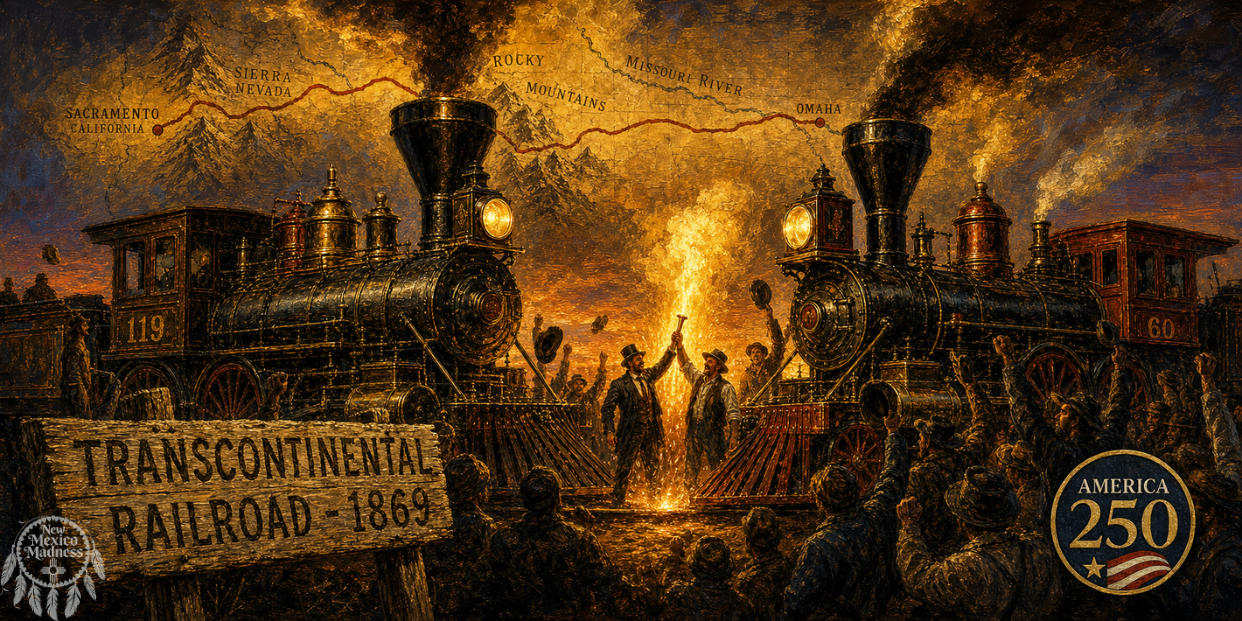
By spring 1869, the two lines were closing the gap through Utah. On May 10, dignitaries, laborers, and reporters gathered at Promontory Summit as the Jupiter and No. 119 locomotives eased toward each other, separated by a single remaining rail. A golden spike was tapped into a pre-drilled tie, telegraph wires relayed the moment instantly to both coasts, and for the first time, the country could be crossed by rail from ocean to ocean.
Newspapers called it the "Wedding of the Rails." It's one of the few moments in American history where the nation's ambition and its patience arrived on the same day.
What changed almost overnight
The effects were immediate, not theoretical. Within days, a trip that had taken four to six months by wagon could be finished in about a week by train. Mail, freight, and passengers that once moved at the speed of a horse now moved at the speed of steam.
- Commerce reshaped: Goods, cattle, grain, and manufactured products moved nationally instead of regionally, tying eastern factories to western markets.
- Settlement accelerated: Towns sprang up along the tracks as depots and supply stops before growing into permanent communities — a pattern still visible in how many Western towns are laid out today, with the old rail line as the spine.
- The military gained reach: The Army moved troops and supplies far faster, and several forts were deliberately sited near rail lines for resupply — a logistics logic that would echo decades later in how bases were positioned near rail and highway corridors alike.
- Time got standardized: Dozens of local timekeeping systems became unworkable once railroads needed synchronized schedules across thousands of miles, pressure that helped push the country toward the standardized time zones still used today.
- Communication rode alongside: Telegraph lines followed the same right-of-way as the tracks, so the railroad carried information as fast as it carried freight.
The railroad didn't just shrink the map. It rewired how the country organized itself on top of it.
Building the template for what came next
The transcontinental railroad set a pattern the United States would return to again and again: identify a problem too large for any one company or region, mobilize public land and capital behind private ambition, and let competition and engineering do the rest.
That formula echoed through the twentieth century. The interstate highway system followed a similar logic of connecting the country point to point at continental scale. GPS, born from military necessity, became a quiet utility for much the same reason — once a nation tastes the advantage of moving faster and coordinating better than its rivals, it rarely gives that advantage back.
An achievement worth the name
It would be easy to reduce the transcontinental railroad to a photograph of two locomotives and a ceremonial spike. But the real achievement lies behind that photograph — an act of Congress passed mid-civil-war, two companies racing across a continent, and tens of thousands of workers who turned mountains and plains into a passable line.
That the workforce included so many immigrants isn't a footnote to the achievement. It's part of what made the achievement possible, and part of what makes it distinctly American — a country that has repeatedly built its biggest projects on the combined effort of people from very different backgrounds, aimed at the same horizon.
As the nation marks 250 years, the Golden Spike belongs in the same company as the Wright brothers' twelve seconds at Kitty Hawk: a moment when a hard, physical problem that had constrained human movement for generations was solved through discipline, competition, and will — and the country was never quite the same size again.
Endnotes
- Library of Congress, "Golden Spike (1869): Topics in Chronicling America."
- Library of Congress, "Today in History: May 10 — Wedding of the Rails."
- Gilder Lehrman Institute, "Official photograph from the 'Golden Spike' Ceremony, 1869."
- HISTORY.com, "Transcontinental Railroad Completed, Unifying United States," May 10, 1869.
- EBSCO Research Starters, "Golden Spike."
- Intermountain Histories, "The Golden Spike: Promontory Summit and the Transcontinental Railroad."
- U.S. Census Bureau, "May 2023: The Transcontinental Railroad."
- Union Pacific, "The Great Race to Promontory: 150th Anniversary of Driving the Golden Spike."
- National Park Service, "Golden Spike National Historic Site."


