

When you look at a statewide election result in New Mexico, it is easy to assume the entire state just shrugged and asked for four more years of 50th-place rankings, higher Gross Receipts Taxes, $68,000 lawmaker salaries, and hundreds of millions in new bond debt.
The precinct receipt book tells a very different story. Thirty-one of New Mexico's 33 counties were essentially bystanders to a margin manufactured inside a tight urban strip—while thousands of metro voters quietly broke ranks and the state's conservative strongholds stayed home.
Here are four charts from the 2026 election vault that show who actually owns the status quo, and why the statewide map is far more movable than it looks.
1. The Blue Bulldozer: Where the Status Quo Lives
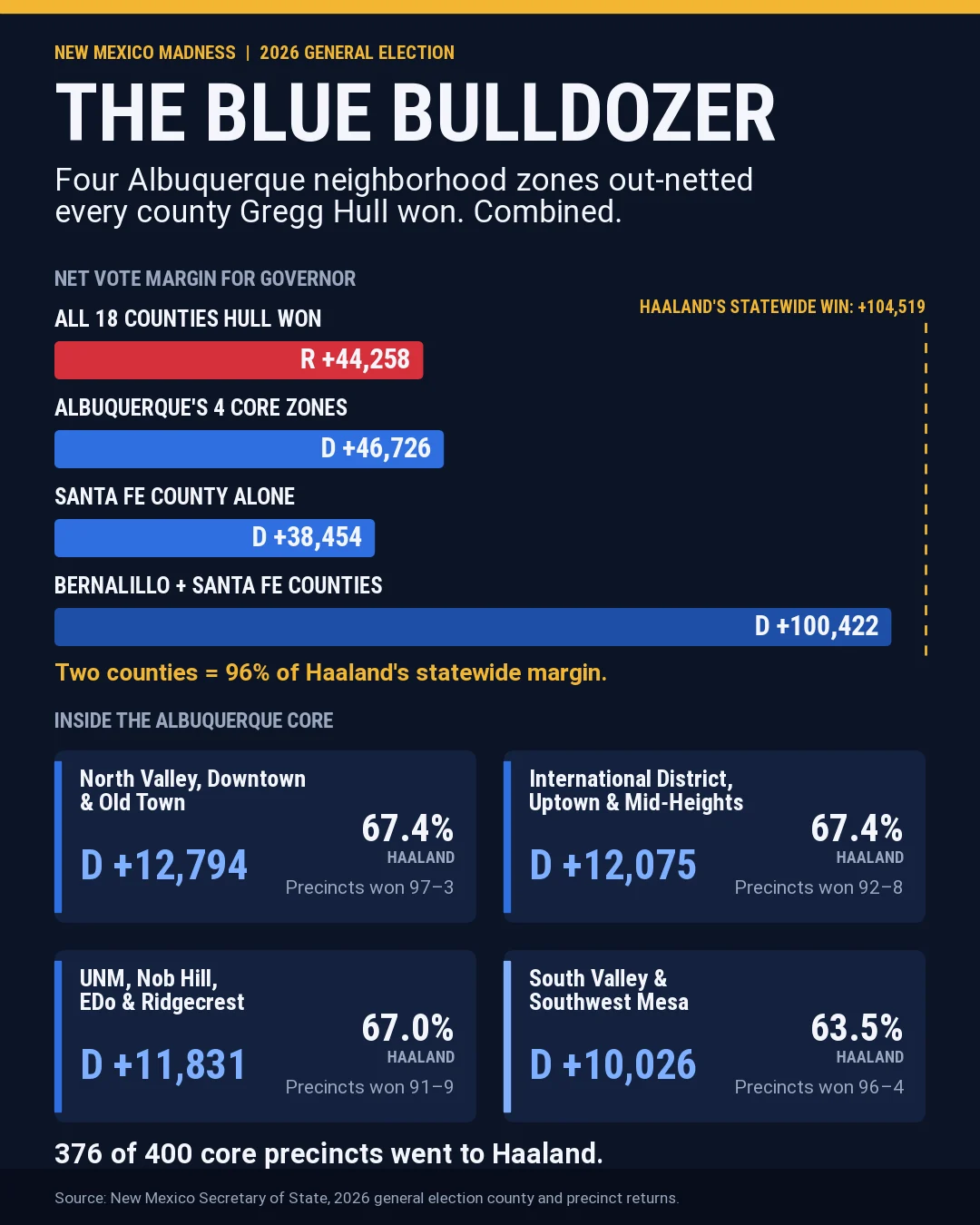
When New Mexicans ask who voted to keep current crime, tax, and education policies in place, they do not need to look at all 33 counties—they only need to look along Central Avenue, the Rio Grande valley, and I-25 up to Santa Fe.
What makes this 400-precinct Albuquerque core so lopsided is not just ideology; it is a total lack of competition:
- 13 Free Passes in the Metro: Republicans did not even field a State House candidate in 10 of Bernalillo County’s 23 districts or in three core Santa Fe districts, allowing Democrats to bank over 110,000 uncontested metro votes with zero pushback.
- The 90% Neighborhoods: In dozens of precincts around UNM, Nob Hill, Ridgecrest, Downtown, and historic Santa Fe, Deb Haaland cleared 85% to 92% of the vote at 65% to 78% turnout.
- The CD-2 Gerrymander Slice: That South Valley and Southwest Mesa block (PCT 001–100) is the exact urban slice carved out of Albuquerque to dilute oil-patch votes in southeastern New Mexico and keep Congressional District 2 blue.
2. The Crossover Vote: The Metro Is Already Cracking
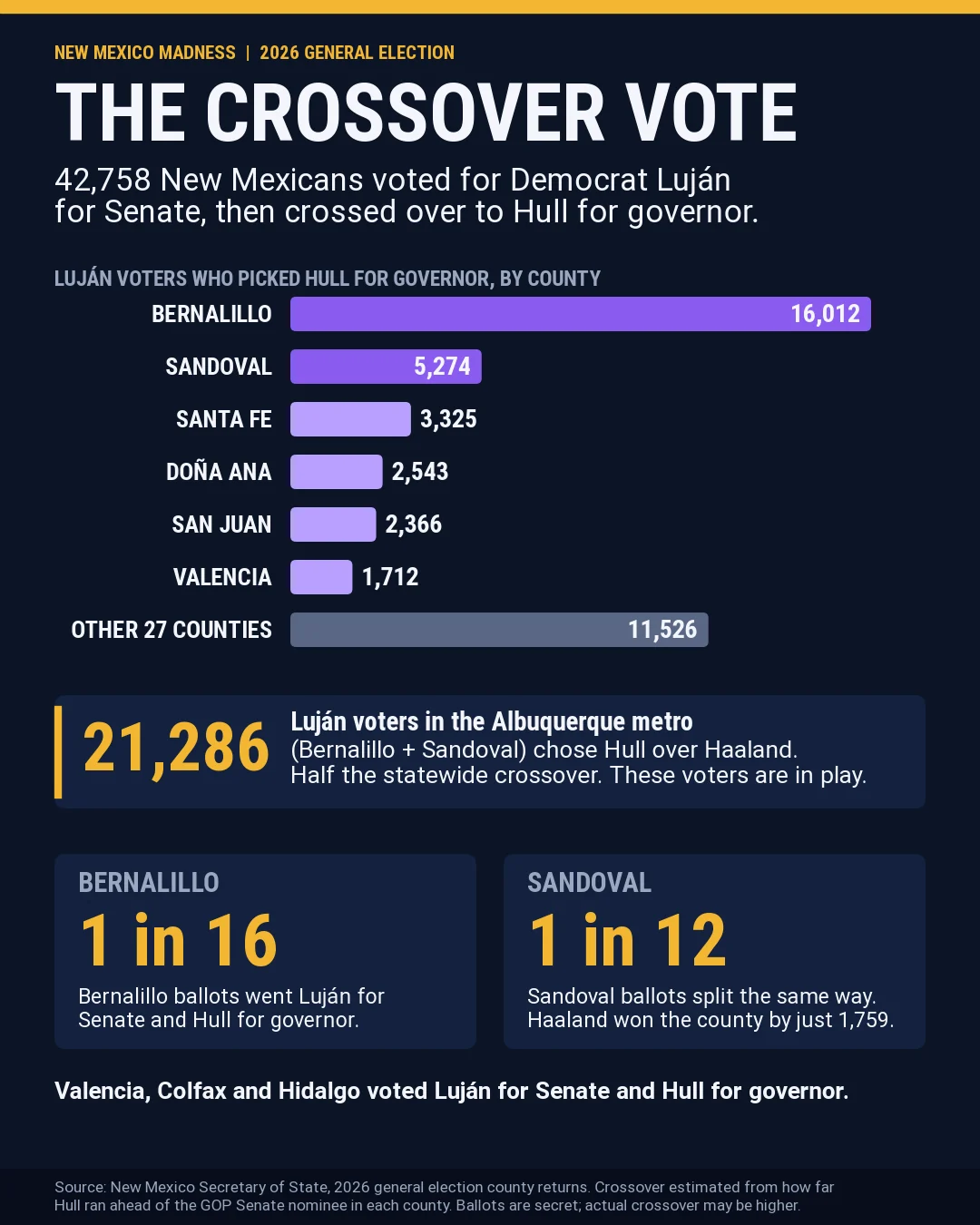
A +61,968 margin in Bernalillo County makes Albuquerque look like an impenetrable progressive wall, until you compare the U.S. Senate race to the governor’s race on the exact same ballots.
Tens of thousands of metro voters who backed Democrat Ben Ray Luján for federal office refused to vote for Haaland to run the state. Why? Because federal partisanship does not fix retail theft on Central Avenue, property crime in the Heights, or failing local schools. Even further down the ballot, Republican State Treasurer nominee James Ellison won Valencia County outright. Suburban voters in Bernalillo, Sandoval, and Valencia counties are already in play when given a practical, local reason to cross over.
3. The Couch Caucus: Leaving the Flippers Hanging
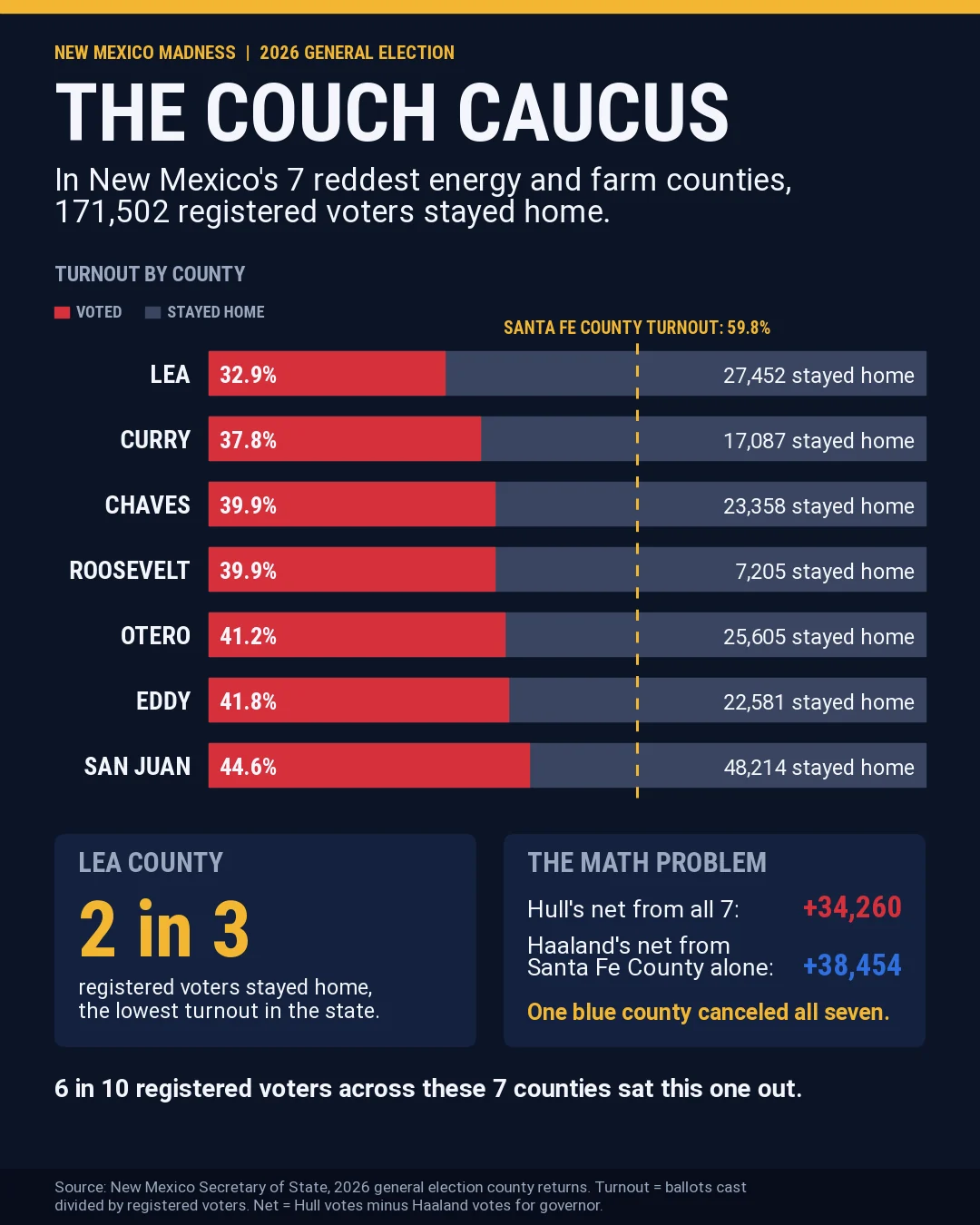
Those 42,758 Luján-to-Hull crossover voters threw rural New Mexico a lifeline, but the state's conservative engine rooms never picked it up.
While core Santa Fe neighborhoods turned out at 70%+ to protect the Roundhouse status quo, the oil patch and farm belt posted the lowest turnout in the state. If those seven red counties had simply matched Santa Fe County’s 59.8% turnout rate, over 55,000 additional ballots would have entered the statewide pool from counties that backed Hull by 2-to-1 and 3-to-1 margins.
4. The Poverty Paradox: Asking for Seconds
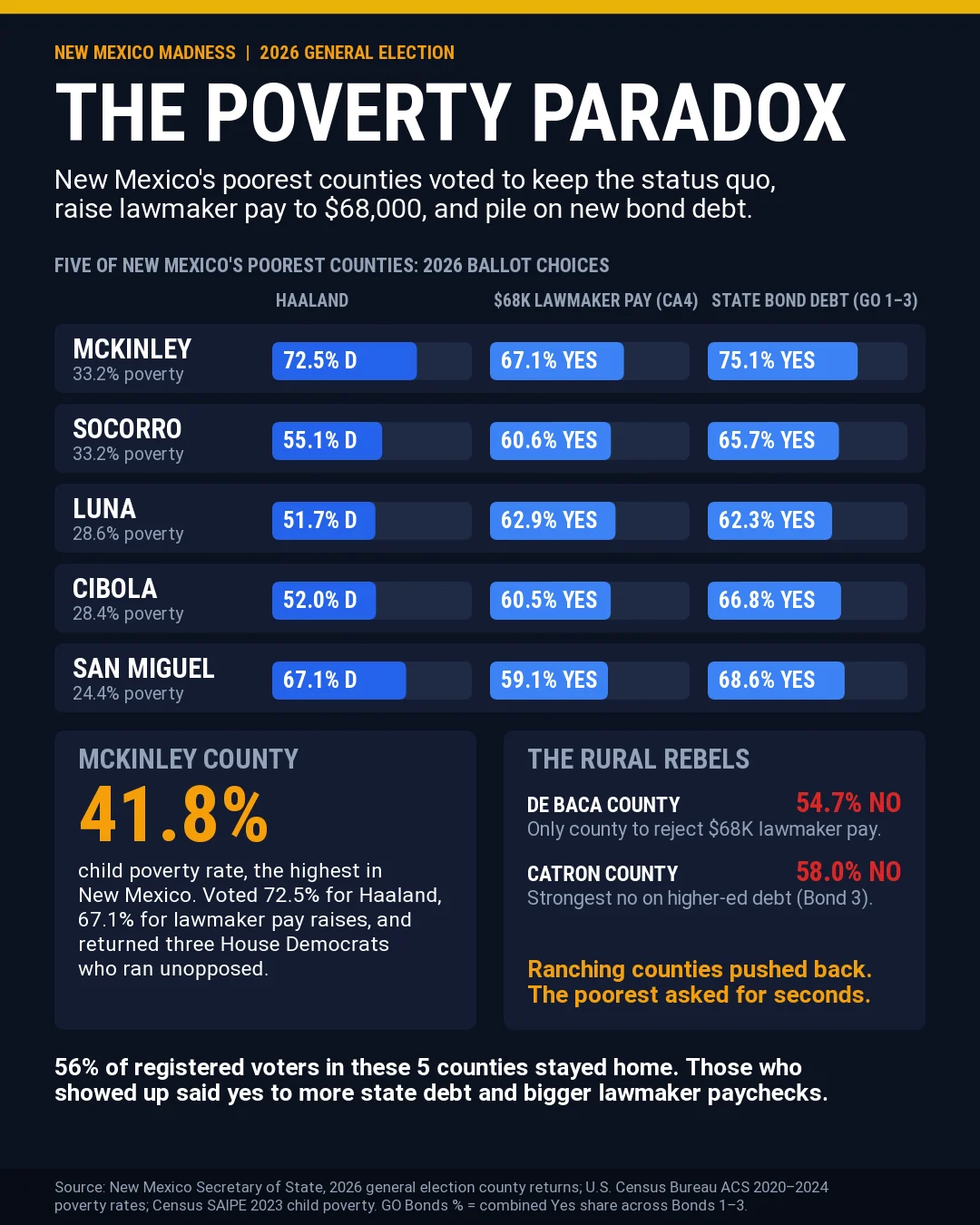
The strangest receipt in the 2026 vault comes from the ballot measures. General Obligation Bonds are backed by statewide property taxes, and Constitutional Amendment 4 puts taxpayers on the hook for a roughly $68,000 legislative salary starting in 2029.
Yet the counties suffering the worst generational poverty—and the highest child poverty rates in America—voted overwhelmingly to reward Roundhouse lawmakers with a pay raise and pile on new state bond debt, while leaving more than half of their own registered voters on the couch. Only tiny De Baca and Catron counties showed up at 56% to 58% turnout and told Santa Fe "no".
New Mexico’s political map isn’t broken by math. It is decided by 376 hyper-mobilized precincts in Albuquerque and Santa Fe that show up to every election—and a conservative and independent majority outside the bubble that keeps leaving its ballots on the kitchen counter.
End Notes / Methodology
Data & Methodology Note: All 2026 general election figures are compiled from official New Mexico Secretary of State county and precinct returns across all 33 counties and 2,204 precincts (1,463,716 registered voters; 726,684 ballots cast; 49.65% statewide turnout). Albuquerque neighborhood zones reflect contiguous Bernalillo County precinct groupings (PCT 001–400 for the four core zones). Crossover vote estimates reflect the county-level ballot differential between Republican gubernatorial nominee Gregg Hull and the Republican U.S. Senate nominee. County poverty and child poverty rates are sourced from U.S. Census Bureau ACS 5-year estimates and SAIPE county poverty tables.


