

New York City is about to open a grocery store that can undercut every private grocer around it by nearly a third. It can do that because somebody else is paying the parts of the bill you never see at the register.
Mayor Zohran Mamdani has committed $70 million in city capital money to build five municipal grocery stores, one per borough, with the first slated for Hunts Point in the Bronx and a second at La Marqueta in East Harlem. The promise is a 30 percent discount on a core basket — produce, meat, milk, bread, beans, rice — with everything else priced at market. No ID required. No income check. Anyone can shop.
The idea has been called socialism, a gimmick, and a lifeline, sometimes in the same news segment. What it has mostly not been is explained. So here is the explanation, in plain terms, followed by the only question that matters for New Mexico: could Albuquerque do this, and could a town like Gallup?
This is not a story about whether public groceries are a good idea. Reasonable people land in different places on that, and food deserts in this state are real enough that the argument deserves better than a bumper sticker. This is a story about how the machine actually works, and about who ends up feeding it.
The City Is the Landlord. Somebody Else Runs the Store.
Start by throwing out the picture in your head. A "city-run" grocery store does not mean a city employee at the register asking whether you found everything all right.
The city buys or already owns the building. The city pays for the coolers, the freezers, the shelving, the registers, the loading dock — the whole expensive guts of a supermarket. Then the city hands the keys to a private grocery operator, who does the hiring, the ordering, and the stocking, and who has to follow the city's rules on what things cost and what workers get paid.
Publicly owned. Privately operated. That distinction is the entire ballgame, and almost every hot take on this plan gets it wrong in the first sentence.
The Discount Is Not Magic. It's Four Missing Bills.
A normal grocery store operates on margins thin enough to make a coupon clipper wince. Pennies on the dollar. That is why the phrase "just charge less" has never worked as business advice.
A city store charges less because four costs are simply gone. It pays no rent, because the city owns the building. It pays no property tax, for the same reason. It sends no profit to shareholders, because there are no shareholders. And it carries no startup debt, because the taxpayers already bought the equipment outright.
Strip those four things out of a grocery bill and you have found most of your 30 percent. The rest comes from a check the city writes to cover the gap on staple items — and here is the part worth sitting with: that check does not go away. There is no year five where the store grows into profitability and thanks the taxpayers for the loan. The gap is structural. The subsidy is permanent by design.
Read that again, because it is the whole story. The discount is not an efficiency. It is a transfer.
Two Buckets: Building Money and Running Money
Every version of this proposal, in every city, comes down to two pots of cash.
Building money is one-time. It buys the property and the equipment, and cities almost always borrow it — bonds paid off over years, the same way a city finances a fire station or a water line.
Running money is forever. It covers the discount, and it comes out of the annual operating budget. That is the same pot that pays for police, for fire, for potholes and parks and plow trucks. There is no separate grocery fund waiting in a drawer.
So when someone asks who pays, the honest answer is not complicated. The cheap price at the register is a line item, and line items compete. Every dollar covering a discount on ground beef is a dollar that was available for something else the city buys.
The Military Commissary Comparison Is Fair — Right Up to the Fence Line
Anyone who has served in the military knows this model already works, because we have been running it for decades across US installations to include overseas. Base commissaries sell at cost, add a small surcharge that funds construction rather than operations, and Congress cuts a check every year — roughly $1.5 billion of appropriated money for the current fiscal year. Nobody pretends the commissary turns a profit. It was never asked to.
But look at what makes it work, because the differences are not small.
The customer base is closed and verified. You show a card at the door. The savings are a benefit attached to service, not a public utility open to the street. And the labor model has a wrinkle most civilians never notice: the baggers at your commissary are not government employees and draw no wage at all. They are self-employed, working for tips, by agreement with the installation. A real cost of running that store sits off the books, paid a dollar at a time by the people in line.
A municipal grocery store has none of that. No door check, no eligibility card, no volunteer-adjacent labor pool. Everyone qualifies, which means the subsidy flows to the shopper who needs it and the shopper who doesn't, in the same checkout lane, at the same discount.
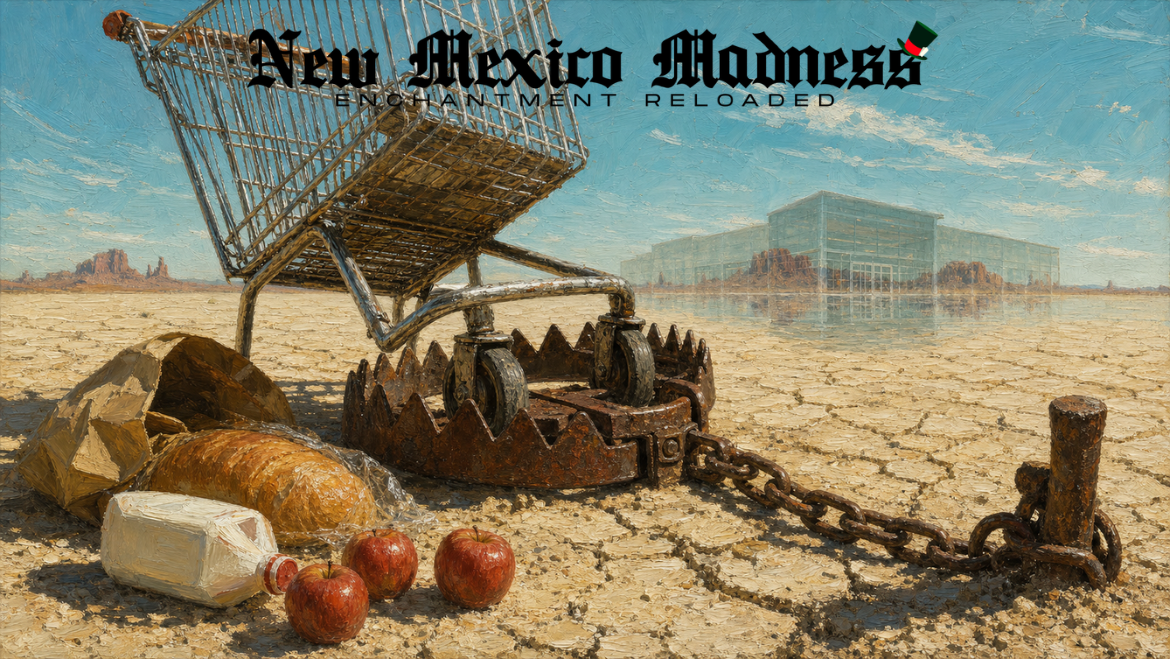
Albuquerque Could Try It. Something Else Would Have to Give.
Albuquerque is the only place in New Mexico with the scale to attempt this seriously. It runs a budget of roughly $1.5 billion, it already has a mayoral order directing city departments to attack food insecurity, it has waived fees and loosened rules to lure grocers into underserved neighborhoods, and it has broken ground on a food market in the International District — a part of town that lost major retailers and now qualifies as one of the worst food deserts in the state.
So the building money is findable. Albuquerque can bond for a building the way it bonds for anything else.
The running money is the problem. This year's budget absorbed tens of millions in cuts and came in lower than the year before, and the council turned down a tax increase. A permanent grocery subsidy would not be funded by new revenue. It would be funded by taking it from a department that currently has it — and in a city where policing alone eats roughly a third of the general fund, that conversation gets short and loud.
That is not an argument against the idea. It is the price tag on the idea, stated out loud, which is more than most proposals get.
Gallup Cannot Get There, and the Reason Is Structural
Now run the same play in a town of twenty thousand that serves as the retail hub for a nation of a quarter million.
Gallup needs a grocery solution more than Albuquerque does. McKinley County is one of the most food-insecure places in the country, thousands of households there depend on SNAP, and the trading-post economy has never been a substitute for a full-service store within reasonable driving distance of home.
Gallup also cannot pay for one, and the reason has nothing to do with political will.
New Mexico cities do not run on property tax the way cities elsewhere do. They run on gross receipts tax — the levy that shows up on your receipt. That is the engine, and in Gallup the city pledges that revenue to secure the bonds it issues. But groceries bought to cook at home are deducted from gross receipts tax in this state. Food, as a category, does not feed the city.
Put those two facts together and the trap closes. A municipal grocery store in Gallup would generate almost no revenue for the city that built it, while demanding a subsidy check every single year, forever, from a small operating budget with nothing spare in it. Albuquerque faces a hard choice. Gallup faces arithmetic.
What This Costs
If a city-owned grocery store ever opens in Gallup, Gallup will not have paid for it. Santa Fe will have.
And Santa Fe's money is not abstract. Depending on the year, somewhere between a third and nearly half of New Mexico's general fund comes out of the ground in the Permian Basin — oil and gas severance taxes and royalties, from wells in Lea and Eddy counties. That is the money that funds the schools, the roads, and every program the Legislature likes enough to make permanent.
So a public grocery store in McKinley County would be paid for by drilling in southeast New Mexico. Not by shoppers, not by the city, not by the store. By a commodity price that no legislator controls and no mayor can forecast.
That is the part worth telling New Mexicans plainly. A permanent obligation funded by a volatile revenue stream is not a plan, it is a bet — and the people holding the ticket are the ones who will still need groceries the year the price of oil goes the wrong way.
There is a real problem here. Thirty percent of this state lives in a food desert, and pointing that out is not a partisan act. But before anyone imports a New York solution, New Mexicans are entitled to know the four bills that disappear, the one check that never stops, and whose well is paying for it.
Notes
- NYC Mayor's Office, "Mayor Mamdani Unveils 30% Discount," July 27, 2026: nyc.gov
- The New York Times, "Mamdani's Grocery Stores Will Offer 30 Percent Discount on Some Products," July 27, 2026
- Vox, "The hidden cost of Mamdani's plan for cheap groceries," August 3, 2026
- TIME, "What We Know About Mamdani's First Planned City Grocery Stores," May 21, 2026
- Defense Commissary Agency FY2027 budget justification, Office of the Comptroller
- Defense Commissary Agency, customer service FAQ on bagging and carryout services, updated July 30, 2026
- City of Albuquerque FY2027 approved budget, Department of Finance and Administration
- Mayor Tim Keller, Executive Order on Food Insecurity, cabq.gov
- New Mexico Taxation and Revenue Department, FYI-201, "Gross Receipts Tax and Certain Foods"
- Lincoln Institute of Land Policy, New Mexico fiscal profile, October 2023
- New Mexico Legislative Finance Committee, "Finance Facts: Oil and Gas Revenue"
- City of Gallup annual financial report on gross receipts tax revenue bonds


