

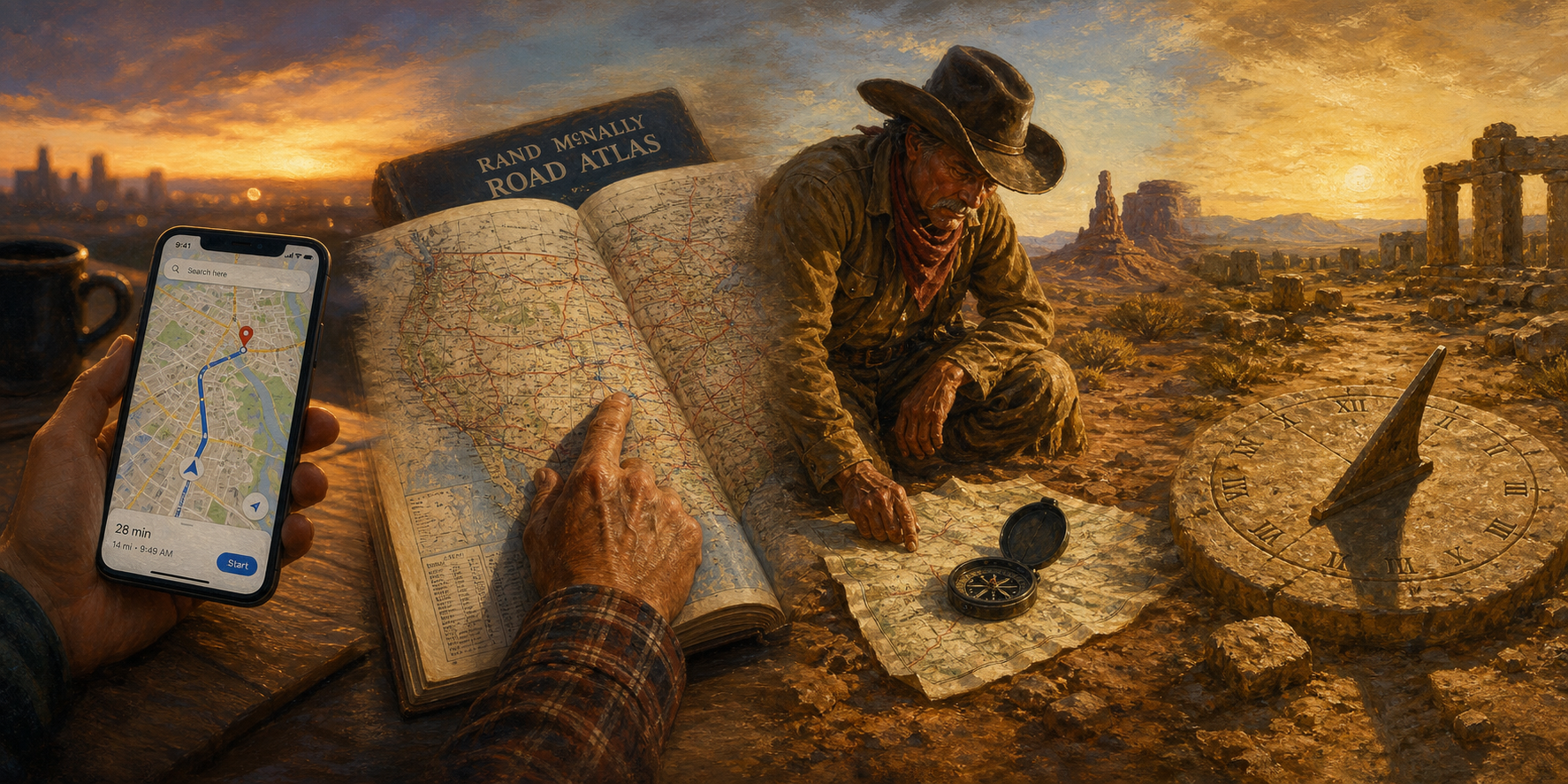
Before the Global Positioning System (GPS) became a blue dot on a screen, it was a bold American answer to a hard problem: how to know exactly where you are, anywhere on Earth, at any moment. That idea now feels so ordinary that it is easy to forget how extraordinary it is. The modern world moves with a confidence that would have seemed almost magical a generation ago, and much of that confidence comes from a satellite system built through American ingenuity, purpose, and power.
As America approaches its 250th anniversary, GPS deserves a place in the national story. Not because it is flashy. Not because it is ceremonial. But because it is one of the clearest examples of an American invention that escaped the laboratory, entered daily life, and quietly made the world safer, simpler, and more connected.
GPS began as a military project in the Cold War era, grew out of satellite navigation experiments and the rise of precise timing technology, and became fully operational in the early 1990s. What started as a defense tool evolved into a civilian utility used by nearly everyone, often without a second thought. That arc — from strategic system to everyday necessity — is one of the most American stories imaginable.
From the sky to the street
At its core, GPS is elegant. Satellites orbit the Earth, broadcasting signals with exact timing. Receivers on the ground measure how long those signals take to arrive, then calculate position. The math is invisible to the user, but the effect is immediate: location, direction, and movement become measurable with astonishing precision.
That precision changed everything.
Drivers no longer need to depend solely on memory or paper maps. Farmers can guide machinery with far greater accuracy. Airlines can navigate more efficiently. Emergency responders can reach people faster. Delivery fleets can route packages with less waste. Telecommunications networks and financial systems can stay synchronized because GPS provides highly accurate timing, not just position.
In other words, GPS is not only about finding your way. It is about helping modern systems function at all.
The hidden engine of everyday life
The best technologies are often the ones people stop noticing. GPS is one of those technologies. It is built into the habits of daily life so completely that most people only think about it when it fails for a moment.
A parent uses it to find a school. A truck driver uses it to hit a tight schedule. A dispatcher uses it to send help to the nearest ambulance. An air traffic controller relies on precise data to monitor multiple aircraft on approach. A logistics company uses it to know where inventory should go next, down to the right zip code. A farmer uses it to manage land more efficiently. A traveler uses it to cross an unfamiliar city with confidence.
That is the genius of GPS. It turns uncertainty into useful information. It turns distance into a system. And it turns the world into something a little more legible.
It also helps explain why GPS became such an economic force. According to RTI International, GPS has generated trillions of dollars in economic benefits by supporting transportation, agriculture, telecommunications, emergency response, and other sectors that depend on precise location and timing. In that sense, GPS is not just a convenience. It is infrastructure.
Why America made it matter
There is a distinctly American pattern to GPS: a difficult national-security problem became a public good.
The system’s origins lie in military navigation and satellite experimentation, but its greatest legacy came when it was opened and expanded for civilian life. That transformation reflects something important about American innovation. We often build with strategic urgency, then let the result scale into the public realm. We make tools that begin as instruments of defense and become instruments of daily progress.
That is not accidental. It is part of the country’s character.
GPS also reflects a deeper American confidence: the belief that complex problems can be solved, systematized, and improved through engineering, research, and persistence. It is an invention that depends on patience, precision, and scale — three things the United States has often produced in abundance when it decides something matters.
A New Mexico perspective
New Mexico is a fitting place to appreciate the GPS story. This is a state shaped by distance, open space, aerospace history, and the need to understand where you are in relation to everything else. GPS is not abstract here. It is practical.
It also belongs to the broader New Mexico landscape of testing, exploration, and science. In a state where the horizon stretches wide and the road can run long, the ability to know your exact location feels less like a luxury and more like a necessity. GPS fits that reality perfectly. It connects the desert to the digital age.
And maybe that is what makes the story resonate here most: a technology born from skyward ambition became a tool for everyday life on the ground.
The American gift to the world
The most remarkable thing about GPS is not that it exists. It is that it became ordinary.
That is the mark of a truly transformative invention. It stops looking like a breakthrough and starts looking like common sense. It becomes so integrated into modern life that the world can hardly imagine functioning without it.
So as America marks 250 years, GPS deserves to be remembered not as a technical system alone, but as a national achievement — one that helped turn the globe into a better, simpler, and safer place to live. The power behind that blue dot on your phone came from American ingenuity, power, and purpose. And once again, the country built something that reached far beyond its borders.
Closing
The next time you stare at your phone and ask for directions, remember what is really happening. You are not just using an app. You are drawing on a system of satellites and signals born from American minds that wanted to solve a problem big enough to matter to the world.
That is the quiet beauty of GPS. It guides us without asking for praise. It works in the background, never demanding attention, even as it shapes the movement of nearly everything around us. It is one of America’s great gifts: a system that made the globe easier to navigate, and life a little less uncertain.

Endnotes
- NASA, “Global Positioning System History.”
- NASA, “GPS.”
- GPS.gov, “GPS Speeds Emergency Response.”
- RTI International, “GPS: A $1.4 Trillion Economic Engine.”
- NIST, “Economic Benefits of the Global Positioning System (GPS).”
- The Aerospace Corporation, “Brief History of GPS.”


