

If you listen to television pundits or political consultants talk about New Mexico elections, they always fall back on the same lazy script: New Mexico votes blue because of its demographics, its geography, and its minority population.
Walk into a backroom in Santa Fe, however, and professional operatives know that script is a decoy.
New Mexico is not divided by race, last name, or even urban versus rural zip codes. It is divided by a much simpler question: Does your household pay for the state budget, or does the state budget pay for your household?
When you overlay U.S. Census income, education, and housing tables onto Tuesday’s 2026 election returns and New Mexico Health Care Authority benefit rolls, the real machine running the state comes into focus.
1. The Barbell Coalition: PhDs at the Top, Subsidies at the Bottom
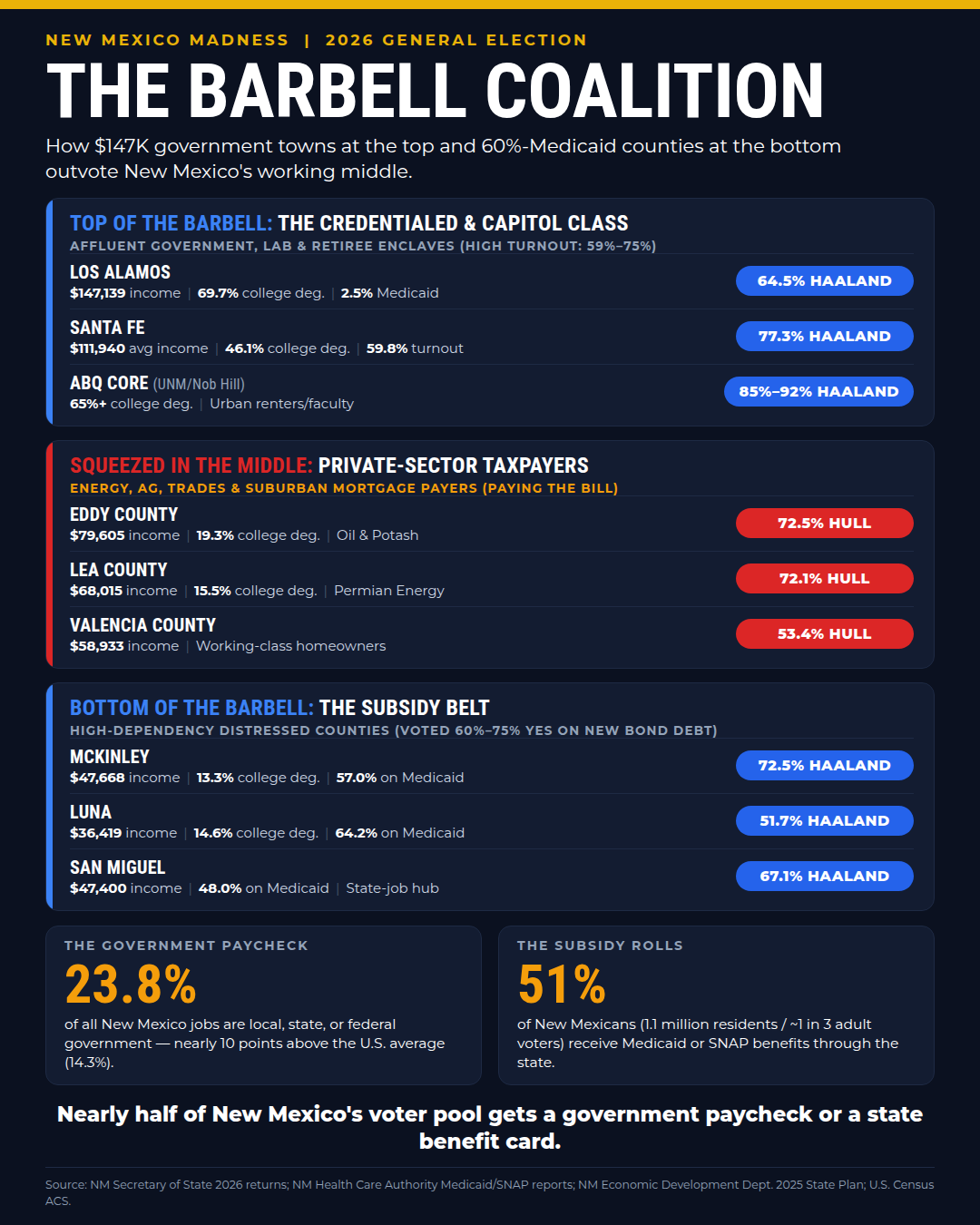
In a healthy economy, the middle class drives election outcomes. In New Mexico, the private-sector middle class is caught in a vise between the two ends of a political barbell:
- Why the Top Votes Blue: The wealthiest, most degreed enclaves in New Mexico—Los Alamos, Santa Fe, Taos, and Albuquerque’s UNM/Nob Hill corridor—are insulated from the state's 50th-place rankings. Their paychecks come from federal labs, state agencies, universities, government contracts, or out-of-state retirement accounts, and urban renters in the university core never see a county property tax bill when they rubber-stamp new state bond debt.
- Why the Bottom Votes Blue: At the other end of the barbell sit counties where the private economy has been hollowed out for decades, leaving half to two-thirds of residents dependent on Medicaid and SNAP just to get by. When state government is the only lifeline in town, voters understandably vote to keep the checks flowing—even if it means approving $68,000 politician salaries and hundreds of millions in new bond debt.
- The Education Irony: Notice how the barbell works on education, too. Los Alamos (#1 in college degrees at 69.7%) and Santa Fe (#2 at 46.1%) voted overwhelmingly to hand Roundhouse politicians a $68,000 salary under Constitutional Amendment 4. Meanwhile, tiny ranching De Baca County—which ranks 33rd out of 33 counties in college degrees at just 9.3%—was the only county in New Mexico with the common sense to vote NO.
When nearly a quarter of the state's jobs are government positions and roughly one in three voting-age adults is enrolled in state-administered Medicaid or food assistance, the status quo starts every election at the 48-yard line.
2. Shattering the "Hispanic Monolith" Myth
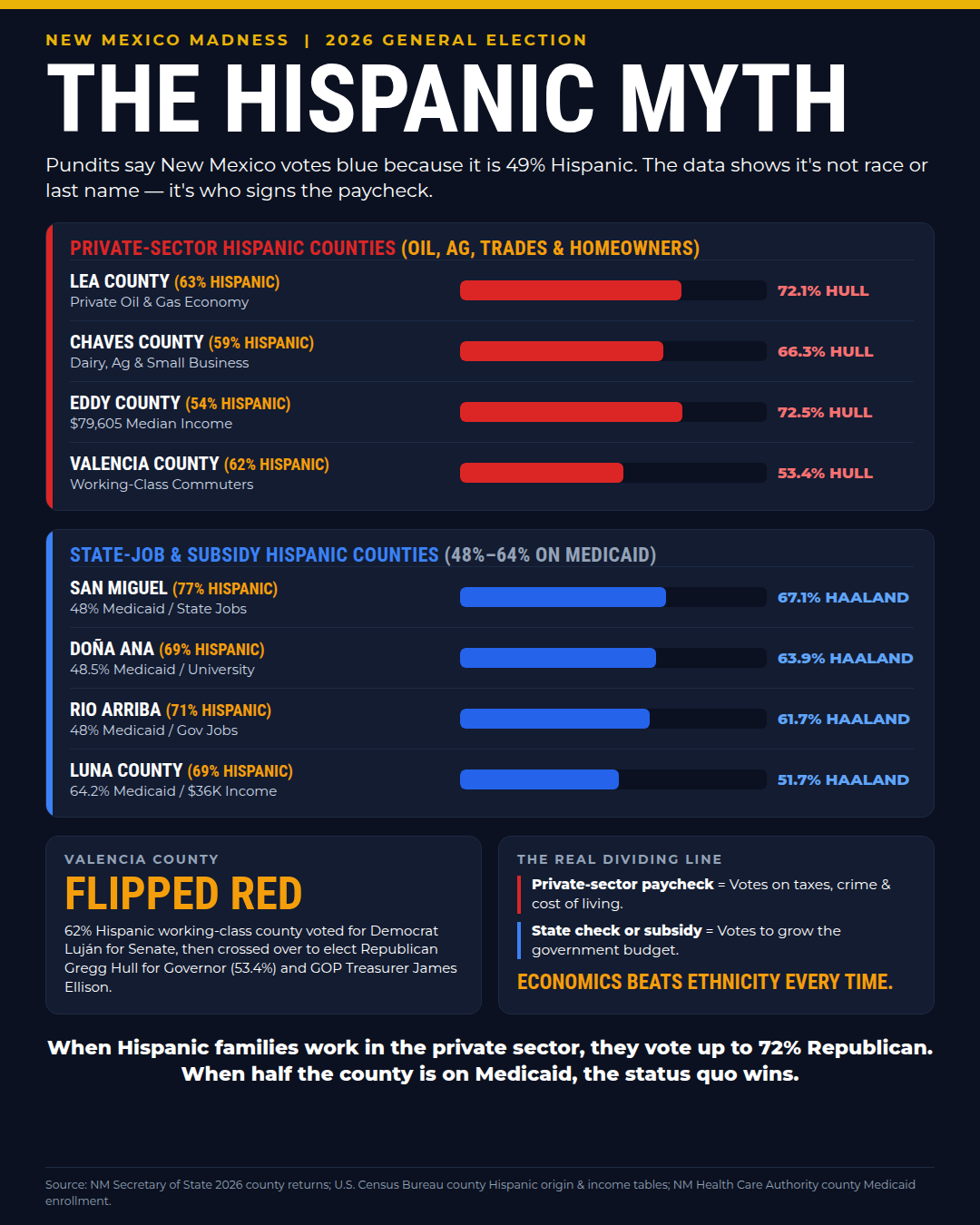
For years, both parties have treated New Mexico’s 49% Hispanic population as an automatic Democratic voting bloc. The 2026 county receipt book blows that myth to pieces.
Take eight majority-Hispanic counties across New Mexico and line them up by how their local economy works:
- Where Private-Sector Jobs and Homeownership Lead: In majority-Hispanic counties powered by oil and gas, dairies, agriculture, skilled trades, and married-couple homeowners—like Lea, Chaves, Eddy, and commuter-heavy Valencia County—voters backed Republican Gregg Hull by 53% to 72.5%. In fact, 62%-Hispanic Valencia County voted for Democrat Ben Ray Luján for U.S. Senate and then flipped on the exact same ballot to elect Hull for governor and Republican James Ellison for state treasurer.
- Where Government Jobs and Subsidies Lead: Cross into majority-Hispanic counties where state universities, courthouses, and Medicaid/SNAP benefits dominate the local economy—like San Miguel, Doña Ana, Rio Arriba, and Luna—and the vote flips 52% to 67% for Deb Haaland.
Culture didn't change between Valencia County and San Miguel County. Family values didn't change between Chaves County and Rio Arriba County. What changed is who signs the paycheck on Friday.
The Bottom Line for New Mexico
Santa Fe’s governing model is not failing by accident; it is working exactly as designed. Every time high taxes, regulations, and bad schools chase another private-sector business or working family out of New Mexico, the Barbell Coalition gets stronger as a share of the remaining electorate.
Until New Mexico’s private-sector taxpayers, skilled tradesmen, and working-class homeowners show up at the same 65% to 75% turnout clip as Santa Fe and Nob Hill, the people cashing the government checks will keep outvoting the people paying the bill.
Data & Methodology Note
2026 election figures from official New Mexico Secretary of State county and precinct returns. Workforce share from the NM Economic Development Department 2025 State Plan Update (public sector = 23.8% of NM jobs vs. 14.3% U.S.). Medicaid and SNAP figures from New Mexico Health Care Authority (HCA) county enrollment reports (1.1M total HCA beneficiaries; ~841k Medicaid enrollees, including ~500k adults 18+). Income, educational attainment (Bachelor's degree 25+), and Hispanic origin percentages from U.S. Census Bureau ACS 5-year estimates.


