

New Mexico is the richest poor state in the history of the United States.
As of late 2026, State Investment Council assets sit at $75 billion—on pace to surpass Alaska by 2030 as the largest sovereign wealth pile in America. Lawmakers are walking into the next legislative session with $4.4 billion in cash reserves and $924 million in brand-new unspent money.
Outside the Roundhouse, 30 of New Mexico's 33 counties are poorer than the national average. Over 283,400 New Mexico children—57.3% statewide, and a majority in 28 counties—are on Medicaid. More than one in five residents rely on SNAP food stamps, ranking #1 in the country. Roughly 32,000 young adults ages 16 to 24 are completely disconnected from both school and work, draining $623 million a year from the state economy, while direct government payrolls account for more than 21% of every job in New Mexico.
For decades, Santa Fe's excuse was that New Mexico lacks organic private industry, forcing taxpayers to rent jobs by subsidizing out-of-state corporations. In October 2026, Legislative Finance Committee analysts audited those giveaways and delivered a brutal verdict: New Mexico's Film Production Tax Credit—capped at $150 million this year—loses 92 to 94 cents of public tax money on every dollar spent while supplying less than 1% of private-sector jobs. Stop mailing checks to Burbank, and the trucks leave.
Yet right now, private infrastructure companies are trying to invest billions of their own capital into southeastern New Mexico—requiring zero taxpayer subsidies—to build water-treatment refineries, critical-mineral plants, and gigawatt-scale data center campuses. And Santa Fe, led by unelected regulators and coastal-funded activist nonprofits, locked the door in their faces.
The Industry New Mexico Paid Nothing For—and Threw Away
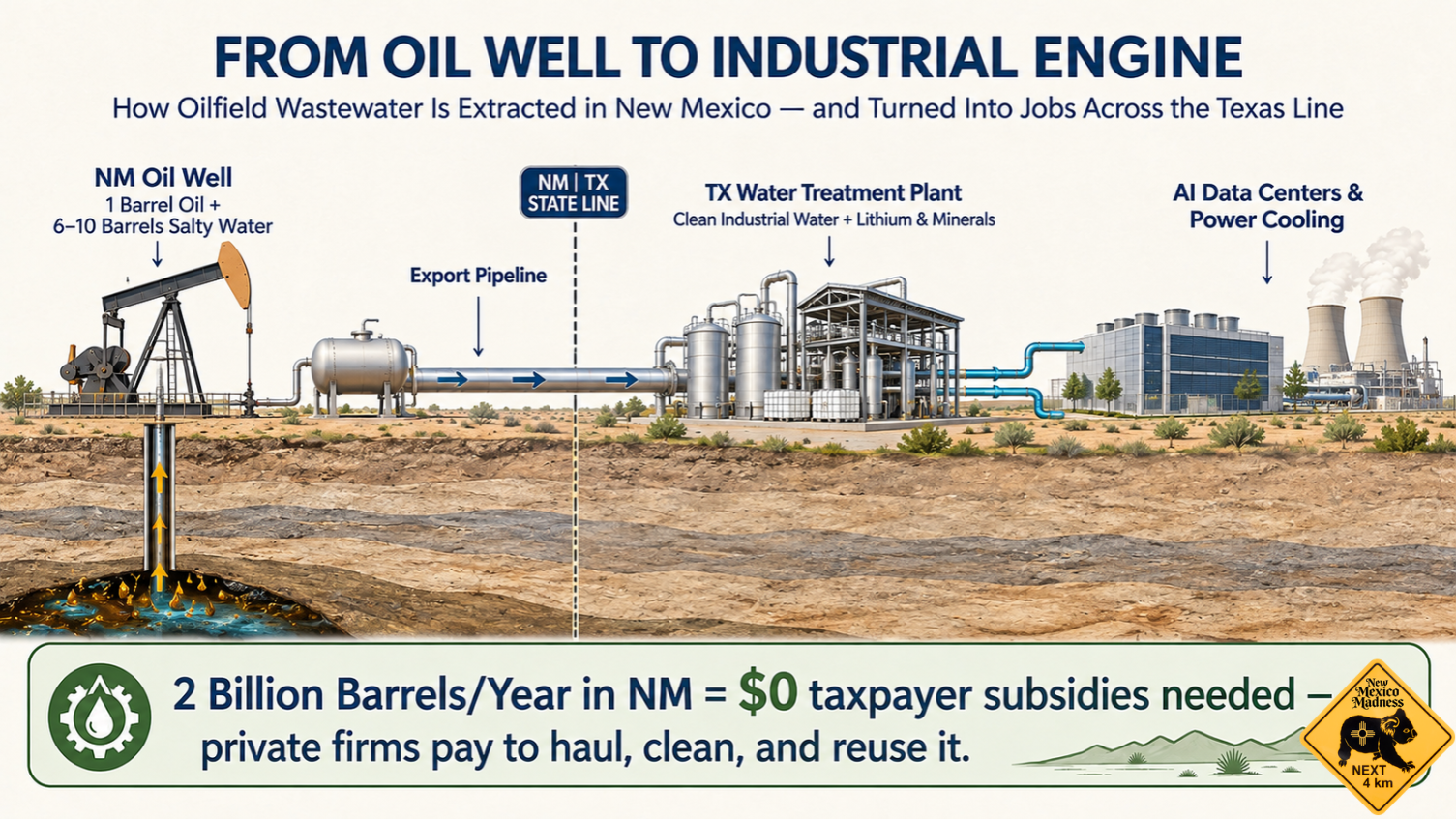
Every year, New Mexico's slice of the Permian Basin brings up roughly 2 billion barrels of hypersaline oilfield wastewater ("produced water") alongside its crude oil. Because oil wells shut down if that water has nowhere to go, producers already pay midstream companies roughly $1.00 per barrel—a $2 billion annual private market—just to haul and handle it.
That front-gate fee changes the entire math of desert infrastructure. When you clean industrial wastewater, you do not need taxpayer handouts:
- Oil companies pay to drop the dirty water off at the front gate.
- Desalination and polishing skids strip out clean non-potable water for industrial cooling towers, hydrogen hubs, manufacturing, or turf—taking heavy industry completely off New Mexico's scarce freshwater aquifers.
- The concentrated leftover brine becomes pre-enriched chemical ore containing $600+ million a year across the Permian in recoverable domestic lithium, iodine, bromine, and hydrochloric acid.
Texas saw the math immediately. In late 2025 and 2026, Texas passed HB 49 and updated its environmental rules to establish clear commercial contracts and liability rules for treated produced water outside the oilfield. Today, West Texas is cashing in: Gradiant is marketing zero-liquid-discharge cooling water to Permian AI campuses; NGL Energy Partners and Natura Resources are pairing modular nuclear reactors with oilfield desalination; Select Water Solutions has inked three commercial lithium extraction deals; and Chevron is building a 2.7-gigawatt power complex in West Texas for Microsoft.
Where is West Texas getting the water feedstock? From New Mexico .
Because New Mexico banned commercial off-field reuse of treated produced water in July 2025, companies like WaterBridge ($430M–$490M Speedway expansion), Western Midstream ($400M–$450M Pathfinder trunkline), and Select Water are spending nearly $900 million in private steel right now to pipe New Mexico's wastewater across the state line into Loving and Reeves counties, Texas. Every barrel of oil still got drilled in New Mexico; Texas simply gets the $2.5-billion-per-million-barrel treatment plants, the pipefitters, the chemists, and the data centers.
Show Us the Bodies—Or Show Us the Data
Ask the groups blocking industrial water reuse in Santa Fe why New Mexico shouldn't touch those jobs, and you get one word repeated like a chant: toxic.
Nobody disputes that raw, untreated fracking brine is toxic—that is the entire reason you build $500 million multi-stage distillation, reverse-osmosis, carbon, and zeolite treatment plants and slap strict industrial labels and permits on the pipe. If a company dumps unpermitted poison on New Mexico dirt, prosecute them.
What the public never hears is what happened when New Mexico's own state-backed scientists actually tested the treated water.
In July 2026, researchers with the New Mexico Produced Water Research Consortium at New Mexico State University briefed lawmakers on lab testing across Permian Basin produced water samples. After multi-stage desalination plus carbon and zeolite polishing, researchers tested the purified water on algae, bacteria, invertebrates, fish embryos, alfalfa soil, and human cells. Their slide to the Legislature was four words long: "No Toxicity. No Cytotoxicity." On untargeted chemical screening: "No Boogeyman (so far)". Meanwhile, out in Kern County, California, farmers in the Cawelo Water District have blended treated low-saline oilfield water for crop irrigation for decades—and multi-year audits by Duke University and California's state Food Safety Expert Panel found zero evidence of elevated human health risks in crops compared to traditional groundwater. nmpwrc.nmsu
So what hard data did environmental lawyers bring to Santa Fe this month to justify keeping New Mexico's ban in place?
On November 3, 2026, the Western Environmental Law Center and Amigos Bravos published their flagship rebuttal white paper. They did not produce a single case of a Texas industrial cooling loop, golf course, or closed-loop facility harming a worker or aquifer. Instead, they argued that while NMSU's tests scanned for nearly 600 chemicals and found post-treated water indistinguishable from clean controls, roughly 1,200 compounds could theoretically exist in produced water nationwide—meaning New Mexico must maintain a blanket ban because science hasn't ruled out every unmeasured hypothetical molecule.
That is not science; that is an unfalsifiable moving goalpost designed to ensure the answer is always "no".
Naming the Gatekeepers
New Mexicans deserve to know exactly who is making the call to turn away self-funding private payrolls while 90,276 kids live below the poverty line:
- The Out-of-State-Funded Litigators: Groups like Santa Fe-based WildEarth Guardians ($3.86M in annual revenue; $5.28M in annual spending per IRS Form 990 filings, backed by coastal foundations like California's Schmidt Family Foundation explicitly earmarked for "transition away from fossil fuels"), New Energy Economy, and Oregon-headquartered Western Environmental Law Center ($3.2M+ budget) pay six-figure legal teams to file motions blocking every industrial water rulemaking. None of their donors lose a paycheck when Lea, Chaves, or Cibola counties lose a plant.
- Unelected Board Holdouts: In May 2025, the 14-member appointed Water Quality Control Commission imposed the five-year commercial reuse ban (
20.6.8 NMAC)—writing rules so punitive that if a pilot greenhouse waters ornamental plants with purified oilfield water, the dirt and dead leaves must be hauled off as regulated waste. Even in May 2026, when Lea County and the City of Bloomfield petitioned (WQCC 26-18) just to hold a public hearing on cautious, three-barrier industrial reuse standards, four commissioners—Chair William Brancard, Vice Chair Bruce Thomson, Chelsea Langer, and Edward Vigil—voted against even letting the evidence be heard. - Elected Officials Working Against Their Own Policies: More than two dozen Democratic legislators signed letters pressuring regulators to block reuse permits in 2025. And Public Lands Commissioner Stephanie Garcia Richard—who banned fresh water sales to oil drillers in 2020 specifically telling operators to recycle produced water instead—turned around in April 2026 and aligned the State Land Office with activist groups trying to dismiss industrial reuse rules.
When you ban industrial companies from using treated wastewater, you do not save a single drop of New Mexico water—you force every prospective employer to either fight towns for scarce drinking aquifers or move five miles east into Texas. Until Santa Fe demands real harm data from its activist gatekeepers instead of rewarding ideological theater, New Mexico will keep writing welfare checks with oil money while Texas builds the future with New Mexico's water.
Endnotes
- State Sovereign Wealth & Budget Reserves: New Mexico State Investment Council, Economic Impact Q2 2026 Report ($75 billion managed across permanent, endowment, and reserve funds, August 2026); Wall Street Journal, "New Mexico Is Divided Over What to Do With $75 Billion in Oil Cash" (July 29, 2026, projecting $100 billion by decade's end); Office of the Governor, "New Mexico general fund to hit record $14.8 billion" (August 26, 2026, detailing 40.4% / $4.4 billion reserves and $924 million in new FY28 money).[sic.state.nm][wsj]
- Poverty, Child Poverty, Medicaid & SNAP Dependency: U.S. Census Bureau, American Community Survey (ACS) 5-Year Estimates, Tables B17001 (17.8% NM poverty vs. 12.5% U.S.; 30 of 33 counties above U.S. rate), S2704 (57.3% / 283,403 NM children under 19 on Medicaid; majority in 28 of 33 counties), and S2201 (19.2% of NM households on SNAP); U.S. Census Bureau Small Area Income and Poverty Estimates (SAIPE) released Jan. 2026 (20.5% / 90,276 NM children in poverty); USDA Food and Nutrition Service FY2025 rankings (21.9% of NM residents on SNAP, #1 in the U.S.).[governor.state.nm]
- Disconnected Youth & Government Workforce Share: New Mexico Legislative Finance Committee (LFC), Program Evaluation: Reconnecting Disconnected Youth Action Plan (April 27, 2026, finding ~32,000 youth ages 16–24 neither working nor in school, costing $623 million annually, and 57.6% labor force participation); U.S. Bureau of Labor Statistics, New Mexico Economy at a Glance & State Employment and Unemployment (October/November 2026 releases showing ~191,400 government jobs out of ~904,200 total nonfarm payrolls, or 21.2% vs. ~14.7% U.S. average).
- Film Tax Credit Fiscal Loss & Cap: New Mexico Legislature Revenue Stabilization and Tax Policy Committee / LFC, Economic Development Tax Expenditure Assessment (October 14, 2026, reporting film tax credits return roughly 6 to 8 cents on the dollar to state coffers—a 92% to 94% fiscal loss—and 1.4 cents of net economic growth per $1 spent); New Mexico Taxation and Revenue Department, Film Production Tax Credit Overview (November 2026, confirming $140M FY26 cap rising to $150M in FY27 and $160M in FY28).
- Permian Produced Water Volumes, Handling Economics & Mineral Value: Davis Graham, "U.S. Produced Water: The Emerging Value Chain Reshaping Energy, Water & Critical Minerals" (March 26, 2026, detailing 6:1 to 10:1 water-to-oil ratios in the Delaware Basin, ~2 billion barrels/year in NM, and $0.75–$1.25/bbl disposal pricing); Select Water Solutions, Beyond the Barrel: Produced Water, Mineral Extraction, and the Road Ahead (August 2026, detailing $1.00+/bbl handling economics and three commercial lithium agreements plus iodine extraction); Permian mineral recovery assessments estimating >$600 million/year in gross recoverable bromine, iodine, magnesium, and lithium across basin brines.
- Texas Commercial Reuse Laws, Industrial Offtake & Cross-Border Export Pipelines: Texas HB 49 (effective Sept. 2025, establishing commercial liability and ownership rules for off-field treated produced water) and 2026 TCEQ industrial reclaimed-water updates; Texas Produced Water Consortium (Texas Tech University), 2026 Report to the Texas Legislature (November 2026, estimating ~$2.5 billion in capital buildout per 1 million barrels/day of beneficial-reuse treatment capacity) ; Composite Piping / Midstream disclosures on WaterBridge's $430M–$490M Speedway expansion and Western Midstream's $400M–$450M Pathfinder 30-inch export pipeline to Loving County, TX ; Select Water Solutions Southwest IDEAS Conference transcript (Nov. 19, 2026) ; National Association of Manufacturers on Chevron/Microsoft's 2.7-GW West Texas power/compute partnership (June 2026).
- NMSU Toxicity Testing & California Crop Safety Audits: New Mexico Produced Water Research Consortium (New Mexico State University), Presentation to the Legislative Water and Natural Resources Committee (July 13, 2026, Item 9, reporting "No Toxicity / No Cytotoxicity" across aquatic, soil, and human-cell assays and "No Boogeyman (so far)" on untargeted screening of multi-stage treated Permian water); California Regional Water Quality Control Board Food Safety Project White Paper & Duke University / RTI International studies on Cawelo Water District oilfield water irrigation in Kern County, CA (finding no elevated health risks in irrigated crops).[koat][bls]
- Environmental Nonprofit Rebuttal & IRS Form 990 Financials: Western Environmental Law Center & Amigos Bravos, Treated Produced Water in New Mexico: Research Gaps Fact Sheet & Industrial Economics Inc. White Paper (Oct. 26 / Nov. 3, 2026, arguing against permitting based on unmeasured theoretical compounds despite clean post-treatment test results); ProPublica Nonprofit Explorer / IRS Form 990 filings for WildEarth Guardians (EIN 85-0406306; $3.86M revenue and $5.28M expenses in FY2024), Western Environmental Law Center (EIN 93-1102247), New Energy Economy (EIN 20-2845513), and Schmidt Family Foundation Form 990-PF grant schedules.[bls][bls][nmlegis]
- New Mexico Regulatory Ban & WQCC Votes: New Mexico Administrative Code
20.6.8.400 NMAC(Ground and Surface Water Protection – Supplemental Requirements for Water Reuse, effective July 12, 2025, prohibiting commercial off-field produced water reuse/discharge and mandating regulated waste disposal for pilot soils/plants); Santa Fe New Mexican & Source NM coverage ofWQCC 26-18(May 12, 2026 7–4 vote where Commissioners William Brancard, Bruce Thomson, Chelsea Langer, and Edward Vigil voted against holding a rulemaking hearing); WildEarth Guardians press release (April 15, 2026, confirming State Land Office alignment againstWQCC 26-18) contrasted with NM State Land Office announcement halting freshwater oilfield sales (Dec. 15, 2020).


