

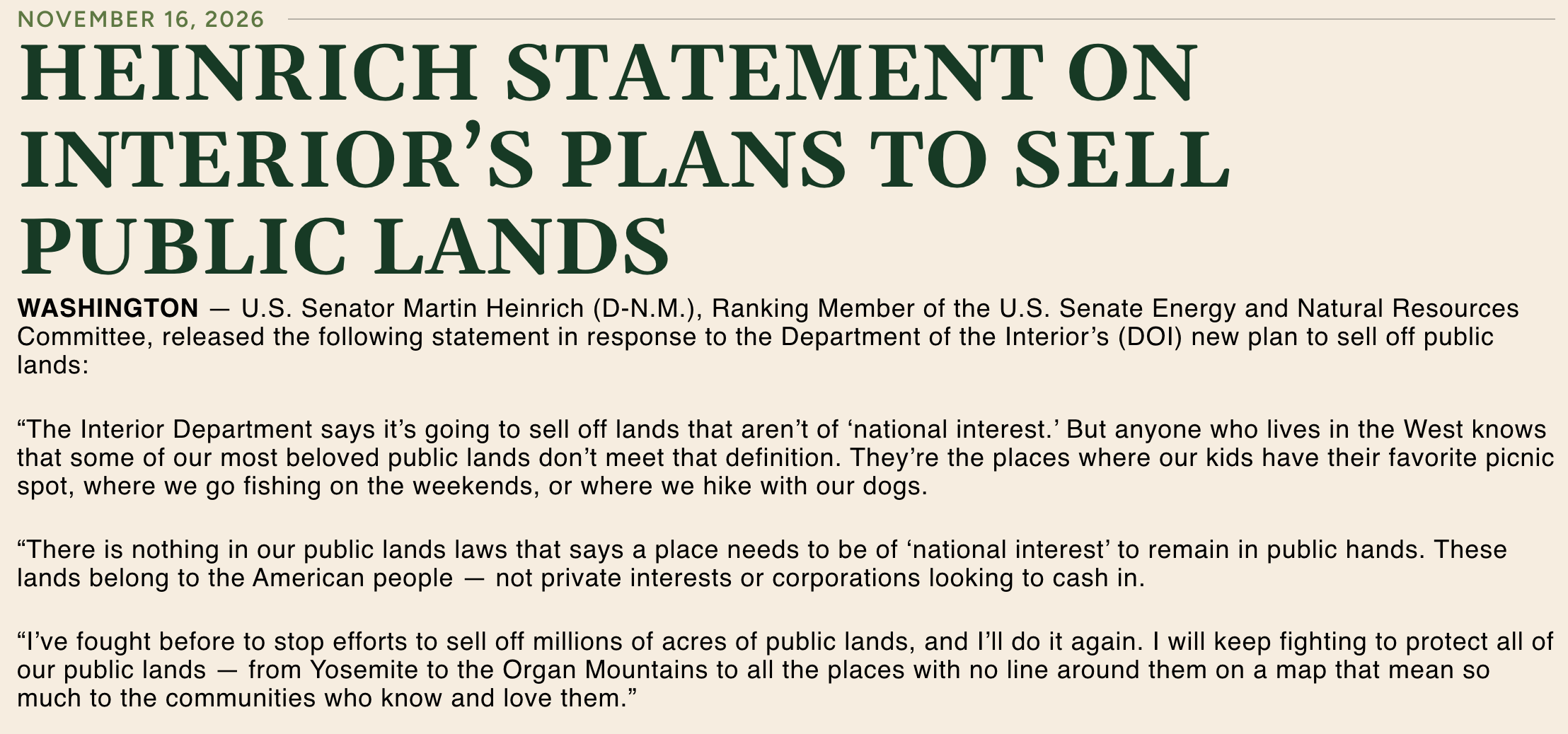
Earlier this week, U.S. Sen. Martin Heinrich issued a fiery statement from Washington vowing to defend federal lands "from Yosemite to the Organ Mountains." Public lands, New Mexico’s senior senator declared, belong to the American people—"not private interests or corporations looking to cash in."
That exact same afternoon, the U.S. Bureau of Land Management quietly opened the federal environmental review for a $5 billion corporate fuel pipeline that will gouge a 90-foot construction trench right past the Organ Mountains-Desert Peaks National Monument.
The proposed Western Gateway Pipeline—a joint venture backed by oil and midstream giants Phillips 66, Kinder Morgan, and HF Sinclair—would run 887 miles of new steel pipe from Borger in the Texas Panhandle to Buckeye, Arizona, connecting into reversed pipeline routes feeding Las Vegas and Southern California. Along the way, it cuts across nine eastern and southern New Mexico counties: Curry, Roosevelt, Chaves, Eddy, Otero, Doña Ana, Luna, Grant, and Hidalgo.
And what did New Mexico’s self-styled public-lands defenders in Santa Fe and Washington have to say when the federal notice dropped? Nothing. Total radio silence.
California’s Mess, New Mexico’s Trench
To understand why three energy giants are burying 20-inch and 24-inch pipes across southern New Mexico, look west. Over the past few years, California squeezed out roughly 285,000 barrels per day of its own refining capacity under strict climate mandates. When pump prices spiked and supply tightened, reality set in. Last Friday, at an international climate summit, Democratic California Gov. Gavin Newsom publicly endorsed the Western Gateway Pipeline to pump 230,000 barrels a day of Texas and Midcontinent gasoline, diesel, and jet fuel west.
Meanwhile, the Trump administration’s BLM is championing the exact same project under the banner of "American Energy Dominance."
It is a rare moment of bipartisan harmony between Washington and Sacramento, and it works because both sides agree on the easiest mark in the Southwest: New Mexico absorbs the trashed land and the environmental risk to water while richer, faster-growing states get the fuel.
Even the bureaucracy treats New Mexico like an afterthought. According to Tuesday’s Federal Register notice, 87 percent of the federal public land being trenched for this pipeline sits inside New Mexico—148 miles managed by BLM offices in Roswell, Carlsbad, and Las Cruces, compared to just 22 miles in Arizona. Yet the BLM put its Phoenix state office in charge of running the entire environmental review. Right now, federal officials are only studying two options: build the pipeline along the companies' preferred path, or don't build it at all.
Read the developers' own website and the insult gets sharper. Western Gateway’s Texas webpage promises Lone Star communities "substantial, long-term property tax revenue across Texas counties, school districts, and hospital districts," alongside direct right-of-way checks for landowners. Click over to the New Mexico webpage and the promises of school funding, county tax windfalls, and jobs vanish. Instead, New Mexicans get a pat on the head noting the state is "no stranger to liquid pipelines" because 7,000 miles of them already cross our dirt. There is no announced delivery terminal to lower pump prices for New Mexico drivers, and the companies won't even confirm whether HF Sinclair's Artesia refinery will get an on-ramp to sell New Mexico-refined fuel into the line.
From SunZia to Project Jupiter: Southern New Mexico’s Extraction Loop
Residents across Doña Ana and Luna counties have every reason to be skeptical, because they are already living inside the fallout of the last two mega-projects pitched by out-of-state billionaires.
First came the $11 billion SunZia transmission corridor. When coastal politicians needed an extension cord for green electricity, New Mexico leaders cheered the groundbreaking, handed out a state property-tax exemption that infuriated county treasurers, and brushed past Socorro residents who complained of being treated like a "flyover" zone—even as Native nations went to federal court over bulldozed cultural sites. Legislative analysts later confirmed the punchline: New Mexico got zero megawatts of SunZia’s power, while out-of-state contractors took the lion's share of the construction jobs.
Then came Project Jupiter, the massive 1,400-acre AI data center campus dropped into Santa Teresa in southern Doña Ana County—the exact same borderland corridor Western Gateway plans to trench on its way out of El Paso. Negotiated behind closed doors under nondisclosure agreements, local officials handed Oracle, OpenAI, and their developers a staggering $165 billion industrial revenue bond package while terrified chile and pecan farmers begged for straight answers on desert groundwater and power bills.
Look at how those corporate promises are aging right now. Developers swore Project Jupiter wouldn't touch local ratepayers' power grid, then quietly opened talks to hook into El Paso Electric anyway. Last week, Doña Ana County commissioners had to slap Project Jupiter with its second formal breach-of-contract notice of 2026 just for failing to turn in required jobs reports on time—after an October site tour revealed nearly two-thirds of its 4,400 construction workers weren't even New Mexico residents. Oracle has already filed a force majeure notice against potential delays, and Wall Street giant HSBC just dumped $300 million of the project’s construction debt at a steep discount. Southern New Mexicans got the anxiety, the dust, and the tax abatement; Silicon Valley got the compute.
Selective Outrage in the Chihuahuan Desert
What makes this pattern maddening isn't just corporate opportunism—it is the selective outrage of New Mexico’s political class. Whether southern New Mexico’s desert is treated as a fragile sanctuary or an industrial utility closet depends entirely on today's talking points.
When federal contractors moved to build roughly 46 to 49 miles of border wall across Doña Ana, Luna, and Hidalgo counties, Heinrich warned it would "irreparably harm sensitive ecosystems" and sever wildlife corridors in the Chihuahuan Desert. Just three months ago, U.S. Rep. Gabe Vasquez demanded federal investigations into border-wall contractors pumping groundwater in Luna County, after slamming border barrier construction earlier this year for offering taxpayers "no return on the investment."
Up north, when oil and gas leases approached Chaco Culture National Historical Park, Heinrich, Sen. Ben Ray Luján, Vasquez, Rep. Melanie Stansbury, and Governor-elect Deb Haaland lined up behind podiums to declare that New Mexico's heritage is "not for sale." And back in July, State Land Commissioner—now Lt. Gov.-elect—Stephanie Garcia Richard made headlines for blocking just six-tenths of a mile of natural gas pipeline from crossing state trust land to feed Project Jupiter, warning that it served outside investors while threatening New Mexico's water and ecosystems.
If 0.6 miles of pipe in Doña Ana County was an environmental dealbreaker in July, where is the outrage over hundreds of miles of pressurized gasoline and diesel crossing nine New Mexico counties in November?
Greasing the Skids for the Next Pass-Through
Western Gateway is simply SunZia filled with benzene and diesel instead of electrons. Instead of high-voltage towers marching west to air-condition Phoenix and Los Angeles, nine New Mexico counties get a buried fuel hose crossing desert washes, shallow aquifers, and riverbeds—from Chaves and Eddy counties straight across Akela Flats in Luna County and north of Interstate 10 to the Arizona line.
And rather than fighting for New Mexico to stop being the Southwest's unpaid hallway, Washington is busy making the hallway wider. The exact same day Heinrich warned corporations to keep their hands off the Organ Mountains, he published an op-ed in The Economist touting SunZia and pushing bipartisan Senate "permitting reform" to fast-track federal energy corridors across public lands.
When lawmakers grease the skids in Washington so multi-state corporations can punch linear corridors through BLM land with fewer roadblocks, they don't just get wind wires for California—they get fuel pipelines for California, too.
The BLM is taking public comments on Western Gateway only through December 17, with two virtual Zoom meetings set for December 1 and December 2. Incoming Gov. Haaland—who until recently ran the entire U.S. Department of the Interior—and Lt. Gov.-elect Garcia Richard, who still holds the pen on New Mexico State Trust Land easements, are weeks away from taking office together in Santa Fe.
After SunZia and Project Jupiter, southern New Mexicans already know what happens when mega-projects treat their home like cheap real estate. If our land and water truly aren't for sale, nine counties are waiting to hear somebody in charge prove it.
Source Notes
- Heinrich "Organ Mountains" Statement & Permitting Op-Ed (Nov. 16, 2026): Senate Energy and Natural Resources Committee minority release, "Heinrich Statement on Interior's Plans to Sell Public Lands" (naming "from Yosemite to the Organ Mountains" and "not private interests or corporations looking to cash in"); Heinrich Nov. 16, 2026 The Economist op-ed release ("A Plan to End America's Most Expensive Bottleneck") championing SunZia and the Bipartisan American Affordability and Jobs Act (
BAAJA) to accelerate federal energy corridor permitting. - Western Gateway BLM Filing & Federal Register Specs (Nov. 17, 2026): BLM Notice of Intent,
91 FR 73793(DOI-BLM-AZ-0000-2026-0002-EIS), confirming 887 new-build miles, 90-foot construction width, nine NM counties (Curry, Roosevelt, Chaves, Eddy, Otero, Doña Ana, Luna, Grant, Hidalgo), 170 BLM miles split 148 miles in NM vs. 22 miles in AZ, Phoenix BLM lead jurisdiction, only Proposed Action vs. No-Action currently analyzed, and Dec. 17, 2026 comment close. - Western Gateway Corporate Financials, Newsom Endorsement & Website Contrast: Phillips 66, Kinder Morgan, and HF Sinclair Aug. 11, 2026 FID release (~$5 billion value, 230,000 bpd capacity); project website citing 285,000 bpd lost CA refining capacity; Politico report (Nov. 13, 2026) on CA Gov. Gavin Newsom backing the pipeline at COP31; Transport Topics report on unconfirmed Artesia refinery connection; contrast between
westerngatewaypipeline.com/texas-1(promising county/school/hospital property taxes and landowner income) andwesterngatewaypipeline.com/new-mexico-1(omitting taxes/jobs and citing 7,000 existing NM pipeline miles). - Project Jupiter Receipts (Doña Ana County / Santa Teresa): NPR, Santa Fe New Mexican, Albuquerque Journal, KOAT, and Bisnow/Bloomberg reporting through Nov. 11–18, 2026 confirming the 1,400-acre Santa Teresa campus for Oracle/OpenAI/Stack Infrastructure, NDA negotiations and the Sept. 2025 $165 billion IRB approval, Nov. 10, 2026 Doña Ana County 4–0 vote issuing a second IRB breach notice over missed Oct. 31 jobs reporting (plus prior breach warning over El Paso Electric grid connection talks despite microgrid pledges), Oct. 2026 workforce breakdown (~1,652 NM residents out of ~4,400 total site workers), Oracle's Sept. 2026 force majeure notice, and HSBC selling ~$300 million of Project Jupiter construction debt at a steep discount. energy.senate
- Garcia Richard 0.6-Mile Pipeline Denial (March & July 2026): NM State Land Office July 15, 2026 release and Source NM report confirming Commissioner Stephanie Garcia Richard twice rejected Energy Transfer's right-of-way applications for a 0.6-mile segment of natural gas pipeline serving Project Jupiter, citing lack of benefit to state lands alongside water and emissions concerns. investor.phillips66
- Border Wall, Chaco & SunZia Comparisons: Heinrich May 2019 border wall ecosystem warning in Luna/Doña Ana counties; Vasquez Jan. 2026 ("no return on the investment") and Aug. 2026 Luna County DHS contractor water-well demand; NM delegation and Haaland Chaco Canyon "not for sale" statements; 2025 NM Legislative
HB 295agency analysis confirming SunZia's RETA property-tax exemption, zero NM power delivery, and mostly out-of-state construction workers.


