

Nearly one in four jobs in New Mexico—23.8% of the entire workforce, almost 10 points higher than the national average—sits on a local, state, or federal government paycheck. Two weeks ago, government-heavy precincts from Santa Fe County (77.3% for Deb Haaland) and Los Alamos (64.5%) to central Albuquerque (67%+) provided the landslide margin that handed Democrats the Governor’s office and a Roundhouse supermajority promising "universal healthcare."
In Part 1, we showed how private-sector trade unions (electricians, pipefitters, machinists, Teamsters) are shielded from a forced state takeover by federal ERISA law—even though they still get taxed twice to subsidize everyone else’s card and wait in longer clinic lines.
For New Mexico’s public workforce, however, there is no federal ERISA shield. If you work for a state agency, a county road crew, a city police or fire department, or a public school district, you didn't just vote to buy subsidized health cards for your uninsured neighbors—you voted to make your family’s health plan the guinea pig pool that bankrolls the entire experiment.
The Legal Bullseye on State, County, City, and School Plans
When the New Mexico Office of Superintendent of Insurance (OSI) commissioned a legal analysis of how the state could actually build a universal health system without getting struck down in federal court, the lawyers spelled out the quiet part in black and white: state government cannot force private corporate or union plans in, nor can it touch Medicare or federal workers.
Just last month, in an October 2026 regulatory notice, OSI stated the exact boundary line again: the only self-funded health plans over which Santa Fe exercises direct legal authority are the four public-employee pools overseen by the state’s Interagency Benefits Advisory Committee—covering state and municipal workers, public school employees, Albuquerque Public Schools (APS), and public retirees.
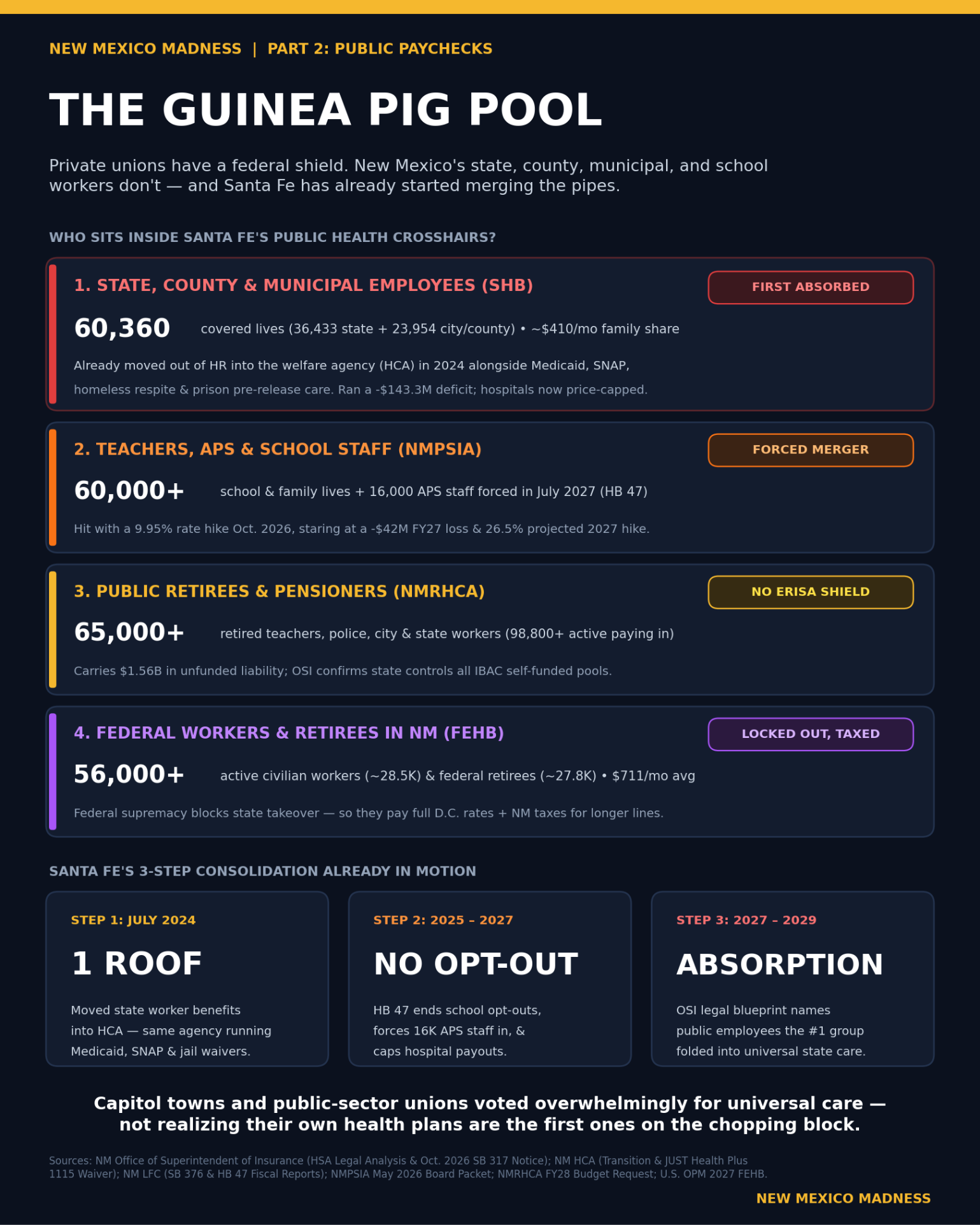
You don't have to guess whether Santa Fe intends to merge those public-employee plans with the state’s welfare rolls, because the three-step consolidation is already underway:
- Step 1 already put your employee benefits inside the welfare agency. On July 1, 2024, lawmakers stripped State Health Benefits (covering 36,433 state workers/dependents and 23,954 city and county employees across dozens of municipalities) out of the General Services Department’s HR shop and merged it into the brand-new Health Care Authority (HCA). That means a state trooper’s or county clerk’s family health plan is now administered under the exact same bureaucratic roof—and by the same agency leadership—managing 819,000 Turquoise Care Medicaid enrollees, SNAP food stamps, medical respite for the homeless, and "JUST Health Plus," New Mexico’s 1115 waiver providing taxpayer-funded Medicaid services, prescriptions, and lab work to prison and county jail inmates up to 90 days before release.
- Step 2 eliminated school opt-outs and slapped price caps on hospitals. In March 2026, lawmakers passed House Bill 47 unanimously, stripping school districts and charter schools of the right to opt out of state health coverage and forcing 16,000 Albuquerque Public Schools employees into the New Mexico Public Schools Insurance Authority (NMPSIA) pool effective July 1, 2027. At the exact same time, SB 376 and HB 47 ordered both the state employee plan and the school employee plan to impose "reference-based pricing"—government price caps limiting what hospitals get paid when a teacher, city worker, or state employee walks through the door. Price caps drive medical specialists out of network thus driving New Mexicans out of state for specialty care.
- Step 3 turns public workers into the starter pool for the "Public Option." You cannot launch a state-run Public Option solely with 88,500 disenrolled Medicaid recipients and uninsured high-risk patients without the fund going instantly bankrupt. To keep the risk pool afloat, universal-care blueprints rely on folding over 200,000 captive state, municipal, school, and public-retiree lives into the state purchasing pool—blending hard-earned civil-service benefits with subsidized marketplace buy-ins and safety-net programs.
Put plainly: if you sit inside this public-employee/retiree pool and voted for Santa Fe’s universal healthcare mandate, you voted to dilute your own family’s coverage, shrink your own doctor network, and use your own tax dollars to bankroll state health cards for roughly 100,000 able-bodied adults getting kicked off Medicaid under federal work rules.
Bankrupting the Plans Santa Fe Already Runs
Before state, municipal, and school workers hand total control of their family’s medical care to Roundhouse politicians, they might want to inspect the books on the public employee plans Santa Fe already manages.
Through FY24 and FY25, the state’s 60,360-person State Health Benefits fund racked up a staggering $143.3 million cumulative deficit because state officials chronically underpriced premiums relative to soaring medical claims—requiring an $85 million taxpayer bailout and emergency 2025 legislation just to keep paying doctors.
Over at NMPSIA—which covers more than 60,000 teachers, bus drivers, school staff, and dependents outside Albuquerque—the math is even uglier. According to NMPSIA’s May 2026 board packet, even after hitting school employees and districts with a 9.95% medical premium hike on October 1, 2026, the school insurance fund is still projected to lose $42 million by the end of FY27—warning bluntly that "FY27 claim payments will be inhibited if loss goes lower than negative $20M." To break even by FY28 without another taxpayer bailout, actuaries modeled a jaw-dropping 26.5% single-year premium spike for October 2027, right after 16,000 APS employees get forced onto the boat.
Even the New Mexico Retiree Health Care Authority—covering 65,000 retired teachers, police officers, and state/local pensioners supported by 98,816 active paycheck contributors—still carries $1.56 billion in unfunded actuarial liability and just raised non-Medicare retiree rates another 5% for 2027.
Santa Fe cannot keep health insurance solvent for its own teachers, state clerks, and county deputies without $85 million bailouts, double-digit rate hikes, and hospital price controls—yet promises that throwing the doors open to a statewide Public Option will somehow lower everyone’s costs.
Federal Workers in New Mexico: Locked Out, Taxed Anyway
Then there is the fourth leg of New Mexico’s government workforce: roughly 28,500 active civilian federal employees—working at Sandia and Los Alamos support offices, Kirtland, Holloman, Cannon, White Sands, the VA, BLM, and Border Patrol—alongside 27,835 federal retirees living across the state.
Under the U.S. Constitution’s Supremacy Clause, Santa Fe has zero authority over Federal Employees Health Benefits (FEHB) or military TRICARE. A federal technician in Alamogordo, Clovis, or Albuquerque—many of whom live in precincts that backed the blue wave—cannot join a New Mexico state health plan even if he wanted to.
Instead, that federal worker’s family of four gets pure financial extraction:
- He keeps paying an average $711 a month ($328.15 biweekly employee share on a $30,471 annual plan in 2027) straight to Washington insurers.
- He pays New Mexico income taxes, gross receipts taxes, and insurance surtaxes while watching lawmakers raid state surpluses and oil-and-gas Permanent Funds to subsidize health cards for everyone else.
- When his wife or kids actually need a dermatologist, pediatrician, or orthopedic surgeon in New Mexico, his $30,000 federal PPO card gets stuck in the exact same bottlenecked waiting room behind 1.2 million Medicaid/Medicare enrollees and 100,000 new Public Option cardholders.
For decades, lower-paid municipal clerks, classroom teachers, county deputies, and state workers accepted modest government salaries in New Mexico for one overriding reason: rock-solid health insurance and retirement security. By handing unchecked power to a Legislature determined to build state-run universal care on top of a severe doctor shortage, New Mexico’s public employees didn't vote to upgrade their healthcare—they volunteered their own benefit pools to pay for the tab.
Endnotes
- New Mexico Government Employment Share & 2026 Precinct/County Returns: U.S. Bureau of Labor Statistics State & Metro Area Employment data & NM Economic Development Dept. 2025 State Plan (23.8% of NM jobs in local, state, or federal government vs. 14.3% U.S. average); and New Mexico Secretary of State 2026 General Election county and precinct returns (Santa Fe County 77.3% Haaland, Los Alamos County 64.5% Haaland, Albuquerque core zones 63.5%–67.4% Haaland).
- State Authority Over Public Employee Plans (Lack of ERISA Shield): New Mexico Office of Superintendent of Insurance (OSI), SB 317 Data Call Notice (Oct. 2026, confirming the only self-funded health plans over which the state holds authority are IBAC plans covering State/GSD-HCA, NMPSIA, APS, and NMRHCA); and OSI / Milken Institute School of Public Health, "An Analysis of New Mexico’s Health Security Act" (identifying state and local public employees as the primary non-ERISA group subject to direct state consolidation).
- Merger of State Employee Benefits into HCA Alongside Medicaid, Homeless & Inmate Waivers: New Mexico Health Care Authority, About the Department / HCA Transition FAQs (confirming July 1, 2024 transfer of State Health Benefits from General Services Department into HCA alongside Medicaid, SNAP, and TANF); HCA Medicaid 1115 Waiver Renewal (Turquoise Care) (authorizing medical respite for members experiencing homelessness and supportive housing); and HCA Justice Initiatives — JUST Health Plus 1115 Waiver Demonstration (providing Medicaid-funded pre-release clinical consultations, lab/radiology, medications, and 30-day Rx supplies to state prison and county jail inmates 30–90 days prior to release). hca.nm
- Elimination of School Opt-Outs, APS Forced Merger & Hospital Price Caps (HB 47 & SB 376): 2026 Regular Session House Bill 47 (signed March 9, 2026, Ch. 52) & LFC Fiscal Impact Report (ending school/charter health insurance opt-out waivers July 1, 2026, mandating 16,000 APS eligible members into NMPSIA effective July 1, 2027, and requiring reference-based hospital pricing); and 2025 Regular Session Senate Bill 376 LFC Fiscal Note (documenting 36,433 state and 23,954 local public body lives, $143.3M cumulative deficit, $85M General Fund bailout, and reference-based hospital payment caps). osi.state.nm
- NMPSIA $42M Loss Warning & 26.5% Rate Scenario: New Mexico Public Schools Insurance Authority Board of Directors Meeting Packet (May 7, 2026 & April 2026 CAP Slides, documenting the 9.95% Oct. 1, 2026 premium increase, projected -$42M FY27 loss, warning that FY27 claim payments will be inhibited below -$20M, and Scenario A modeling a 26.5% Oct. 2027 premium increase to break even by end of FY28). nmdfa.state.nm
- Retiree Health Care Authority Liability & Rate Increases: New Mexico Retiree Health Care Authority FY28 Appropriation Request (Sept. 1, 2026) and Continuing Disclosure Report (covering 65,000+ retirees and 98,816 active contributors across ~315 public entities, reporting $1.557B Net OPEB Liability / 54.5% funded ratio); and NMRHCA Aug. 25, 2026 Board Book (approving 5% non-Medicare retiree/spouse rate hikes for 2027). nmlegis
- Federal Workforce Exclusion & 2027 FEHB Costs: NM Legislature Health Security Act Summary (confirming federal supremacy excludes FEHB and military plans from state takeover); U.S. Office of Personnel Management (OPM) Federal Civilian Employment & 2027 FEHB Self & Family premium tables ($30,471/yr total plan, $711/mo / $328.15 biweekly average worker share; 27,835 federal retirees and ~28,500 federal jobs in NM).


