

On November 2, First Judicial District Judge Matthew Wilson handed down a blistering reality check on New Mexico’s public schools. Eight years after the landmark Yazzie/Martinez ruling found the state was violating children’s constitutional right to a basic education, Wilson ruled the Public Education Department’s latest reform plan is still legally deficient—citing the state’s failure to adequately address basics like textbook funding, class sizes, and summer school.
Three days later, state officials announced a very different school priority: expanding a $12.65 million "school-based" program to pay parents' rent, utility bills, and car repairs—in just seven of New Mexico’s 89 school districts.
Pair that housing bailout with a separate $6.3 million state pilot depositing $500 a month directly into select high schoolers' personal bank accounts just to show up to class, and Santa Fe has quietly committed nearly $19 million to turn favored school districts into cash-and-welfare hubs. Meanwhile, the rural taxpayers and energy-producing counties bankrolling the state budget are largely shut out—left with 10 consecutive years of dead-last, 50th-place academic results.
Taxed in Rural New Mexico, Spent in the Corridor
Administered by the Department of Workforce Solutions’ Office of Housing, the Family Stabilization Program spent $4.85 million last school year and is spending another $7.8 million in 2026–27. In Year 1, 100% of the money went to just three metro districts: Albuquerque Public Schools ($2.6 million), Las Cruces Public Schools ($1.4 million), and Santa Fe Public Schools ($850,000). This year, those three districts keep $5.6 million of the pot, while the remaining $2.2 million expands to San Juan County’s four districts (Farmington, Central Consolidated, Bloomfield, and Aztec).
Compare that payout map against U.S. Census Bureau poverty data (2020–2024 ACS and 2024 SAIPE), and the geographic inversion is stark:
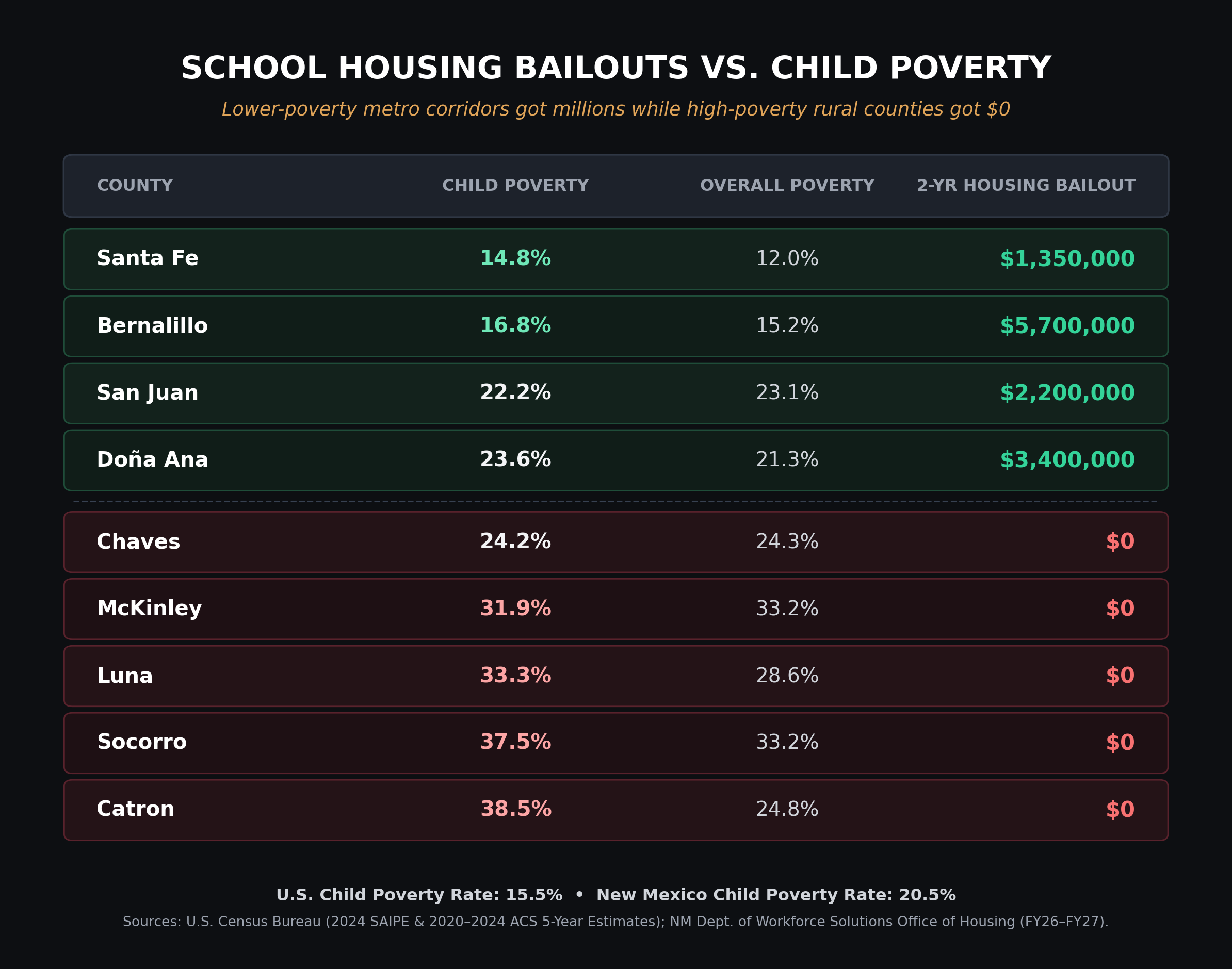
Thirty of New Mexico’s 33 counties have worse child poverty than the national average of 15.5%. Santa Fe County is one of only three counties in the state doing better than the national rate, and Bernalillo sits well below New Mexico’s 20.5% statewide child-poverty mark—yet those two metro counties and Las Cruces captured the entire first year of funding and more than 70% of Year 2.
That was no accident. When Gov. Michelle Lujan Grisham’s office unveiled the broader $120 million Office of Housing package in August 2025, its own press release admitted the initial money was steered by "legislative intent for projects in the Albuquerque-Bernalillo County metropolitan area and the Las Cruces-Doña Ana County metropolitan area, and the potential for fully expending the funds by June 30, 2026." Over $91 million went to Albuquerque and Las Cruces, leaving $13 million for the rest of New Mexico combined.
Where did those General Fund and state reserve dollars come from? Nearly half of New Mexico’s General Fund is generated by oil and gas taxes and royalties pumped overwhelmingly out of rural Eddy and Lea counties, supplemented by gross receipts taxes paid by working families on everyday bills across Chaves, Otero, Luna, and McKinley counties. Every single one of those counties received $0 from the school housing program.
Worse, while Albuquerque and Santa Fe have dense networks of city shelters, transit systems, county housing authorities, and well-funded charities blocks away from campuses, rural districts have virtually nothing nearby to fall back on. Gallup-McKinley County Schools—actually one of the named Yazzie plaintiff districts—reported 521 homeless students last fall on a $73,000 federal grant, or roughly $140 per child for basic soap, coats, and food. Deming Public Schools in Luna County and rural districts across Socorro, Sierra, and Catron face over-30% child poverty without metro safety nets—and got nothing.
$15,000 Per Family, Middlemen, and $500 "Attendance NIL"
Parents in the seven chosen districts aren't being handed $10,000 checks directly. Instead, taxpayers are funding something arguably more expensive over the long haul: a sprawling web of government navigators, county agencies, and nonprofit fiscal agents paying household bills piecemeal.
Divide the state's grant awards by the number of families served (or targeted to be served), and the gross cost runs from $9,140 per family in Santa Fe and $9,886 in Albuquerque to $13,793 per family in Bloomfield ($400,000 for 29 families) and $15,000 per family in Farmington ($750,000 for 50 families). Even inside Farmington, 655 students qualified as homeless last year—meaning more than 90% of housing-unstable students in the district won't see a dime while a tiny fraction get intensive multi-thousand-dollar interventions.
Because New Mexico’s constitutional Anti-Donation Clause restricts public schools from simply handing private cash to citizens, districts route the funds through outside middlemen. APS funnels its millions through Bernalillo County; Las Cruces uses the Community Foundation of Southern New Mexico as a fiscal agent alongside local nonprofits Tresco and FYI; Santa Fe partners with community navigators to pay landlords and auto shops directly. And the temporary "pilot" payroll is already hardening into permanent bureaucracy: in its FY28 budget request filed in September 2026, Workforce Solutions asked lawmakers for recurring General Fund dollars as districts push to make temporary grant-funded navigators permanent staff.
Meanwhile, the Public Education Department and Santa Fe advocacy group New Mexico Appleseed went a step further in late 2025—launching the three-year, $6.3 million "Guaranteed Payment for Attendance" pilot. Under Senate Bill 201, up to 330 housing-insecure high schoolers in select districts (including Las Cruces, Albuquerque, Santa Fe, Taos, Silver City, Roswell, Artesia, and Carlsbad—though again excluding Luna and McKinley) get $500 deposited directly into their personal bank accounts every month if they hit 92% attendance and attend tutoring and advising.
Unlike the rent program, New Mexico Appleseed’s director confirmed to The Washington Post that teenagers "do not have to account for how they spend the funds." Yet even in a direct-cash scheme, the math reveals steep overhead: paying 330 students $500 a month over a 9-to-10-month school year totals $1.48 million to $1.65 million out of a $2.1 million annual appropriation—leaving $450,000 to $615,000 a year absorbed by administration and nonprofit coordination. By January 2026, PED red tape had delayed the promised payments to hundreds of qualifying teens anyway.
Is Paying Bills and Stipends Even Following the Law?
Strip away the press releases, and a fundamental legal and fiscal question remains: is paying adults' car repairs and teenagers' bank stipends what New Mexico's Constitution and education laws actually require?
No—and existing state and federal laws already draw a bright line between welfare agencies and public classrooms:
- Article XII, Section 1 of the New Mexico Constitution requires the Legislature to maintain a "uniform system of free public schools sufficient for the education of, and open to, all the children of school age in the state." Seven districts getting $12.65 million in family bill-pay while 82 districts get zero is the opposite of a uniform statewide system.
- Federal McKinney-Vento Law requires every school district to appoint a homeless liaison, waive enrollment barriers, and provide school transportation so unhoused children can stay in class. It is an educational access law—not a mandate for select public schools to act as municipal housing authorities or auto-repair financiers.
- Existing welfare agencies already operate statewide. New Mexico already funds the Health Care Authority (which runs YesNM cash assistance, TANF/NMWorks, Medicaid, and utility aid) and Housing New Mexico (MFA), which already administers millions in dedicated rental and emergency homelessness grants statewide. Duplicating those welfare functions inside seven favored school districts builds a second bureaucracy instead of fixing classrooms.
- Since the 2018 Yazzie/Martinez ruling, New Mexico’s public school budget has nearly doubled from $2.5 billion to $4.8 billion in direct school formula funding—with PED now requesting a record $5.9 billion for FY28, over 40% of the entire state budget. Yet as Judge Wilson ruled on November 2, PED still hasn't delivered a compliant plan for core educational duties: textbooks, smaller classes, summer school, and trained teachers for low-income and rural kids.
For the working New Mexico parent who pays taxes on every paycheck and grocery run, fixes their own transmission, pays their own rent, and makes sure their teenager goes to school without a $500 monthly taxpayer stipend, the return on investment could hardly be bleaker.
In June 2026, the Annie E. Casey Foundation’s KIDS COUNT Data Book ranked New Mexico 50th in education for the 10th consecutive year—assigning the state an Education Index Score of 1 out of 1,000, the lowest in America, with 80% of fourth graders not proficient in reading and 86% of eighth graders not proficient in math. Over that same decade, equally poor Mississippi climbed to 16th in the nation by obsessing over phonics, literacy coaches, and classroom fundamentals rather than turning select school districts into uneven social-welfare experiment zones.
Endnotes
- Yazzie/Martinez November 2, 2026 Court Ruling: First Judicial District Judge Matthew Wilson order finding the New Mexico Public Education Department’s remedial action plan deficient on textbook funding, class sizes, and summer school, Source New Mexico (Nov. 9, 2026). newsbreak
- Family Stabilization Program Funding, District Awards & Caseloads (FY26–FY27): New Mexico Department of Workforce Solutions, Office of Housing release, "New Mexico invests $7.8 million to help students' families stay housed in seven school districts" (Nov. 5, 2026), and NM State Housing Youth Programs portal ($4.85M FY26 + $7.8M FY27; district awards and families served/targeted for APS, LCPS, SFPS, Farmington, Central Consolidated, Bloomfield, and Aztec).
- County Overall & Child Poverty Figures: U.S. Census Bureau, American Community Survey (ACS) 2020–2024 5-Year Estimates (Table B17001 / S1701) and Small Area Income and Poverty Estimates (SAIPE) 2024 (released Jan. 27, 2026).
- Metro Allocation Intent ($120M Housing Rollout): Office of the Governor press release, "Governor announces $120 million for housing and homelessness" (Aug. 19, 2025), stating initial allocations were based on "legislative intent for projects in the Albuquerque-Bernalillo County metropolitan area and the Las Cruces-Doña Ana County metropolitan area, and the potential for fully expending the funds by June 30, 2026" (over $80M to Albuquerque/Bernalillo, over $11M to Las Cruces/Doña Ana, $13M to rest of state).
- General Fund Revenue Geography (Oil & Gas Share): Federal Reserve Bank of Dallas ("New Mexico fuels U.S. crude oil output, funding for local programs," March 2025), NM Legislative Finance Committee General Fund Consensus Revenue Estimates (Aug. 2026), and NMOGA FY25/FY26 General Fund revenue summaries on Eddy and Lea counties.
- Rural District McKinney-Vento Caseloads: Gallup Sun report on Gallup-McKinley County Schools McKinney-Vento caseload (521 homeless students on $73,000 federal grant, Oct. 3, 2025) and U.S. Department of Education Ed Data Express McKinney-Vento subgrantee data for Deming Public Schools.
- Recurring Budget Requests & Navigator Staffing: New Mexico Department of Workforce Solutions FY28 Appropriation Request (submitted Sept. 2026) and Las Cruces Public Schools Family Stabilization Project Navigator job filings and board summaries (routing via Community Foundation of Southern New Mexico, Tresco, and Bernalillo County).
- $500/Month High School Attendance Stipend ("Guaranteed Payment for Attendance"): Senate Bill 201 (2025 Regular Session); The Washington Post / New Mexico Appleseed ("New Mexico will pay homeless high schoolers to stay in school," Dec. 5, 2025, confirming students "do not have to account for how they spend the funds"); KOB 4 district list (Nov. 27, 2025); and The Santa Fe New Mexican ("New Mexico promised homeless students $500 a month; they're still waiting for cash," Jan. 22, 2026).
- Constitutional & Statutory Framework: New Mexico Constitution, Article XII, Section 1 (Uniform System of Free Public Schools); federal McKinney-Vento Homeless Assistance Act (42 U.S.C. § 11431 et seq.); New Mexico Health Care Authority (TANF/YesNM) and Housing New Mexico (MFA) program summaries; and PED FY28 Budget Request ($5.9 billion request, Sept. 2026). law.justia
- 10 Consecutive Years at 50th Place & 1/1,000 Score: Annie E. Casey Foundation, 2026 KIDS COUNT Data Book (June 2026), New Mexico state profile (80% of 4th graders not proficient in reading, 86% of 8th graders not proficient in math), NMKidsCAN Education Index analysis (score of 1 out of 1,000), and Mississippi 16th-place education ranking.


