

If you scrolled past the Albuquerque Journal or read Taxation and Revenue Secretary Stephanie Schardin Clarke’s recent victory lap, you might think New Mexico just pulled off an economic miracle. "New census data shows child poverty falling sharply," the teaser promised, celebrating a drop in New Mexico’s child poverty rate from 20.9% down to 10.9%.
Wait a second. How does a state that ranks dead last in child well-being—and sits at the bottom of the Journal’s own brand-new New Mexico Data Scoreboard on 12 of 13 economic indicators—suddenly cut child poverty in half?
Did factories open across rural New Mexico? Did median wages jump?
No. Nobody got a $10,000 raise. Santa Fe simply switched from one Census Bureau spreadsheet to another—trading a formula that measures paychecks for a formula that counts food stamps, tax rebates, and government subsidies as "income".
The Shell Game: Official vs. Supplemental Poverty
When state officials brag that child poverty dropped from 20.9% to 10.9%, they aren't comparing last year’s wages to this year’s wages. They are comparing two completely different metrics from the exact same 2023–2025 Census window:
- 20.9% Official Child Poverty (The Paycheck Reality): More than 1 in 5 New Mexico children still live in households that do not earn enough pretax cash income to clear the federal poverty line. Even after a modest drop from the post-pandemic inflation peak, New Mexico ranks 48th in the nation.
- 10.9% Supplemental Child Poverty (The Subsidy Stack): To get down to 10.9%, the Census Bureau’s Supplemental Poverty Measure takes those exact same low-wage families, tacks on SNAP food stamps, federal EITC, New Mexico’s Working Families Tax Credit, $138 million in state Child Tax Credits, WIC, school meals, and LIHEAP utility subsidies, and lowers the poverty threshold to account for rural New Mexico's cheaper housing costs.
Even more telling? While the state trumpets the 10.9% supplemental figure as a breakthrough, New Mexico’s supplemental child poverty rate actually ticked up from 10.3% in 2022–2024 to 10.9% in 2023–2025.
Two Families, One Broken Incentive
Look at what this accounting trick means in the real world for a married family of four facing the $33,000 federal poverty line:
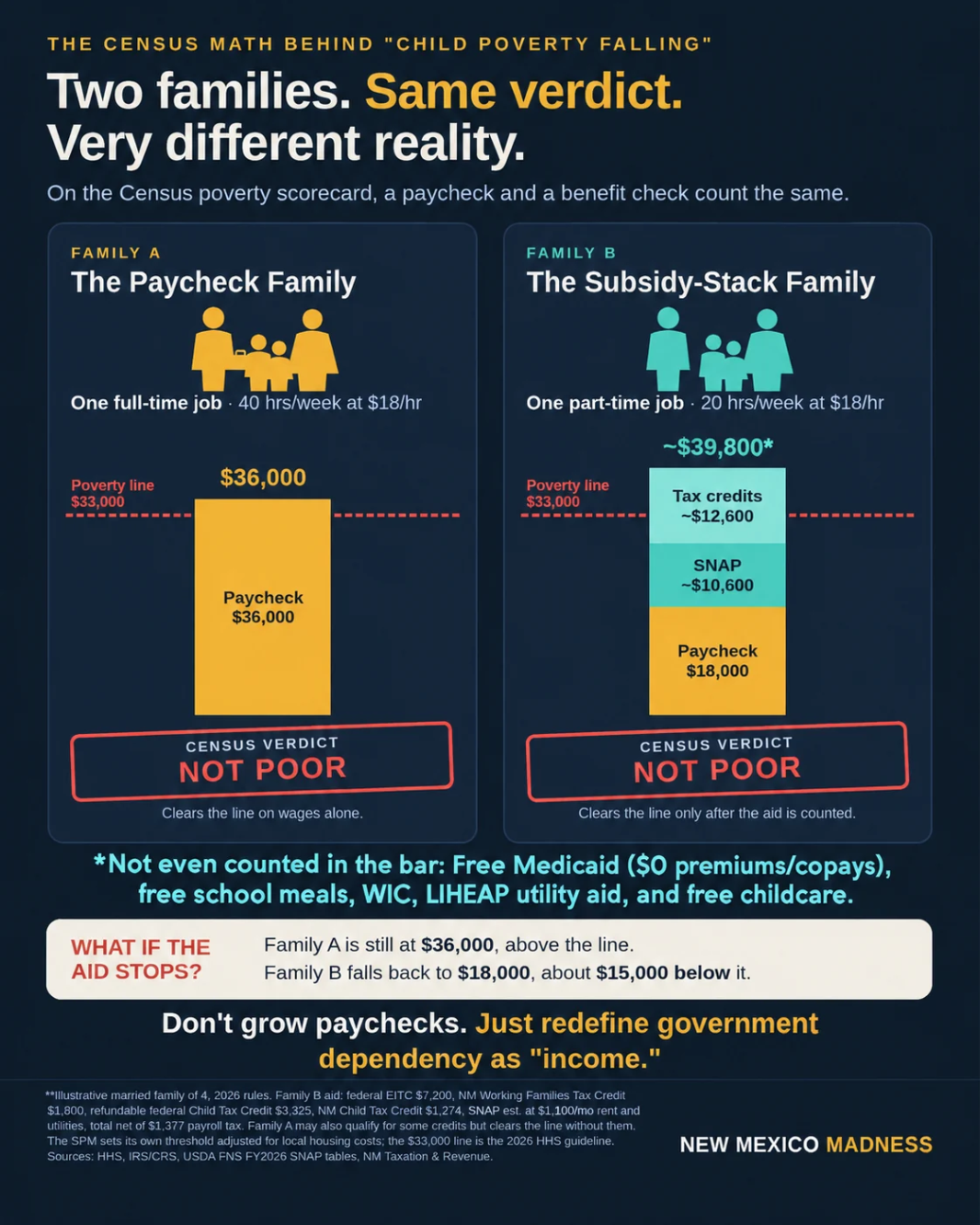
- Family A (The Full-Time Paycheck Family): Works 40 hours a week at $18 an hour, earning $36,000 a year. They clear the $33,000 poverty line on their own sweat, pay their payroll taxes, lose SNAP eligibility, and start phasing out of tax credits and adult Medicaid coverage.
- Family B (The Subsidy-Stack Family): Works 20 hours a week at $18 an hour, earning $18,000 a year—$15,000 below the poverty line. Then the subsidy stack kicks in: roughly $10,600 in SNAP food stamps plus $12,600 in combined federal and state refundable tax credits. Suddenly, Family B sits at ~$39,800 on paper—plus free Medicaid with zero copays, free school meals, utility aid, and free childcare.
On the Census Bureau’s Supplemental Poverty scorecard, both families get stamped NOT POOR.
Yet if the Permian Basin oil boom slows down or the Roundhouse runs out of rebate money, Family A still earns $36,000—while Family B crashes right back to $18,000. As Legislative Finance Committee Director Charles Sallee admitted to the Journal, refundable credits are a "two-edge sword" that bump families sitting right near the threshold over the statistical line without moving the needle for families in deep poverty.
Door #1, Door #2, or Door #3: Who Is Telling the Truth?
New Mexicans are currently getting three wildly different stories about their economy:
- Door #1 (The Roundhouse Press Release): Poverty is "slashed," state tax credits are working wonders, and universal childcare—now open to wealthy families with no income cap, where less than 23% of aid goes to families below the poverty line—will fix the rest.
- Door #2 (The Albuquerque Journal’s Own Data Scoreboard): Just six days before publishing its "New Mexico poverty declines" headline, the Journal reported that New Mexico loses to its neighboring states on 12 of 13 economic indicators. Private-sector job growth is crawling at 0.61% (barely half the regional pace), and 25.3% of all personal income in New Mexico now comes from government transfer payments.
- Door #3 (The Madness County-by-County Ground Truth): Step outside Los Alamos (2.8% child poverty), Sandoval (11.7%), and Santa Fe (14.8%), and the spreadsheet mirage vanishes.
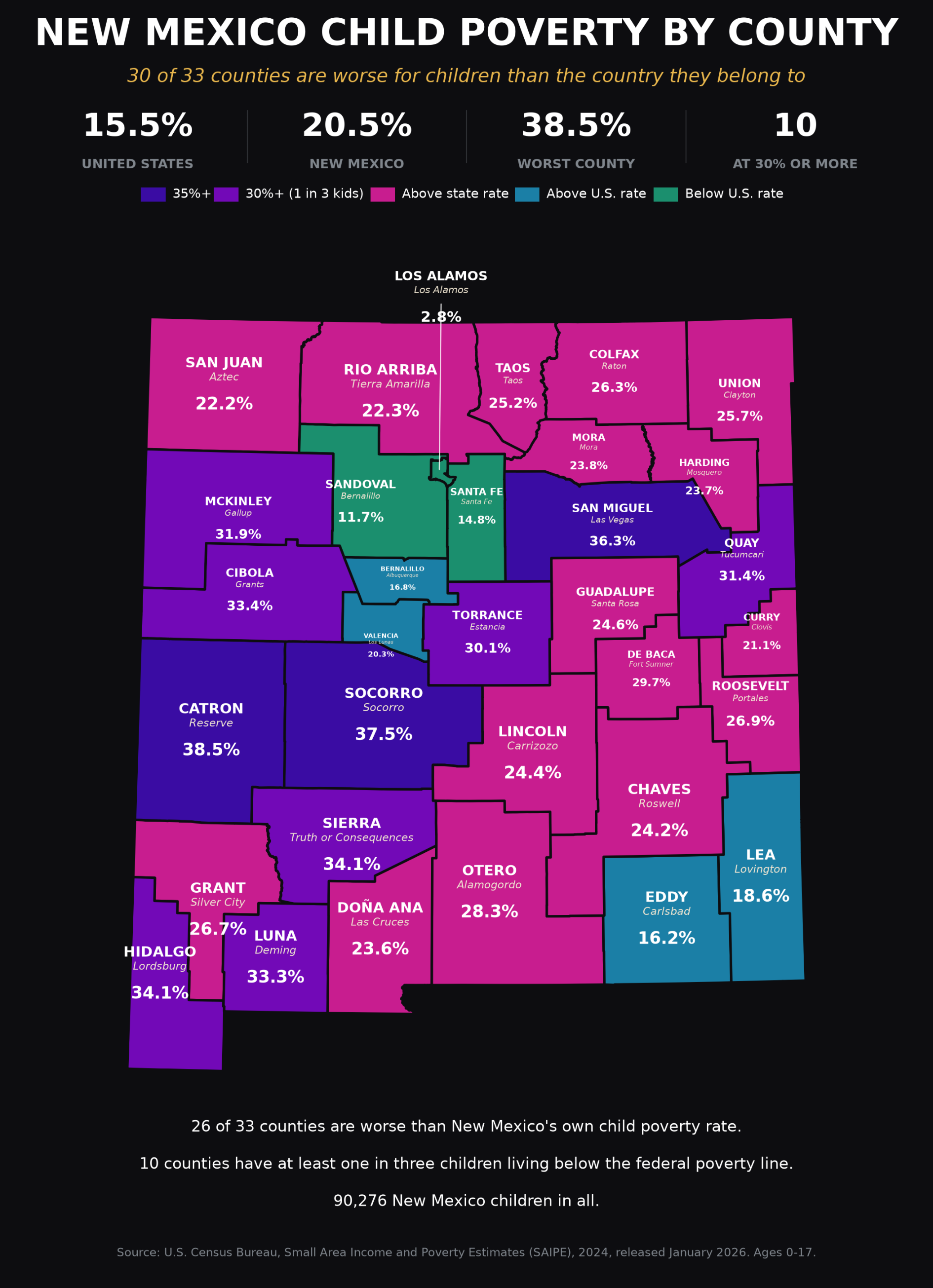
Across New Mexico’s 33 counties, the structural reality is unmistakable:
- 30 of 33 counties have higher pretax child poverty than the U.S. average
- 21.9% of New Mexicans are on SNAP—#1 in the entire United States
- 57.3% of all New Mexico children (more than 283,000 kids) rely on Medicaid
Giving a feverish patient Tylenol lowers the thermometer reading for four hours, but it doesn't cure the infection. Until New Mexico grows private-sector paychecks instead of government transfer payments, counting welfare checks as "income" isn't ending poverty—it's just making dependency look good on a bar chart.
Sources & Data Notes
- U.S. Census Bureau Official vs. Supplemental Poverty Measures (2023–2025 Three-Year Estimates): New Mexico’s Official Poverty Measure (pretax cash income) sits at 16.0% overall and 20.9% for children (down from 17.2% overall and 24.2% for children in 2022–2024, moving New Mexico from 50th to 48th nationally). Under the Supplemental Poverty Measure (which adds refundable tax credits, SNAP, WIC, school meals, and housing/energy subsidies while adjusting thresholds for local housing costs), New Mexico’s overall rate is 13.2% and its child rate is 10.9% (up slightly from 10.3% in 2022–2024). See James Bennett, New Mexico poverty falls, but challenges remain, Albuquerque Journal (Nov. 6, 2026), and New Mexico improves from 50th to 48th in national child poverty rankings, Albuquerque Journal (Sept. 27, 2026).abqjournal
- New Mexico Taxation and Revenue Department Commentary & Figures: State Child Tax Credit distributions ($138 million across 255,000 families, up to $600 per child) and Working Families Tax Credit claims cited in Secretary Stephanie Schardin Clarke’s op-ed, New Mexico slashes poverty despite soaring inflation, Las Cruces Sun-News (Nov. 1, 2026), and NM TRD Press Release Archive.
- Legislative Finance Committee (LFC) Analysis: LFC Director Charles Sallee’s remarks on the Supplemental Poverty Measure acting as a "two-edge sword" for deep poverty and LFC findings that removing income caps reduced the share of childcare assistance going to families at or below the poverty line from ~50% in 2019 to under 23%, via the Albuquerque Journal (Nov. 6, 2026).
- Regional Economic Comparisons (12 of 13 Economic Indicators): Median household income ($67,816 in NM vs. $84,225 in neighboring states), labor force participation (56.9% vs. 63.68%), private-sector job growth (0.61% vs. 1.12%), and personal income derived from government transfer payments (25.3%), via New Mexico must turn potential into progress, Albuquerque Journal (Oct. 31, 2026) , and the Albuquerque Journal New Mexico Data Scoreboard.
- 2026 Federal Poverty Guidelines & Benefit Rules (Two-Family Graphic): 2026 HHS Federal Poverty Guideline for a family of four in the 48 contiguous states is $33,000; see U.S. Department of Health and Human Services (ASPE) 2026 Poverty Guidelines. Federal EITC, refundable Child Tax Credit, NM Working Families Tax Credit (NMSA 1978, § 7-2-18.15), NM Child Tax Credit, and FY2026 USDA FNS SNAP benefit tables calculated for a married couple with two children.
- County-Level Poverty, SNAP, and Medicaid Maps:
- Child Poverty by County: U.S. Census Bureau, Small Area Income and Poverty Estimates (SAIPE), 2024 (released Jan. 2026), ages 0–17.


