

On the night after Election Day, Governor-elect Deb Haaland wasted zero time telling New Mexico voters what she and a newly expanded House Democratic supermajority plan to do with their mandate: "With a bigger majority, we’re going to deliver universal healthcare for our state."
Helping bankroll and knock doors for that victory was nearly every major private-sector labor hall in New Mexico—from the New Mexico Federation of Labor (AFL-CIO), UA Local 412 Plumbers & Pipefitters, and SMART Sheet Metal Workers Local 49 to the Machinists, Carpenters, Teamsters Locals 399 and 492, and the IBEW PAC. Yet across union job sites from the Permian Basin to Albuquerque, almost nobody has bothered to explain what Santa Fe’s incoming healthcare experiment does to the blue-collar worker who actually pays dues and already fought to cover his spouse and two kids.
Strip away the campaign slogans, and Santa Fe isn't building hospitals or minting doctors. Lawmakers are preparing to extract hundreds of millions more from New Mexico’s public wealth and working taxpayers to hand out state-subsidized insurance cards in a state where clinics are already turning patients away—selling concert tickets when there is no band on the stage.
Paying Twice at the Bargaining Table and the Tax Counter
Ask any union electrician, pipefitter, machinist, or lineman why workers sign a union card in the first place, and comprehensive family health insurance sits right alongside hourly pay. Nationally, 95% of unionized private-sector workers have job-based medical coverage compared to 71% of non-union workers, paying an average employee share of $541 a month for family coverage instead of $697—or, in many building trades, zero out-of-pocket paycheck premiums because members gave up direct wage raises over decades to fund multi-employer Taft-Hartley health trusts.
Now trace what happens to that blue-collar husband covering a wife and two children when Haaland and House Speaker Javier Martínez roll out their promised state "Public Option" between the January 2027 legislative session and 2029.
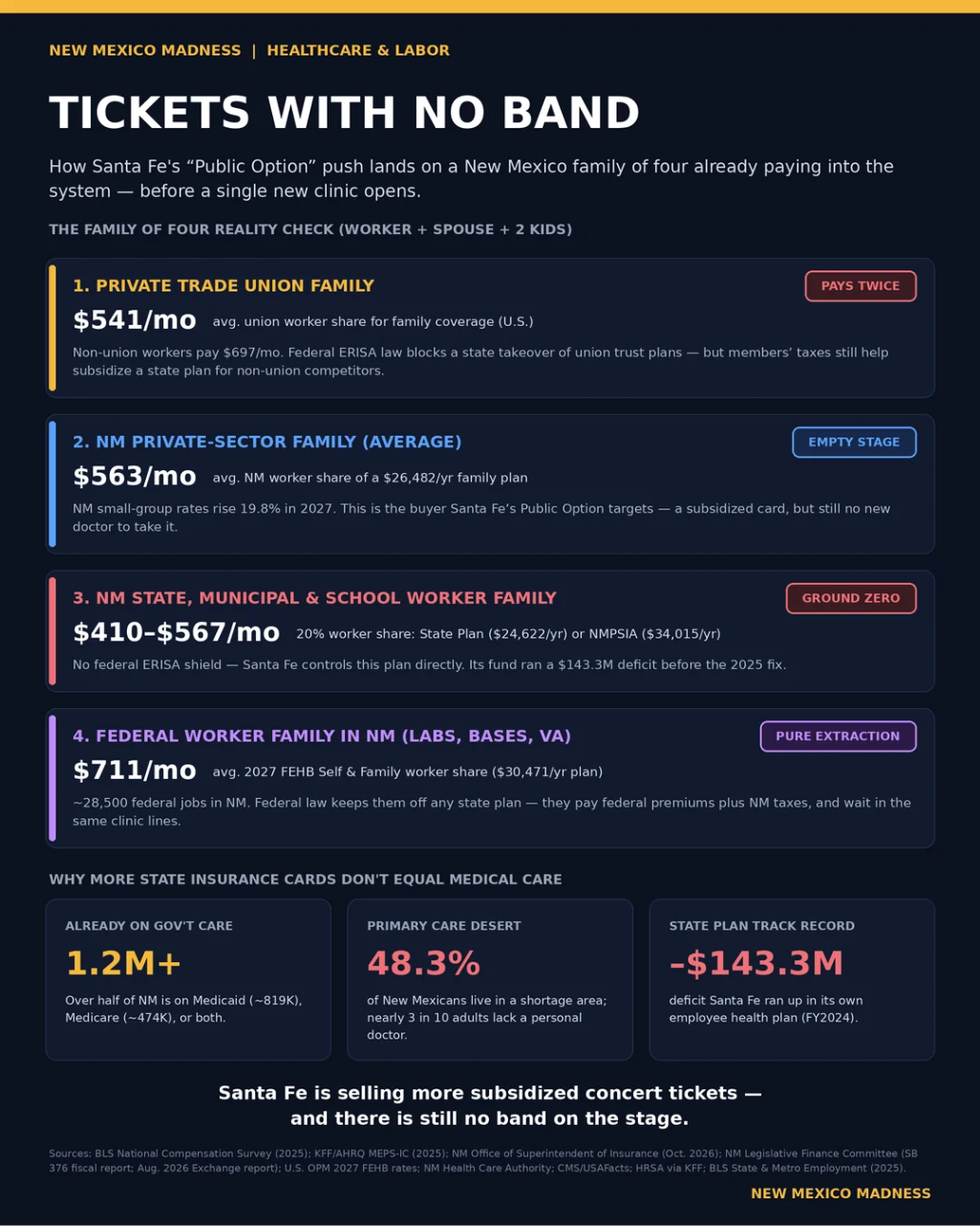
Under federal preemption rules in the Employee Retirement Income Security Act (ERISA), Santa Fe cannot legally outlaw private-sector, self-insured union health trusts. Even New Mexico’s long-running single-payer blueprint, the Health Security Act, admits ERISA-covered union plans have to remain voluntary unless Washington rewrites federal law.
That legal technicality gave state AFL-CIO leaders enough political cover to endorse Haaland—and earned NM Federation of Labor President Ashley Long a co-chair seat on Haaland’s Affordability Steering Committee rather than her Healthcare Steering Committee. For rank-and-file trade members, however, keeping their union card comes with three ugly catches:
- Taxpayers end up bankrolling non-union competition. Great family health insurance is one of the biggest reasons tradespeople join a union and non-union shops lose workers. If Santa Fe uses state oil money and tax surpluses to sell cheap, taxpayer-subsidized "Public Option" plans on BeWellNM, non-union contractors suddenly get an easy way to offer cheap coverage without paying union-scale wages and benefits.
- Union families pay for their own healthcare—and then pay for their neighbor’s too. On regular Medicaid, Washington picks up 71% to 90% of the bill; on a state-only Public Option, New Mexico taxpayers eat 100% of the subsidy cost alone. Between the state’s 3.75% tax on health insurance premiums ($212.8 million a year), state budget surpluses, and Speaker Martínez’s pitch to dip into New Mexico’s $100 billion-plus Permanent Funds, a union worker gives up hourly raises to cover his own family and then watches his taxes and state oil wealth pay for everyone else’s plan.
- Healthy workers stay put, leaving taxpayers stuck with the most expensive bills. Insurance only stays cheap when plenty of healthy people pay in without using much care. Because workers who already have strong union or corporate plans won't ditch them for a government experiment, a state buy-in mostly attracts higher-cost patients—starting with the 88,530 to 103,900 New Mexicans projected to lose Medicaid in January 2027 under new federal work and eligibility rules. Keeping those monthly rates artificially low will take non-stop taxpayer bailouts.
1.2 Million Government Cards and Nobody in the Clinic
Even if New Mexico had unlimited oil royalties to burn, handing out tens of thousands more state-backed insurance cards collides headfirst with basic supply and demand.
More than 1.2 million New Mexicans—over half the entire state, including roughly 808,759 on Turquoise Care Medicaid alone—are already enrolled in government-funded healthcare. Only about 10.2% to 10.5% of New Mexicans lack health insurance, yet nearly half the state (48.3%) lives in a federally designated primary care shortage area, 32 of 33 counties suffer critical care gaps, and nearly three in 10 New Mexico adults cannot even secure a personal doctor.
Santa Fe already ran this exact supply-blind experiment with "universal" child care last November: Speaker Martínez boasted that the state put up the money to make child care free regardless of income, only to admit rural families still couldn't use it because there were no actual child care providers to take the vouchers.
Doing the same thing in medicine actively degrades the coverage union families already pay for. Government plans manufacture "savings" on paper by slashing hospital and physician reimbursement rates—meaning clinics either refuse the state card or drown under a subsidized surge of new patients. When a Roswell or Farmington union worker’s kid needs a specialist, his gold-plated Taft-Hartley PPO card still sits behind the exact same six-month waitlist as everyone else.
A Licensing Mirage While Republicans Watch the Clock
Aware that voters are furious over six-month waits for basic care, lawmakers spent 2026 scrambling to pass medical malpractice caps (House Bill 99) and interstate licensing compacts—fixes that even supporters admit will take three to four years to rebuild New Mexico’s physician ranks. Meanwhile, when the New Mexico Medical Board bragged in August that the state added 3,864 medical licenses over four years, hospital leaders pointed out the obvious catch: out-of-state telehealth doctors filing paperwork from Austin or Phoenix do not staff emergency rooms in Chaves, Eddy, Lea, or San Juan counties.
Behind closed doors, Roundhouse Republicans are mostly sitting back and watching the collision unfold. Progressive activists think they just elected federal-style "Medicare for All," labor brass were promised union trusts won't be touched, and working families were promised lower bills—all before a single fiscal note hits a committee desk in January 2027.
And if private-sector union families think getting taxed twice for longer clinic lines is rough, they at least have federal ERISA law shielding their health plans from a hostile Santa Fe takeover. In Part 2, we look at the two groups of New Mexicans sitting directly in the crosshairs: the 60,000 state and municipal workers whose deficit-ridden state health plan is first in line to be absorbed—and the roughly 28,500 federal employees legally barred from ever using the state system they are being forced to bankroll with state taxes.
Endnotes
- Governor-Elect Universal Healthcare Mandate & Legislative Roadmap: KOB 4, "The day after: Haaland discusses objectives as governor-elect" (Nov. 5, 2026); KUNM / New Mexico PBS, "Haaland would invest budget surplus in state needs, pursue public option" (Oct. 14, 2026); Source New Mexico, "New Mexico US Rep. Stansbury touts state’s universal healthcare push" featuring Rep. Liz Thomson’s 2027–2029 phased rollout and Speaker Javier Martínez’s permanent-fund comments (Oct. 22, 2026); and Albuquerque Journal, "Deb Haaland outlines plan to overhaul New Mexico health care" (April 1, 2026).
- 2026 Labor Endorsements & Transition Committee Placements: New Mexico Federation of Labor (AFL-CIO) and NM State Council of Machinists endorsement release (July 21, 2026, listing UA Local 412 Plumbers & Pipe fitters, SMART Local 49, Carpenters, IAFF, AFSCME Council 18, NEA-NM, AFT-NM, and CWA); Teamsters Locals 399 & 492 endorsement (Oct. 23, 2026); campaign finance filings noting IBEW PAC Voluntary Fund and NM AFL-CIO max contributions (Oct. 2026); and Santa Fe New Mexican, "House Dems, GOP announce familiar leadership teams" / Haaland transition steering committee appointments naming Ashley Long to Affordability rather than Healthcare (Nov. 14, 2026).
- Union vs. Non-Union Healthcare Access & Family Premium Math: Georgetown University Center on Health Insurance Reforms (CHIR), "The Impact of Unions on Employer-Sponsored Health Insurance" citing U.S. Bureau of Labor Statistics National Compensation Survey data (96% union vs. 69% non-union medical benefit access; $487.42/month union vs. $655.39/month non-union average employee family premium); and U.S. BLS Union Members — 2025 (released Feb. 18, 2026, showing 52,000 union members / 6.1% membership rate in New Mexico).
- Federal ERISA Preemption & Voluntary Union Trust Rules: New Mexico Office of Superintendent of Insurance (OSI) & Milken Institute School of Public Health, "An Analysis of New Mexico’s Health Security Act" (confirming federal ERISA preempts state mandates over private self-insured employer and multi-employer Taft-Hartley plans); and Health Security for New Mexicans Campaign Plan Info summary.
- Medicaid Federal Match (FMAP), Surtax & 2027 Disenrollment Projections: U.S. Department of Health and Human Services Federal Register FY2027 FMAP table (Nov. 28, 2025, setting New Mexico’s regular Medicaid match at 71.47% and ACA expansion match at 90%); NM Together for Healthcare HCAF Factsheet and Becker’s Payer Issues (Sept. 25, 2026, detailing the 3.75% health insurance premium surtax, $212.8M FY26 revenue, and 2028 General Fund shift); NM Health Care Authority Medicaid Powers New Mexico Health Care one-pager (Jan. 2026, documenting ~808,759 Medicaid enrollees and projecting 88,530 to 103,900 Medicaid disenrollments starting Oct. 2026–Jan. 2027); and NM Office of Superintendent of Insurance 2027 small-group rate release (+19.8% average hike, Oct. 8, 2026). federalregister
- Provider Shortage, Uninsured Rate & Universal Child Care Comparison: Native News Online (April 2, 2026, noting 1.2M+ New Mexicans on Medicaid/Medicare); NM Legislative Finance Committee NM Health Insurance Exchange Progress Report (Aug. 25, 2026, citing 10.2% uninsured rate and SHB/NMPSIA family premium benchmarks); Albuquerque Journal healthcare data reports (Nov. 15, 2026, citing 48.3% living in primary care shortage areas and 29% of adults lacking a personal doctor); NPR / Connecticut Public Radio report on New Mexico universal child care rural provider shortages quoting Speaker Martínez (Nov. 15, 2026); and NM Political Report / Source New Mexico on HB 99 malpractice reform and the 3,864 MD license telehealth caveat (Aug.–Oct. 2026).
- State Employee Plan Deficit & Federal Employee FEHB Benchmarks (Graphic Data): NM Legislative Finance Committee SB 376 Fiscal Note (documenting State Health Benefits enrollees, $143.3M cumulative deficit, General Fund bailout, and reference-based hospital pricing); U.S. Office of Personnel Management (OPM) 2026–2027 FEHB Self & Family premium tables ($30,471 annual / $711 monthly average employee share; $501/month Standard); and USAFacts / BLS federal civilian employment in New Mexico (26,600 active civilian workers).


