

New Mexico Madness Investigations | Project Apollo | Part One of Three
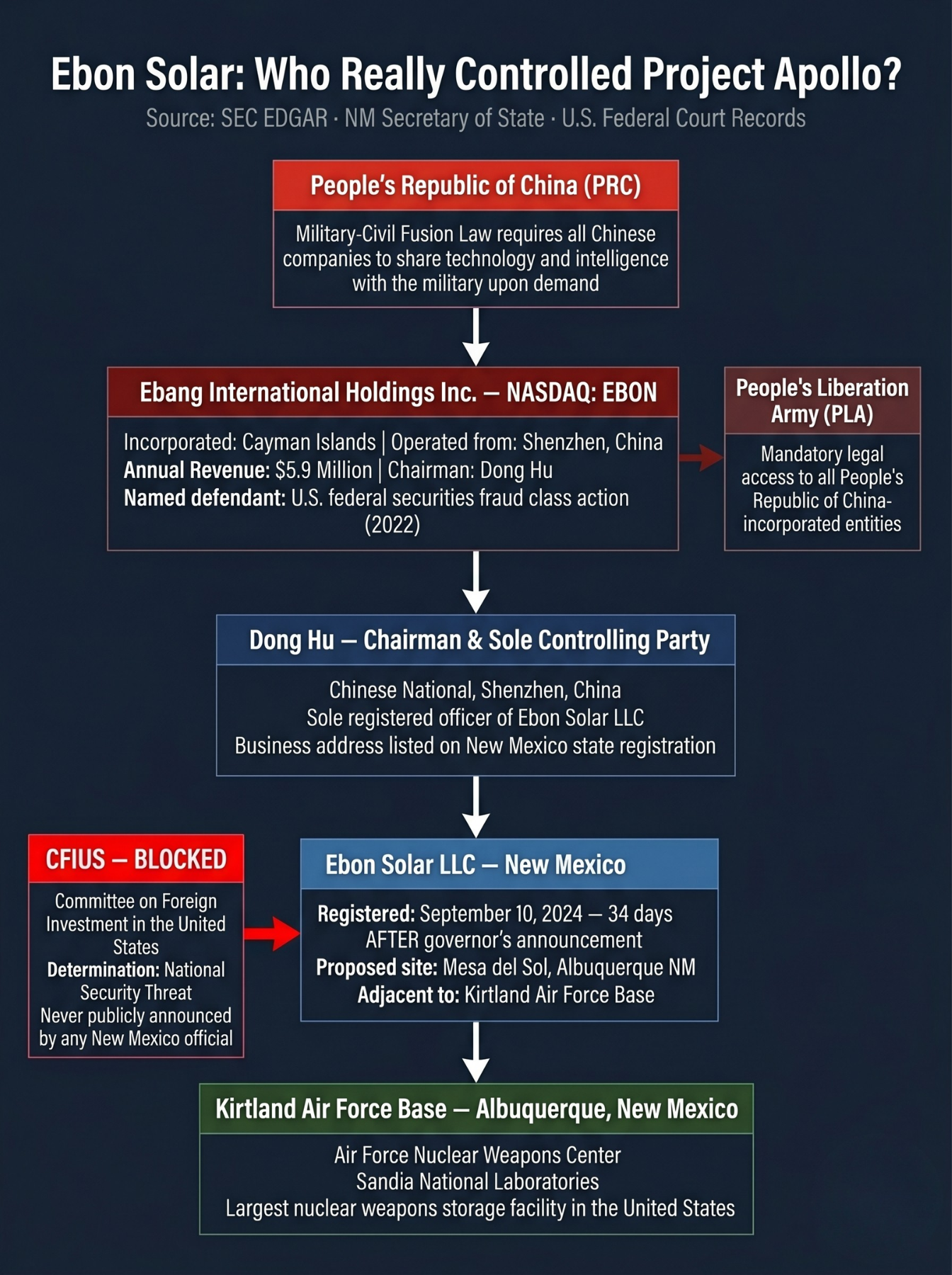
A company called Ebon Solar — the New Mexico subsidiary of Shenzhen-based Ebang International Holdings, and the anchor tenant proposed for the Mesa del Sol development on Albuquerque's south side — was bringing a billion-dollar solar manufacturing facility to the city.
Let me tell you about a deal that should have never happened.
In August 2024, Governor Michelle Lujan Grisham stood before cameras and told New Mexicans their ship had come in. A company called Ebon Solar was bringing a billion-dollar solar manufacturing facility to Albuquerque — 911 jobs, clean energy leadership, a transformational moment for the state.
Eighteen months later, the federal government had quietly killed the deal on national security grounds. The $942 million bond authorization had expired in silence. Not one official who celebrated the announcement — not the governor, not the mayor, not a single county commissioner — had bothered to tell the people of New Mexico any of it.
That silence is the story.
New Mexico Madness spent weeks pulling public records, corporate filings, federal court documents, campaign finance data, and government contracts to find out what really happened with Project Apollo. What we found should make every New Mexican angry — and every elected official in this state very uncomfortable.
The Company: A Ghost With a Chairman in Shenzhen
Start with the basics. Before you give any company $10 million in public money, you check who they are.
Ebon Solar's parent company is Ebang International Holdings Inc., traded on the Nasdaq under the ticker EBON. It is controlled by its chairman, Dong Hu — a Chinese national based in Shenzhen, China. The company's most recent annual report filed with the Securities and Exchange Commission reported total global revenue of $5.9 million. That is not a typo. The company that New Mexico officials described as capable of building and financing a $942 million manufacturing facility reported annual revenue smaller than a decent-sized Albuquerque car dealership.
It gets worse.
At the time New Mexico was rolling out the welcome mat, Dong Hu was a named defendant in a federal securities fraud class action in the Southern District of New York. The Rosen Law Firm alleged that Ebang made materially false and misleading statements to investors. That lawsuit was public record — on PACER, on CourtListener, available to anyone who looked.
Nobody looked. Or if they did, they kept it to themselves.
Here is the detail that should stop you cold: Ebon Solar LLC — the specific New Mexico company that received the public grant commitment — was not registered with the New Mexico Secretary of State until September 10, 2024. The governor's announcement was made on August 7, 2024. The company did not legally exist in New Mexico when she made it. New Mexico committed $10 million in public money to a company that had not yet bothered to incorporate in this state. The ink on the press release was dry before the company was real.
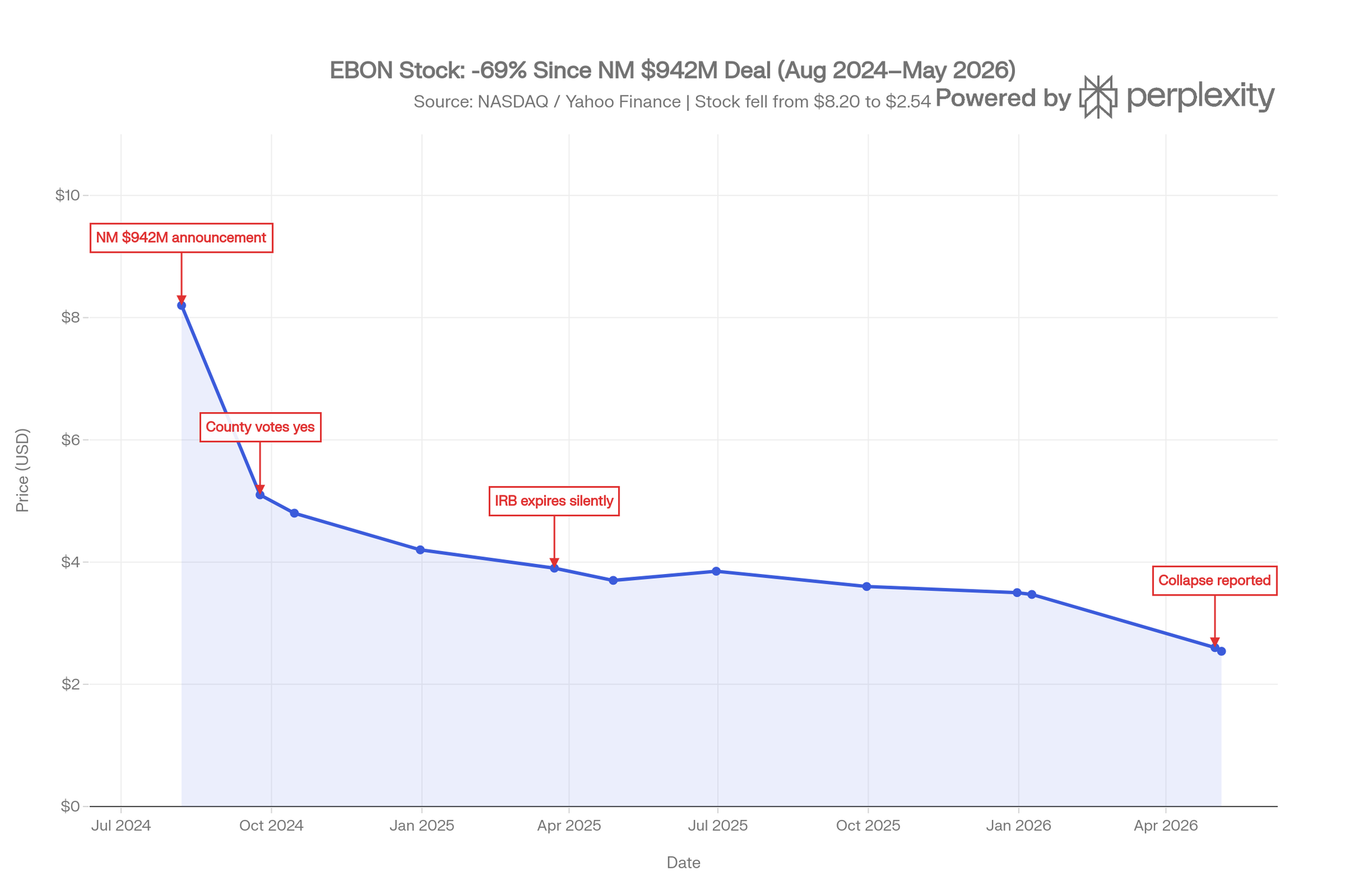
Ebang International Holdings Inc. (NASDAQ: EBON) share price, August 2024 — May 2026. The stock has declined 69% since Governor Lujan Grisham announced the Project Apollo partnership. Source: Yahoo Finance / New Mexico Madness.
The Money: Follow It and It Leads Straight to the Governor's Campaign Account
In New Mexico, as in most places, the people who benefit from government decisions tend to be the same people who fund the campaigns of the officials making those decisions. Project Apollo is a case study.
Steve Chavez and Rudy Guzman, the principals behind MDS Funding LLC, control significant land at Mesa del Sol — the exact site proposed for the Ebon Solar facility. When the governor announces a billion-dollar anchor tenant for your property, its value goes up. Before that announcement, Chavez and Guzman had contributed a combined $81,000 to Governor Lujan Grisham's campaigns, according to official New Mexico Campaign Finance Information System records.
That alone would raise eyebrows. But it is not the most significant political relationship in this deal.
Patricia Collawn is the Chief Executive Officer of TXNM Energy — formerly PNM Resources — New Mexico's dominant electric utility. A company the size of Ebon Solar, running a major photovoltaic manufacturing facility, would have been one of PNM's largest industrial power customers. Collawn personally contributed $31,800 to Governor Lujan Grisham. PNM's political action committee contributed an additional $50,607 net. Combined: $82,407 from the Chief Executive Officer whose utility stood to profit directly from the deal.
Here is where it gets structural. Patricia Collawn was simultaneously serving as Board Chair of the New Mexico Partnership — the state's officially designated economic development recruiter, the nonprofit specifically tasked with identifying and recruiting companies like Ebon Solar to New Mexico. The woman chairing the organization that recruited the deal ran the company that would have profited from it and gave the governor who announced it $82,407. None of that was disclosed publicly. All of it is documented in public records.
The New Mexico Partnership itself received $3,104,000 in state contracts from the New Mexico Economic Development Department between fiscal years 2022 and 2024 — your tax dollars — to perform marketing, attraction, and recruitment services. The organization is funded 91 percent by a single government grant, with the source listed as "RESTRICTED" on its Internal Revenue Service filings. It is, in practical terms, a government operation wearing a nonprofit's clothes — with a utility Chief Executive Officer as its board chair and a revolving door straight into the cabinet.
That revolving door had a name: Rob Black. Black sat on the New Mexico Partnership board while the Ebon Solar deal was being built. On September 4, 2024 — twenty days before the county commission vote — Governor Lujan Grisham appointed him Cabinet Secretary of the New Mexico Economic Development Department. The man who helped recruit the deal from the board of the recruiting nonprofit became the cabinet officer overseeing it two and a half weeks before the biggest vote in the process. No recusal. No disclosure. No problem, apparently, for anyone involved.
The Vote: Unanimous, Uninformed, and Unchallenged
On September 24, 2024, the Bernalillo County Board of County Commissioners voted on Item 8A — "Ordinance for Ebon Solar — Project Apollo Industrial Revenue Bond Application."
When the clerk called for public speakers on the item, not one person had signed up to address it directly.
The commission voted unanimously. All five commissioners — Barbara Baca, Eric Olivas, Steven Michael Quezada, Adriann Barboa, and Walt Benson — voted yes. Commissioner Quezada moved it. Commissioner Benson seconded it. Chair Baca signed it. The result was Ordinance 2024-20: authorization for up to $942,000,000 in Industrial Revenue Bonds for the benefit of Ebon Solar LLC.
Read that number again. Nine hundred and forty-two million dollars. Authorized unanimously by five elected officials for a company with $5.9 million in annual revenue, controlled by a Chinese national under federal securities fraud litigation, that had incorporated in New Mexico just fourteen days earlier.
Buried in Section 7 of that ordinance — language that received zero public discussion — was a provision that the county simultaneously waived its own Economic Development Policy for this specific transaction. The safeguard rules adopted to protect New Mexico taxpayers were set aside by the same five people who approved the deal. In the same vote. Without debate.
And in Section 12, a hard legal deadline was written in: the bonds had to be issued within 180 days or the authorization would expire automatically. One hundred and eighty days from September 24, 2024 was March 23, 2025.
The Location: What Nobody Said Out Loud
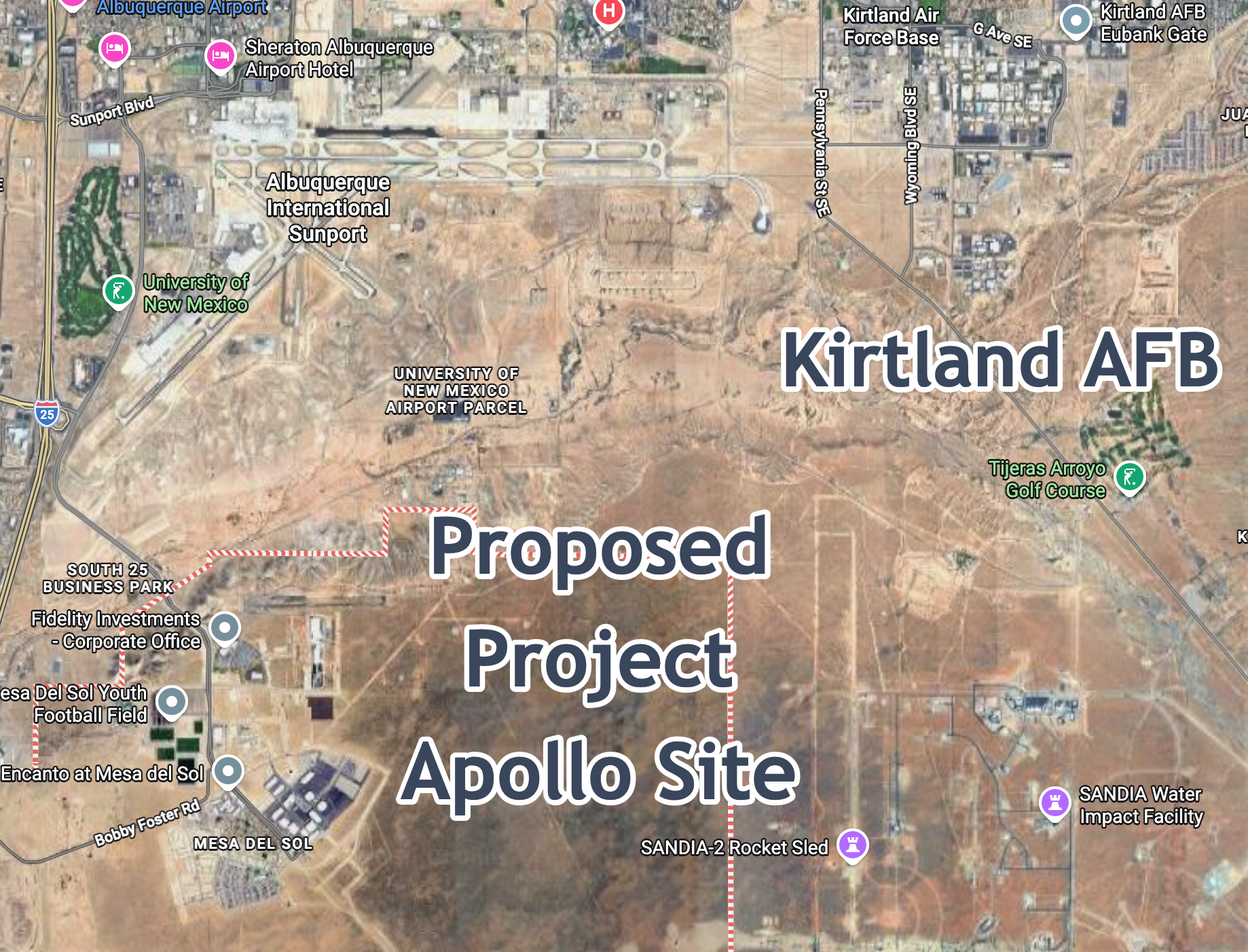
Mesa del Sol development area, Albuquerque, New Mexico, immediately adjacent to Kirtland Air Force Base — home to the Air Force Nuclear Weapons Center, Sandia National Laboratories, and the nation's largest nuclear weapons storage complex. Google Maps does not display Kirtland's internal perimeter due to the installation's classified status. The proposed Ebon Solar Project Apollo manufacturing site was located within this development area. Source: Google Maps.
Here is the part that every New Mexican needs to understand clearly.
Mesa del Sol is not just any piece of Albuquerque real estate. Its southern and eastern boundaries are shared with Kirtland Air Force Base. Kirtland is home to the Air Force Nuclear Weapons Center, Sandia National Laboratories, and the Kirtland Underground Munitions Maintenance and Storage Complex — the largest nuclear weapons storage facility in the United States. What happens at Kirtland is central to America's nuclear deterrence posture. The missions conducted there are among the most sensitive in the entire Department of Defense.
The proposed Project Apollo manufacturing site was not across town from Kirtland. It was adjacent to its perimeter. You could throw a baseball from the fence line.
Under China's Military-Civil Fusion doctrine — not a theory, an actual law of the People's Republic of China — Chinese companies are legally required to share technology, data, personnel, and infrastructure access with the People's Liberation Army upon demand. Ebang International, as a People's Republic of China-incorporated entity, operates under that law. A Chinese-controlled manufacturing facility with hundreds of workers, supply chain logistics, and industrial operations running around the clock, positioned on the boundary of America's nuclear weapons center — that is not an economic development opportunity. That is a threat vector.
The national security concern extended well beyond the base perimeter itself. The neighborhoods surrounding Kirtland are home to a dense concentration of active duty military personnel, defense contractors, Sandia National Laboratories employees, and their families — exactly the population that represents high-value intelligence targets for a foreign adversary. The technology to passively collect electromagnetic emanations from consumer electronics — phones, home routers, smart televisions, connected vehicles — within range of a large industrial facility is documented in open congressional testimony and is a primary reason the Committee on Foreign Investment in the United States scrutinizes foreign operations near military installations.
Within the same geographic footprint: the New Mexico VA Medical Center, whose patient records include the service histories of veterans with security clearances. Albuquerque International Sunport, through which defense personnel and contractors move daily. And the regional water infrastructure serving both the base and surrounding communities. None of these vulnerabilities were mentioned at the podium on August 7, 2024. The people most at risk had no idea it was being proposed — because the officials approving it apparently never asked what they were actually approving.
The federal government recognized the threat immediately.
Consider what happened in North Dakota when a Chinese company proposed building a corn processing mill 12 miles from Grand Forks Air Force Base. Twelve miles. The United States Air Force sent formal letters to Congress. Hearings were held. The episode drove a federal rule change expanding Committee on Foreign Investment in the United States review authority over land transactions near military installations nationwide.
New Mexico officials approved a billion-dollar Chinese-controlled manufacturing facility yards from a nuclear weapons installation and handed out press releases about jobs and clean energy.
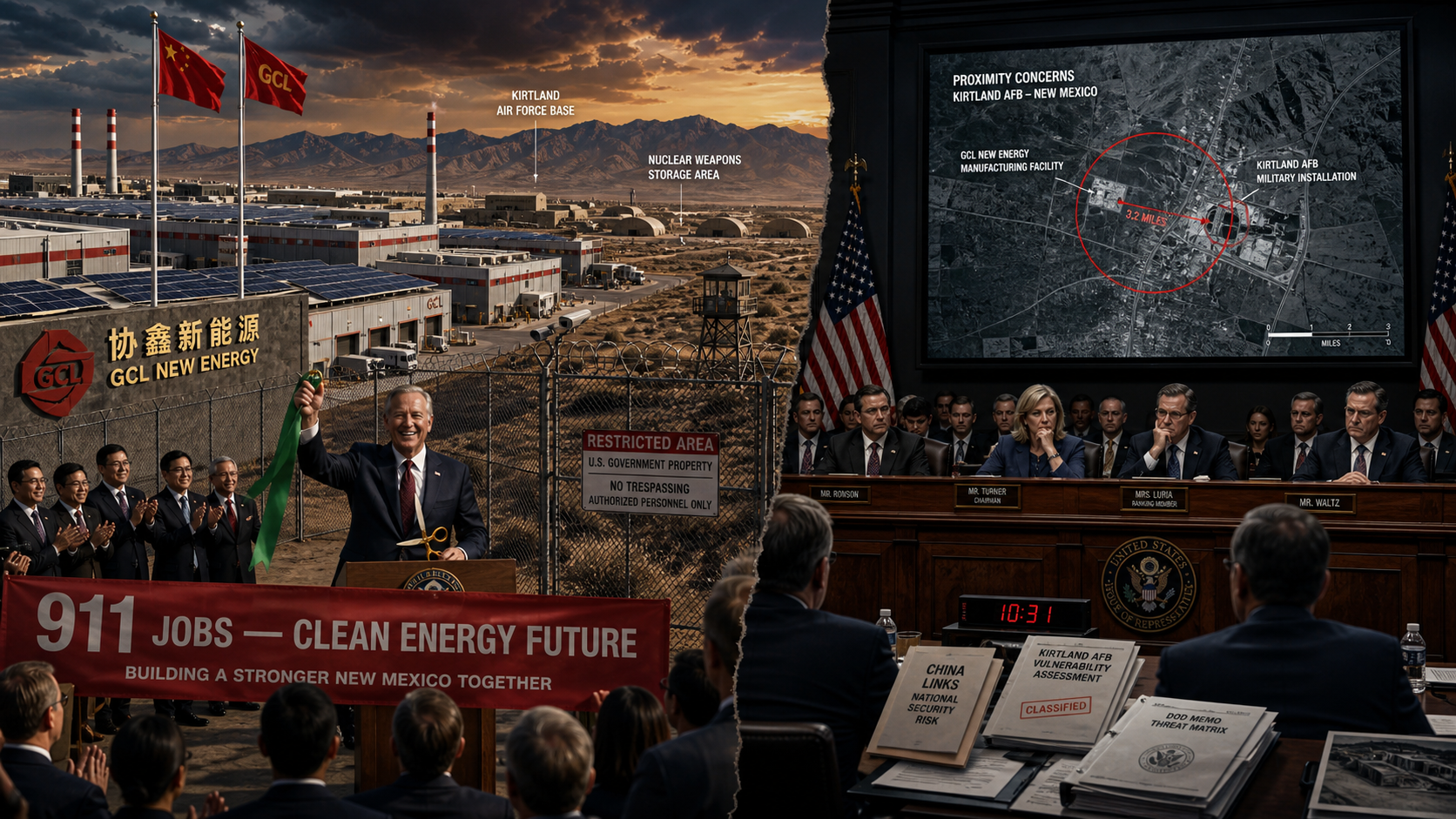
"When a Chinese company proposed a corn mill 12 miles from Grand Forks Air Force Base, Congress held hearings. New Mexico approved a billion-dollar Chinese facility yards from Kirtland's fence line and issued a press release."
The Collapse: Six Months of Silence
The bonds were never issued.
On March 23, 2025, by the explicit terms of the ordinance that five commissioners unanimously approved, the $942 million Industrial Revenue Bond authorization expired. There was no press release. No statement from the governor. No explanation from the county commission. No announcement from the mayor. The authorization that had been celebrated as the crown jewel of New Mexico's economic development future simply ceased to exist — legally, quietly, without a word to the people who had been promised 911 jobs.
The reason was more significant than a missed deadline.
The Committee on Foreign Investment in the United States reviewed the Ebon Solar transaction and blocked it on national security grounds. The federal government's designated national security review body, after examining what New Mexico's own officials had enthusiastically approved, determined it posed an unacceptable risk to the United States of America.
That determination — the most important fact in this entire story — was never publicly announced by any New Mexico official. Not the governor. Not the cabinet secretary she appointed from the deal's own recruiting board. Not the mayor. Not one of the five county commissioners whose names are on the ordinance.
The stock of Ebon Solar's parent company has declined 69 percent since the day Governor Lujan Grisham called the deal transformational.
What the City Admitted — And What Everyone Else Refused to Say
When New Mexico Madness submitted formal media inquiries to the City of Albuquerque, the New Mexico Economic Development Department, the Office of the Governor, and the Bernalillo County Commission, only one office responded substantively.
City of Albuquerque Community Outreach Manager Sara Mannal confirmed in writing on May 6, 2026:
"The City of Albuquerque worked closely with Ebon, its partners, New Mexico's federal delegation, Governor Michelle Lujan Grisham, and Mayor Tim Keller to advance a proposed photovoltaic manufacturing project. Albuquerque emerged as a top choice through a competitive national site selection process, underscoring the city's strong workforce, infrastructure, and business climate. Ultimately, federal policy constraints and CFIUS-related considerations prevented the company from establishing U.S. operations. No public funds were expended. While we are disappointed the project will not move forward, Albuquerque remains well positioned to attract advanced energy manufacturing and will continue pursuing high-quality investment and job creation opportunities."
— Sara Mannal, Community Outreach Manager, City of Albuquerque Economic Development Department, May 6, 2026
That confirmation — the first on-the-record acknowledgment by any government official of what actually happened — came not from a press conference, not from a proactive public announcement, but from a media inquiry by a New Mexico news outlet asking direct questions that should have been answered publicly more than a year ago.
The city's Economic Development Director was traveling and unavailable to respond to follow-up questions, including whether the city conducted any financial due diligence on Ebon Solar prior to the Local Economic Development Act commitment and whether officials knew the company was incorporated in New Mexico a month after receiving the public grant commitment.
New Mexico Madness was subsequently directed by the Governor's constituent services office to Communications Director Michael Coleman. A formal media inquiry was submitted directly to Mr. Coleman on the morning of publication, May 7, 2026. No response was received before press time.
New Mexico Economic Development Department Cabinet Secretary Rob Black did not respond to a media inquiry submitted to his office and executive assistant.
The Bernalillo County Board of County Commissioners did not respond to a media inquiry seeking comment on Ordinance 2024-20 and its March 23, 2025 expiration.
The Bottom Line
No public funds were ultimately expended on this deal. The Local Economic Development Act grant structure — which requires reimbursement of actual expenditures — may have been the only mechanism in this entire process that functioned as intended. New Mexico got lucky. But luck is not a due diligence strategy, and luck is not a substitute for the basic obligations elected officials owe the people who put them in office.
The federal government protected New Mexico from itself. The Committee on Foreign Investment in the United States caught what a governor's office, a cabinet secretary recruited from the deal's own recruiting board, a county commission of five, a city administration, two nonprofit executives, and a network of political donors either never identified — or never chose to disclose.
A twenty-minute review of publicly available Securities and Exchange Commission filings would have revealed the $5.9 million revenue figure, the securities fraud litigation, and the 34-day gap between the public announcement and the company's New Mexico incorporation. These are not obscure findings. They appear in the first results when you search Ebang International on the Securities and Exchange Commission's public database.
The people of New Mexico were promised 911 jobs, a billion-dollar investment, and clean energy leadership. They got silence. They were owed accountability. They still are.
This investigation is not finished. New Mexico Madness will continue its investigation into Project Apollo and the network of political relationships that shaped its approval. Part Two examines the institutional conflicts, subcontractor payments, and revolving door appointments that built the machine that approved this deal — and whether that machine is still running today.
Tips, documents, and information: reidrothchild@newmexicomadness.com
Sources & References
Corporate Records
- Ebon Solar LLC — New Mexico Secretary of State, registration date September 10, 2024; registered agent Northwest Registered Agent; sole officer Dong Hu, Shenzhen, China
- Ebang International Holdings Inc. — U.S. Securities and Exchange Commission EDGAR, Annual Report Form 20-F, fiscal year 2023; total reported revenue $5.9 million
- Rosen Law Firm v. Ebang International Holdings Inc. et al. — U.S. District Court, Southern District of New York; federal securities fraud class action, filed 2022
Campaign Finance
4. New Mexico Campaign Finance Information System (CFIS) — contributions from Steve Chavez, Rudy Guzman, Patricia Collawn, and PNM Responsible Citizens Group to Governor Michelle Lujan Grisham, 2018–2022
5. Public Accountability Project — New Mexico historical contributions dataset, 2018–2019 election cycles
Government Records
6. Bernalillo County Ordinance 2024-20 — adopted September 24, 2024; Industrial Revenue Bond authorization for Ebon Solar LLC, $942,000,000
7. Bernalillo County verbatim meeting minutes — Administrative Meeting, September 24, 2024
8. New Mexico Sunshine Portal (SHARE) — New Mexico Economic Development Department purchase orders to New Mexico Economic Development Corporation (New Mexico Partnership), fiscal years 2022–2024; total $3,104,000
9. New Mexico Economic Development Department — Local Economic Development Act Program Results, fiscal year 2025 commitments
Internal Revenue Service Filings
10. New Mexico Economic Development Corporation (New Mexico Partnership) — Form 990, tax year ending June 30, 2024; EIN 20-0100129; government grant revenue 91% of total
On-the-Record Statements
11. Sara Mannal, Community Outreach Manager, City of Albuquerque Economic Development Department — email correspondence with New Mexico Madness, May 6, 2026; confirms no public funds expended and Committee on Foreign Investment in the United States-related considerations ended the project
12. Governor's Office constituent services auto-response directing media inquiries to Communications Director Michael Coleman — received May 7, 2026
13. Media inquiry submitted to Michael Coleman, Communications Director, Office of Governor Michelle Lujan Grisham — May 7, 2026, 9:11 AM; no response received before publication
News and Public Sources
14. PV-Tech — "New Mexico approves $942 million bond for Ebon cell plant," September 2024
15. Yahoo Finance / Ebang International investor reporting — EBON share price history, August 2024–May 2026
16. Atlantic Council — "China's ability to buy U.S. land near military bases just got more restricted," July 2024
17. New Mexico Economic Development Department press release — "Governor appoints Rob Black as Secretary of Economic Development," September 4, 2024
18. Energy and Policy Institute — utility political contribution analysis, New Mexico, 2018
19. Heritage Foundation — "China's Dual-Use Ambitions Could Severely Threaten America's Force Posture," April 2026
20. U.S. Treasury Department — proposed expansion of Committee on Foreign Investment in the United States jurisdiction over land deals near military installations, 2023–2024


