

Chapter 5: The Captured Capital and the Path Forward
The previous chapters of this investigation have laid bare a structural machinery that operates with mathematical precision. We have traced how billions of dollars in capital, millions of acres of pristine public and ancestral land, and the literal heavy industrial supply lines of New Mexico have been systematically weaponized. This complex does not serve the citizens who reside within the state's borders. From the engineered housing inflation in Albuquerque’s urban core to the multi-billion-dollar out-of-state wind siphons of the Estancia Basin, the baseline reality remains unchanged: New Mexico has been structured to carry 100% of the long-term material, environmental, and financial liabilities, while 100% of the premium assets are exported to coastal economic hubs.
This final chapter synthesizes the forensic ledger of this captured capital and outlines the immediate, unyielding policy directives required to dismantle the extraction loop. The machine survives entirely on the deliberate creation of administrative complexity, hiding its extractions behind dense regulatory filings, non-competitive municipal buyouts, and sweeping federal preemption bills. When you strip away the legal terminology, the entire apparatus collapses into a clear picture of institutional capture.
The Ledger of Institutional Capture
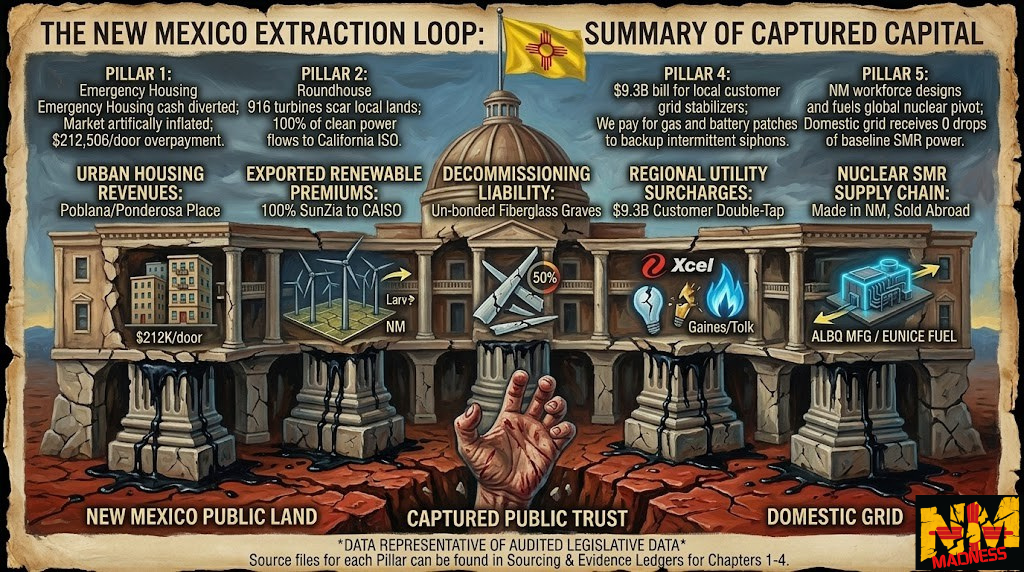
To understand how to break the loop, the public must first understand the total volume of captured wealth documented across this multi-pillar audit:
- The Real Estate Shell Game: In Bernalillo County, emergency affordable housing cash allocations were completely diverted from ground-up municipal construction. Instead, public agencies executed a Taxpayer Double-Tap, overpaying premium market rates ($212,506 per door at Poblana Place and $7,000,000 at Ponderosa Place) to absorb pre-existing commercial real estate assets onto public books. This process artificialized the market, rewarded private real estate networks, and left local low-income residents trapped in engineered supply scarcity.
- The Material Asymmetry: While urban housing developments sat stalled due to localized concrete and aggregate shortages, hundreds of thousands of cubic yards of heavy industrial materials were actively commandeered to anchor Pattern Energy Group's $11 billion SunZia loop.
- The Decommissioning Double Standard: Traditional local energy producers are forced to lock up upfront, dollar-for-dollar cash sureties and performance bonds before a drill bit ever touches the earth. Meanwhile, out-of-state wind syndicates exploit the State Land Office's commercial lease frameworks to post a mere 50% of decommissioning costs for the first decade of operation—leaving behind a looming 110,000 cubic yard solid waste crisis of non-recyclable fiberglass blades, like the ones left rotting uncovered at the Vaughn Landfill.
- The Baseline Deception: Federal legislative fast-tracks like Gabe Vasquez's Energy Bills Relief Act (H.R. 7977) and the CERTAIN Act (H.R. 8308) work to explicitly strip states of their zoning vetoes and bypass active tribal sovereignty lawsuits brought by the Tohono O’odham Nation and San Carlos Apache Tribe. Simultaneously, local Xcel Energy utility customers have been hit with a $9.3 billion NMPRC-approved bill to build traditional fossil-fuel natural gas patches (Gaines and Tolk) and battery banks just to stabilize a local grid hollowed out for export—all while the state’s world-class nuclear SMR fuel supply in Eunice and manufacturing hub in Albuquerque are packaged and sold to the highest out-of-state bidders.
The Path Forward: Statutory Blueprints to Break the Loop
Dismantling a multi-billion-dollar extraction colony cannot be achieved through passive oversight or incremental regulatory adjustments. It requires an aggressive, statutory restructuring of how New Mexico protects its land, regulates its grid, and bonds corporate infrastructure.
The following policy directives represent the immediate, non-negotiable legal frameworks required to reclaim the state's sovereignty:
1. Parity in Reclamation Bonding (The 180-Degree Equalizer)
The State Land Office and the New Mexico Environment Department must immediately terminate the decade-long financial liability holiday granted to commercial renewable energy developers.
- The Directive: Implement a strict Renewable Energy Reclamation Parity Act. This statute must legally mirror the exact financial oversight forced upon traditional oil and gas operators.
- Before a single shovel touches dirt or a single turbine anchor is poured, commercial wind and solar developers must post 100% upfront, cash-backed performance bonds covering the total projected lifecycle decommissioning costs.
- Furthermore, a mandatory Liquidated Fiberglass Disposal Fee must be levied per blade at the time of installation, creating a ring-fenced state terminal fund to guarantee that out-of-state operators—not local municipal solid waste authorities—pay to extract, process, and permanently dispose of their industrial waste.
2. Mandatory Decommissioning and Phase-Out Mandate
When a multinational energy cartel finishes its contract with out-of-state markets, they cannot be allowed to simply walk away or upgrade the towers on our dime.
- The Directive: Enact a strict Renewable Lifecycle Expiration Act to prevent infinite corporate land possession.
- The moment a commercial wind array hits its initial contract term (typically 20 to 25 years under existing CAISO power purchase agreements), the operator must be legally prohibited from auto-extending the land lease or executing a "repowering" phase to upgrade the hardware.
- The state must mandate a hard, immediate sunset clause: once the out-of-state procurement contract terminates, the operator has a non-negotiable 12-month window to completely dismantle the towers, excavate the concrete pads, extract the components, and fully restore the land to its original ranching or ecological baseline. If they fail to comply, the state immediately seizes their assets and draws 100% of the cash from the upfront performance bonds established under our new parity rules.
3. The Commercial Wind Moratorium (The Grid Justification Filter)
To completely stop the bleeding, the state must treat further wind deployment as a restricted industrial liability rather than an unlimited green gold rush.
- The Directive: Enact a Commercial Turbine Moratorium and Grid Justification Act. This law places an immediate, sweeping ban on the approval or construction of any new commercial wind projects exceeding a cumulative nameplate capacity of 10 megawatts, unless the developer can mathematically prove a direct domestic utility necessity.
- Under this strict criteria, a developer must present an audited load-growth analysis to the NMPRC proving two things: first, that 100% of the generated power is spoken for by domestic New Mexico consumers and businesses, and second, that the project's spatial land-use footprint cannot be more efficiently satisfied by a compact nuclear SMR facility. If the power is destined for export, or if the land footprint can be compressed by next-generation baseline nuclear tech, the application is denied by default.
4. State-Level Siting Vetoes and Tribal Sovereignty Protection
To counter the sweeping federal preemption clauses embedded in Section 405 of H.R. 7977, New Mexico must erect an unyielding state-level legal barrier to protect its geographic interior.
- The Directive: Enact the Sovereign Land and Historic Corridor Protection Act. This law must mandate that any interstate transmission line traversing New Mexico soil must allocate a minimum of 35% of its physical carrying capacity directly to the domestic New Mexico public utility grid at cost, transforming export corridors into mandatory local infrastructure dividends.
- Crucially, the statute must dictate that no state agency or construction permit shall be validated if the infrastructure path encroaches upon land subject to active National Historic Preservation Act (NHPA) litigation or tribal land-claim disputes. If a federal bureaucrat attempts to steamroll local zoning via a FERC override, this state statute will legally bar the deployment of state law enforcement, municipal road access, and local utility interconnections—effectively freezing corporate bulldozers at the state line.
5. Mandating Homegrown Nuclear Baseline Power
New Mexico must immediately cease acting as a raw resource quarry that mines its own advanced nuclear engineering capabilities for the benefit of global tech consortia while local residents burn natural gas and pay multi-billion-dollar utility surcharges.
- The Directive: The New Mexico Public Regulation Commission must issue an immediate Baseline Energy Security Order. This mandate will require that any utility operating within the state—such as Southwestern Public Service / Xcel Energy—must prioritize the integration of compact, 24/7 baseline technologies over land-intensive, intermittent arrays.
- Leveraging the active manufacturing footprints of Kairos Power at Mesa del Sol and the advanced fuel enrichment capabilities of Urenco in Eunice, the state must establish the New Mexico Modular Nuclear Grid Initiative.
- This framework will legally divert a fixed percentage of the advanced nuclear components and mid-enriched fuel currently manufactured on our soil to construct a network of localized, state-owned Small Modular Reactors. By replacing hundreds of square miles of invasive, exported wind corridors with compact, four-square-mile nuclear baseline facilities, New Mexico can secure permanent energy independence, lower domestic customer bills, and completely eliminate the spatial destruction of its rural ranching and ancestral lands.
The Final Audit
The extraction loop survives on the assumption that New Mexicans will continue to accept a decades-long reality of geographic and financial betrayal. The machine expects rural communities to quietly accept the material rot of an un-bonded fiberglass graveyard, expects tribal nations to surrender their sacred valleys to federal steamrollers, and expects urban taxpayers to submissively shoulder billions in utility spikes just to stabilize a hollowed-out grid.
But the ledger is now unsealed. The data proves that New Mexico possesses the physical concrete, the world-class laboratory infrastructure, the advanced manufacturing hubs, and the raw fuel capabilities to dictate its own economic destiny. The state does not suffer from a scarcity of resources; it suffers from a capture of capital. By enforcing strict bonding parity, enacting legal shields around tribal and local sovereignty, executing a mandatory lifecycle phase-out of expired turbines, and demanding that homegrown advanced nuclear baseline power remain on domestic soil, the citizens of New Mexico can finally dismantle the infrastructure colony, shatter the extraction loop, and reclaim the Land of Enchantment from the architectures of encroachment.
SOURCING & EVIDENCE LEDGER
I. Statutory Frameworks & State Revenue Logs
- State Capital Allocation Guidelines: General fund disbursement criteria, municipal infrastructure financing dockets, and agency oversight archives are maintained under the New Mexico Department of Finance and Administration Ledger.
- Renewable Energy Exemption Clauses: Commercial lease guidelines, industrial easement rules, and financial assurance exclusion forms are archived via the New Mexico State Land Office Commercial Lease Registry.
- Affordable Housing Emergency Funding: Transaction tracking sheets, property acquisition audits, and state allocation histories for house bill appropriations are managed via the New Mexico Department of Workforce Solutions Office of Housing Procurement Portal.
II. Advanced Infrastructure & Regulatory Precedents
- Federal Siting Preemption and Fast-Track Legislation: Complete statutory provisions, FERC jurisdiction expansion clauses, and judicial review restriction items are maintained under the U.S. GovInfo Repository for H.R. 7977 and the GovInfo Database for H.R. 8308.
- Industrial Utility Surcharges & Resource Mandates: Final approval orders, regional capacity metrics, and fossil-fuel asset construction authorizations for the Tolk and Gaines facilities are compiled under the New Mexico Public Regulation Commission Case Records under Docket No. 24-00123-UT.
- Advanced Nuclear Supply Chain Integration: Capital investment records, LEDA industrial project agreements, and component manufacturing dockets for the Mesa del Sol campus are managed via the New Mexico Economic Development Department Project Portal.
- Appellate Land Sovereignty Rulings: National Historic Preservation Act injunction files, ancestral corridor maps, and appellate review mandates itemizing tribal challenges in the San Pedro Valley are cataloged under the United States Court of Appeals for the Ninth Circuit Database (Tohono O’odham Nation et al. v. U.S. Department of the Interior, Docket No. 24-3659).


