

Part 1 priced the "baby bond" and found a $1.3 billion liability funded by New Mexicans, promoted with a funding source its own champion calls "undecided," attached to a voucher the child never owns. The obvious next question — the one every taxpayer asks — is "so what would you do instead, and when does this hit my property tax bill?" Fair. Here's the answer, with the math the Roundhouse skipped. It costs about four cents on their dollar, the child actually owns it, and no one's property taxes go up to pay for it.
The Fix, in One Sentence
Stop building a second, state-owned savings program next to the federal one New Mexicans already fund — and instead supercharge the account that already exists.
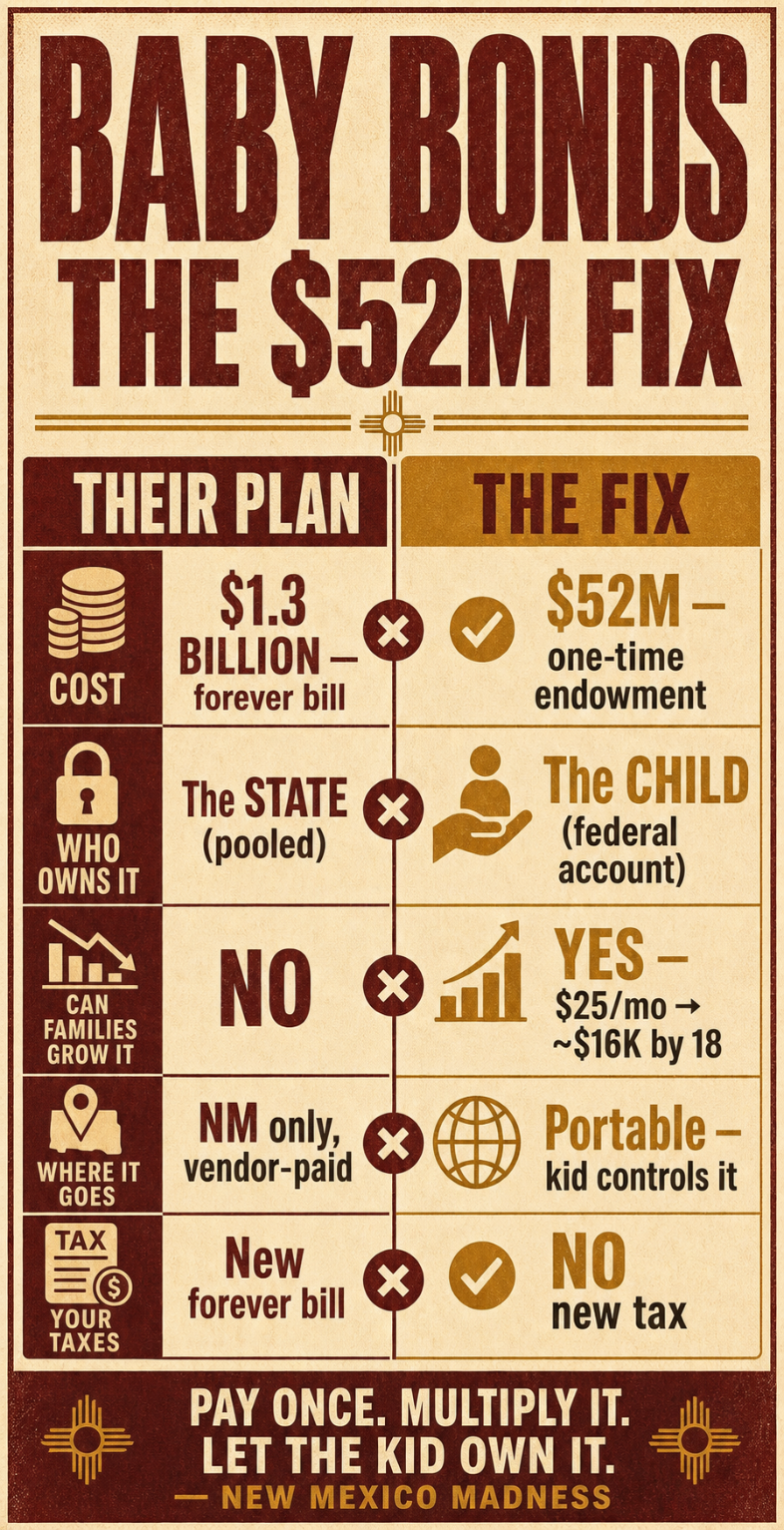
Every child born in America now gets a federal "Trump Account" — a $1,000 seed, individually owned, that families can grow. New Mexico's plan ignores that and spends $1.34 billion building a parallel, pooled, state-controlled system beside it. The smarter move: drop a targeted $500 state seed into that same federal account for low-income New Mexico newborns, add a state tax credit for families who contribute, and fund the whole thing from a one-time endowment — not a forever bill. One account. Three funding streams — federal, state, family. All of it owned by the child.
The Scoreboard
Start with the numbers, because this is where the argument lives.
- Their plan: ~$1.34 billion endowment to seed every birth at $7,000, or a recurring ~$94–120 million every year, forever.
- This plan: a one-time ~$52 million endowment, invested at the State Investment Council's own 7% target, throwing off enough each year to seed every low-income newborn — about 4% of the cost.
- What the child gets: a $500 state seed plus the $1,000 federal seed grows to roughly $5,000 by 18 untouched — and with a modest $25-a-month family contribution, about $16,000 by 18 and $52,000 by 35. No billion-dollar state fund required.
The difference isn't a rounding error. It's the difference between a launchpad and an anchor.
You Already Pay Once. Why Pay Twice?
Here's the part that answers the property-tax question directly — and it's the one the boosters never mention.
You are already funding a newborn savings account. Every New Mexican, as a federal taxpayer, pays for the $1,000 Trump Account seed that lands automatically for every baby born in the state. The baby bond asks you to reach into your pocket a second time — out of state money now — to fund a second program chasing the exact same goal. Montoya says the quiet part plainly: New Mexico is "looking to expand upon" the federal accounts.
That's not building wealth. That's paying twice to do one job — and the second payment buys the worse product, the one your child can't own, move, or fully claim. A responsible state doesn't duplicate a program its residents already fund. It builds on it. Our fix does exactly that: it stacks the state's $500 on top of the federal $1,000 inside one account, so every dollar compounds together instead of funding two competing bureaucracies.
So When Do My Property Taxes Go Up? They Don't.
This is the question that sinks most "help the children" programs, so let's kill it directly.
New Mexico's own budget doctrine favors "major one-time investments that can result in lasting" value over strapping taxpayers to recurring bills — and the state has already done it, endowing trust funds for early childhood and conservation in recent years. Even Speaker Martínez concedes a baby bond "would likely involve creation of a new state trust fund, as has been done… for conservation and early childhood programs." So the mechanism is proven. The only question is scale — and $52 million, capitalized once from existing surplus, is a rounding error against a state sitting on tens of billions in permanent funds.
No new property tax. No recurring general-fund line that grows every year. No "we'll raise it again next session." You endow it once, the earnings do the work forever, and the principal is never touched. That's the discipline Part 1 found missing — applied here on purpose.
The Gates: Reward the Kids Who Show Up
Handing money to a child for merely being born is the design flaw. The fix makes the state's dollars earned and multiplying:
- Graduation gate — access requires a New Mexico diploma or GED, turning the seed into a completion incentive.
- Match-to-unlock — the state matches family contributions, rewarding "skin in the game," with a zero-match floor so the poorest child still gets the base seed and is never punished for having nothing to add.
- Financial-literacy gate — a short state-approved course before access, so an 18-year-old knows what they're holding.
- Leave-it-in bonus — the state adds to whatever a young adult doesn't cash at 18, rewarding the ones who let it compound toward that $52,000-by-35 number instead of buying a depreciating car.
That's the opposite of the pooled voucher. It's an account the child owns, funded three ways, that pays off more the harder they work.
Reaching the Kids Who'd Otherwise Be Left Behind
The honest hard case: a destitute family that can't add a dollar and may not even open the account. The fix meets them where the state already is.
New Mexico already drops WIC, SNAP, and Medicaid enrollment on a new mother at the hospital bed. Add federal-account enrollment plus the state seed to that same intake — auto-open the account, drop in the $500, hand over one page of plain-language education, and the state's job is done. Even a child whose family never adds another cent walks away with a real, owned asset of roughly $5,000 by 18 — something the pooled bond can't promise either, but does far more expensively. Create the opportunity, inform the parent, then respect the adult's freedom to choose. That's the whole philosophy.
What Its Defenders Will Say
Supporters of the big version will point at the seed and say: your plan still spends taxpayer money, and it still recurs. True — and we won't pretend otherwise. The $500 seed is public money, and it repeats with each low-income birth. We concede it cleanly, because honesty is the point. A destitute child still nets a real asset they'd never otherwise get.
But the objection was never the amount — it was the design. Our version costs about a twenty-fifth of theirs, kills the recapture loop, lets families grow the account, builds on the federal program instead of duplicating it, and hands the child something they actually own. Their version costs a billion-plus, pools the money, forbids family contributions, fences every dollar inside state lines, and can't tell you where its own funding comes from. One of these is stewardship. The other is a press release with a nine-figure invoice attached.
The Launchpad and the Shopping Cart
Part 1 showed you the shopping cart — a child locked in a state-pushed basket, reaching for an account just out of reach, the money never really theirs. This is the launchpad: the same child, the same seed, but in an account they own, that their family can grow, that leaves the state with them if opportunity calls them elsewhere, funded once and built to last.
New Mexico doesn't have to choose between helping poor kids and respecting taxpayers. That's a false choice the boosters need you to believe. For four cents on their dollar, the state can seed a real future, let families multiply it, reward the kids who finish and keep saving — and never send you a bigger tax bill to do it. The money that builds a child's wealth should leave the hospital with the child. Not stay locked in a cart with the state's hand on the handle.
We priced their plan. We built a better one. Now it's on the Roundhouse to explain why they'd choose the billion-dollar cart over the fifty-two-million-dollar launchpad.
Endnotes
- Federal "Trump Account" ($1,000 newborn seed) and Montoya's stated intent to "expand upon" it — KOB kob
- Universal cost (~$94–120M/yr; "at least $120M"), new-trust-fund requirement, early-childhood/conservation precedent — Yahoo/Journal yahoo
- Restricted-voucher mechanics, pooled fund, vendor-direct payment — Las Cruces Sun-News lcsun-news
- NM budget doctrine favoring one-time investments over recurring appropriations — LFC budget guidelines nmlegis
- Graduation-access requirement (HB 7 structure) — NM House Democrats nmhousedemocrats
- Endowment corpus and kid-outcome modeling (7% SIC return, principal preserved) — internal model, SIC return validation yahoo


