

New Mexico is being sold a "baby bond" — a nest egg for every child, a cure for generational poverty. Strip the branding and look at the mechanics, and it's something else entirely: a state-controlled, use-locked, in-state-only voucher the child never owns, funded by New Mexicans, promoted with a funding source its own champion admits is "still undecided." This is Part 1 of two. Here, the diagnosis. Next, the fix — one that costs the state a fraction and hands the money to the kids who actually need it.
The Pitch, and Who's Making It
Start with who's driving this, because it isn't a fringe idea — it's becoming Democratic-establishment consensus.
State Treasurer Laura Montoya is the current engine, working with lawmakers toward a 2027 bill that would automatically invest $7,000 for every child born in New Mexico. It surfaced again publicly around July 8. The failed 2025 vehicles — SB 397 from Sens. Leo Jaramillo and Moe Maestas, and the competing "Children's Future Act" (HB 7) from House leadership including Speaker Javier Martínez — cleared committees before dying. And the leading candidate for governor, Deb Haaland, has folded it into her platform, pledging to "Distribute Baby Bonds… long-term savings accounts for all babies born in New Mexico." Her own word is "distribute" — a tell we'll come back to.
Why This Isn't a Bond — It's a Restricted Voucher
Here's the heart of it, and it's the single most important thing a New Mexican needs to understand.
A bond is an asset you own. You can hold it, sell it, borrow against it, or cash it and do whatever you want with the money. What the state is proposing has none of those properties. By the promoters' own description, it is restricted four separate ways:
- Restricted by use — the money can only go toward in-state college, a home, a "reliable vehicle," or a New Mexico business.
- Restricted by geography — the home, the business, the school all must be in New Mexico.
- Restricted by time — locked until 18, with a window running to 35.
- Restricted by behavior — access is gated behind a state "financial fitness" course.
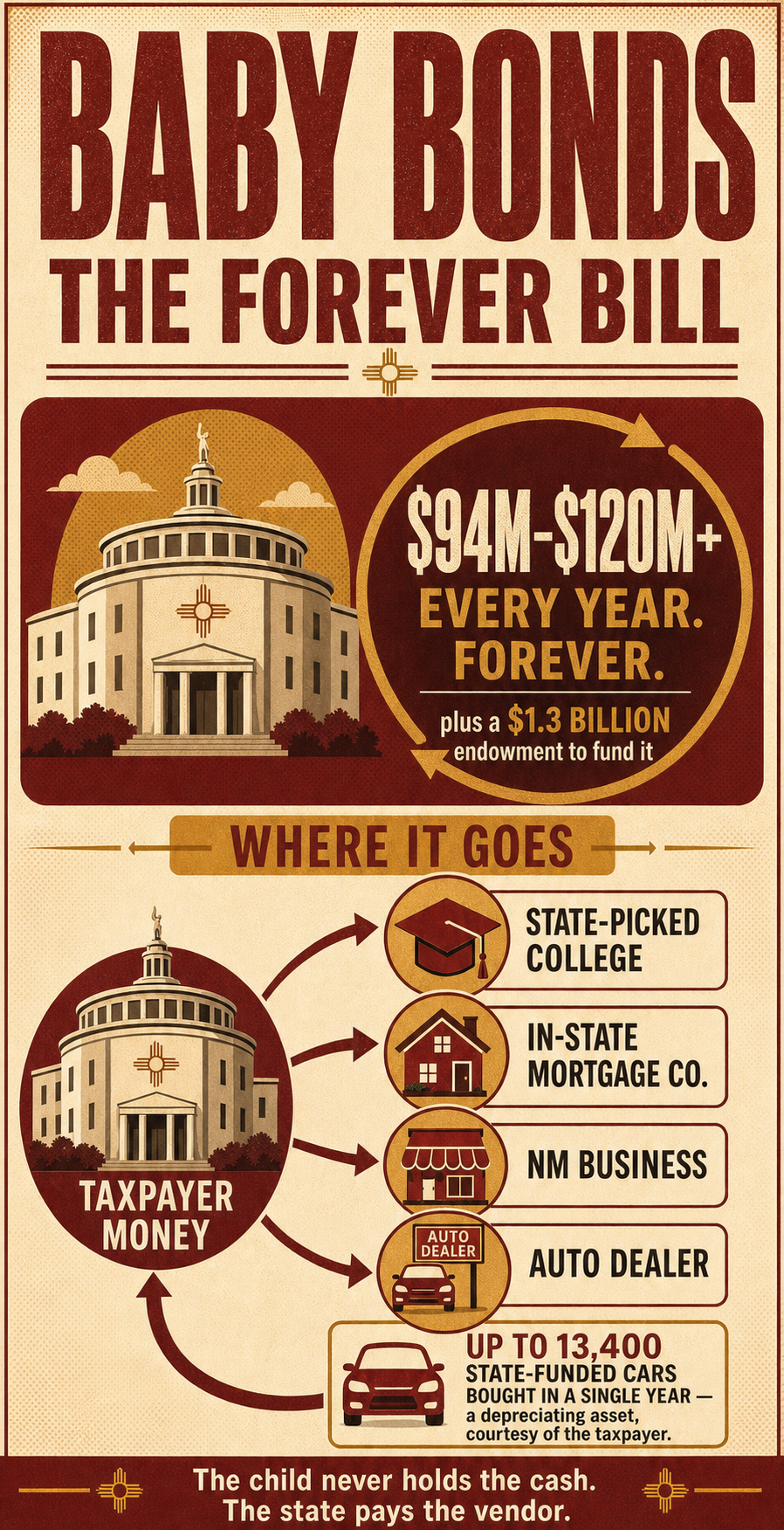
And critically, the recipient never touches the cash. The state pools the money, invests it collectively, and pays the vendor directly — the university, the dealer, the title company. Montoya's own description says it best: "it all gets put into a pool of cash… it's their money but it isn't their money." That is not a gaffe. That is the most accurate sentence anyone has spoken about this program. When the person the money is "for" cannot hold it, move it, or freely spend it, the honest word isn't bond. It's voucher — a restricted, in-state, use-locked voucher redeemed by the state on the recipient's behalf. Haaland's verb, "distribute," is the correct one. You distribute a benefit. You own a bond.
The Number They Won't Put on the Marquee
Slogans are cheap. The scoreboard is what matters.
A universal $7,000-per-child program covers roughly 13,400 births a year — a recurring cost of about $94 million annually by the seed math alone, and by Speaker Martínez's own public estimate "at least $120 million" even at the lower $6,000 figure floated in 2025. To fund that from investment earnings without touching principal — the responsible way — New Mexico would need an endowment on the order of $1.34 billion. That is the true scale of the ask hiding behind the word "bond." And under the failed SB 397's structure, the first dollar wouldn't reach a recipient until decades out.
The Funding Source: "Still Undecided"
Now the part that should stop every taxpayer cold.
Asked where the money comes from, Montoya's answer is that she is "still working with state lawmakers on the fine details, including where that money will come from," floating a draw from the state's roughly $68 billion sovereign wealth. Read that again. A nine-figure recurring program, promoted publicly, pitched to the governor's race — and the funding source is openly unresolved.
This is not a knowledge gap. New Mexico has one of the strongest nonpartisan fiscal shops in the country — a Legislative Finance Committee staffed by advanced-degree analysts whose literal job is to answer "what does it cost and where does it come from" before a proposal goes public. The tools exist. The discipline doesn't. And the pattern is documented: the same LFC recently found the state "spent $520 million on tax breaks for economic development in FY25," but "only some… paid off and the overall impact was limited." Big money moved on good intentions, without a return. The baby bond isn't an anomaly. It's the house style.
The Broken Engine
Here's the design flaw that turns a merely expensive idea into a bad one.
The single deposit is all there is. There is no mechanism for a family to add to their child's bond — no top-ups, no matching, no contributions. The money sits pooled in a state fund, growing only on market return, capped at whatever one deposit becomes. Compare that to the very tools sitting elsewhere in Haaland's own platform — an expanded Child Tax Credit, an expanded Working Families Tax Credit, down-payment assistance, and an "Affordability Navigator" to enroll families in benefits they qualify for but don't access. Her plan already concedes that refundable credits and better enrollment are how you help struggling families. So why bolt an expensive, state-owned, un-growable voucher on top of the tools her own document says work? That's not a rhetorical question. It's Part 2.
What Its Defenders Will Say
Supporters will point to the real problem underneath — New Mexico's chronic child poverty and wealth gap — and say at least this does something. They'll note a low-income child still ends up with a restricted asset they'd never otherwise get. Fair. The concept has serious academic backing; the Urban Institute has modeled baby bonds' effect on family wealth. We don't dispute the goal. A destitute kid netting something is not nothing.
But the goal was never the question. The question is the vehicle. A program that forbids families from adding a dollar, pools the money so the child never owns it, fences every use inside state lines, and can't tell you where its own funding comes from — that isn't a wealth-building bond. It's a spending mandate wearing a nursery blanket. And the state's own analysts, the same ones who flagged $520 million in low-return spending, were apparently not the voice that carried the day.
The Blanket and the Ledger
Its promoters will keep calling it a bond, because "bond" sounds like ownership, like inheritance, like a gift you hand your child. The ledger tells a colder story: a billion-dollar liability funded by New Mexicans, controlled by the state, spent on the state's terms, inside the state's borders, on a program whose own champion can't yet say who pays for it.
You can dress a voucher in a baby blanket. You can call a spending mandate a nest egg. What you can't do is change what the ledger says when the child turns eighteen and finds out the money was never really theirs to hold. New Mexico deserves the version that actually builds a child's wealth instead of the state's economy — and that version costs a fraction of this one. That's where we go next.
Part 2: The $52 million fix — how New Mexico could seed every low-income newborn's future, let families grow it, and let the child actually own it, for about four percent of the price of the "bond."
Endnotes
- Treasurer Laura Montoya's universal $7,000 proposal and July 2026 resurfacing — KOB kob
- Program mechanics, "pool of cash / it's their money but it isn't," use restrictions, vendor-direct payment — Las Cruces Sun-News lcsun-news
- Universal cost estimate ("at least $120 million"), new-trust-fund requirement, competing 2025 bills (SB 397; HB 7 sponsors) — Yahoo/Journal; KSFR ksfr
- Haaland "Distribute Baby Bonds… all babies born in New Mexico"; CTC/WFTC/down-payment/Navigator planks — An Affordable New Mexico plan ppl-ai-file-upload.s3.amazonaws
- Funding source "still undecided," ~$68B sovereign wealth draw — KOB kob
- Endowment corpus math (7% perpetuity, principal preserved): ~$1.34B universal — internal model, SIC return validation nmlegis
- Legislative Finance Committee structure and analyst qualifications — NM Legislature/LFC legislature.vermont
- LFC finding: $520M FY25 economic-development tax breaks, "limited" impact — LFC nmlegis
- Urban Institute modeling of baby-bonds wealth impact (concept-level support) — Urban Institute urban


