

In May, Vice President JD Vance gave all 50 states an ultimatum: fully comply with federal antifraud laws or risk losing federal Medicaid money. His White House fraud task force made Minnesota its poster child and named California, Illinois, New York, Maine and Colorado as states of concern.
New Mexico isn't on the list. Going by the federal government's own numbers, maybe it should be.
The money
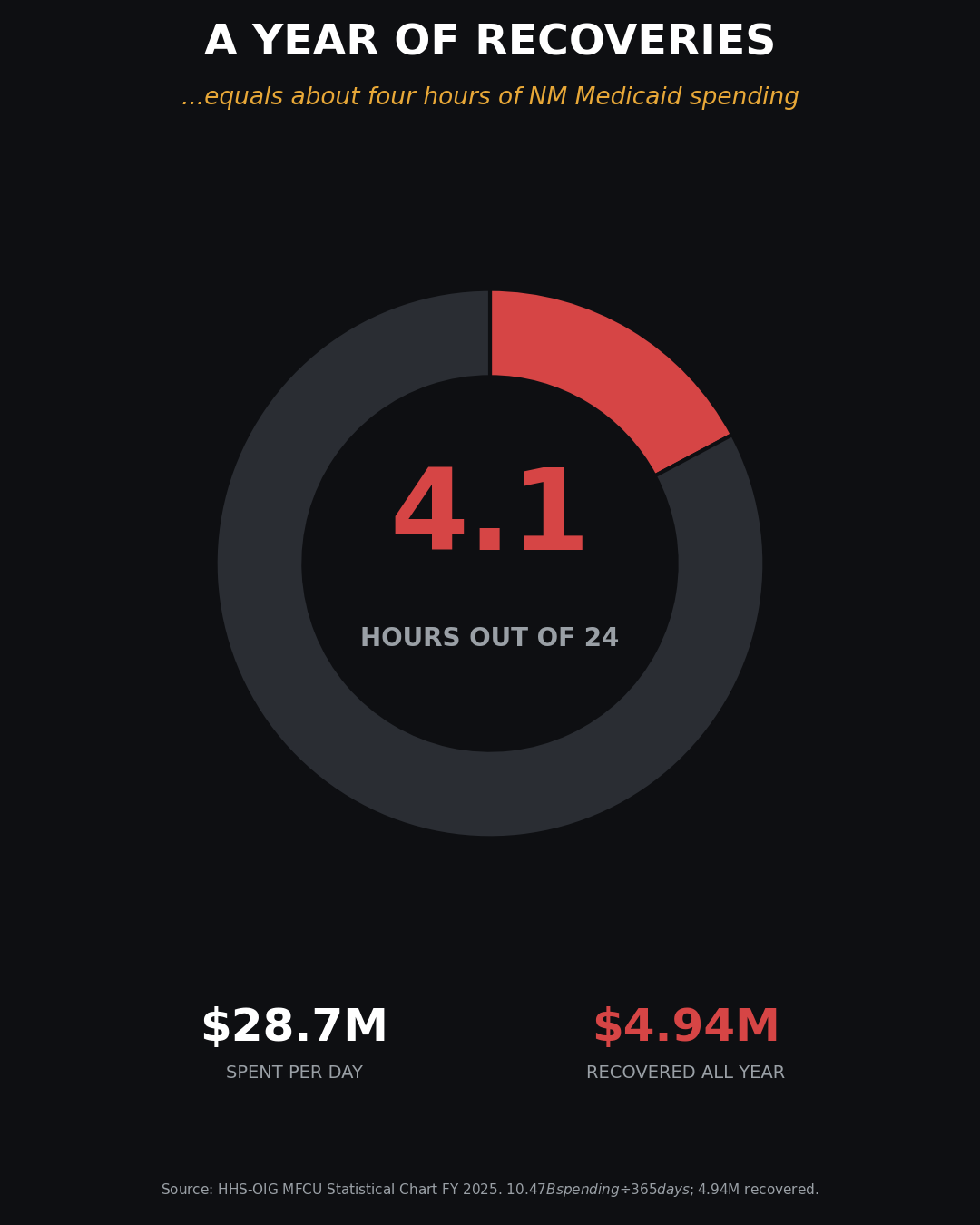
New Mexico spent $10.47 billion on Medicaid in federal fiscal year 2025, according to the HHS Office of Inspector General. That's about $28.7 million a day.
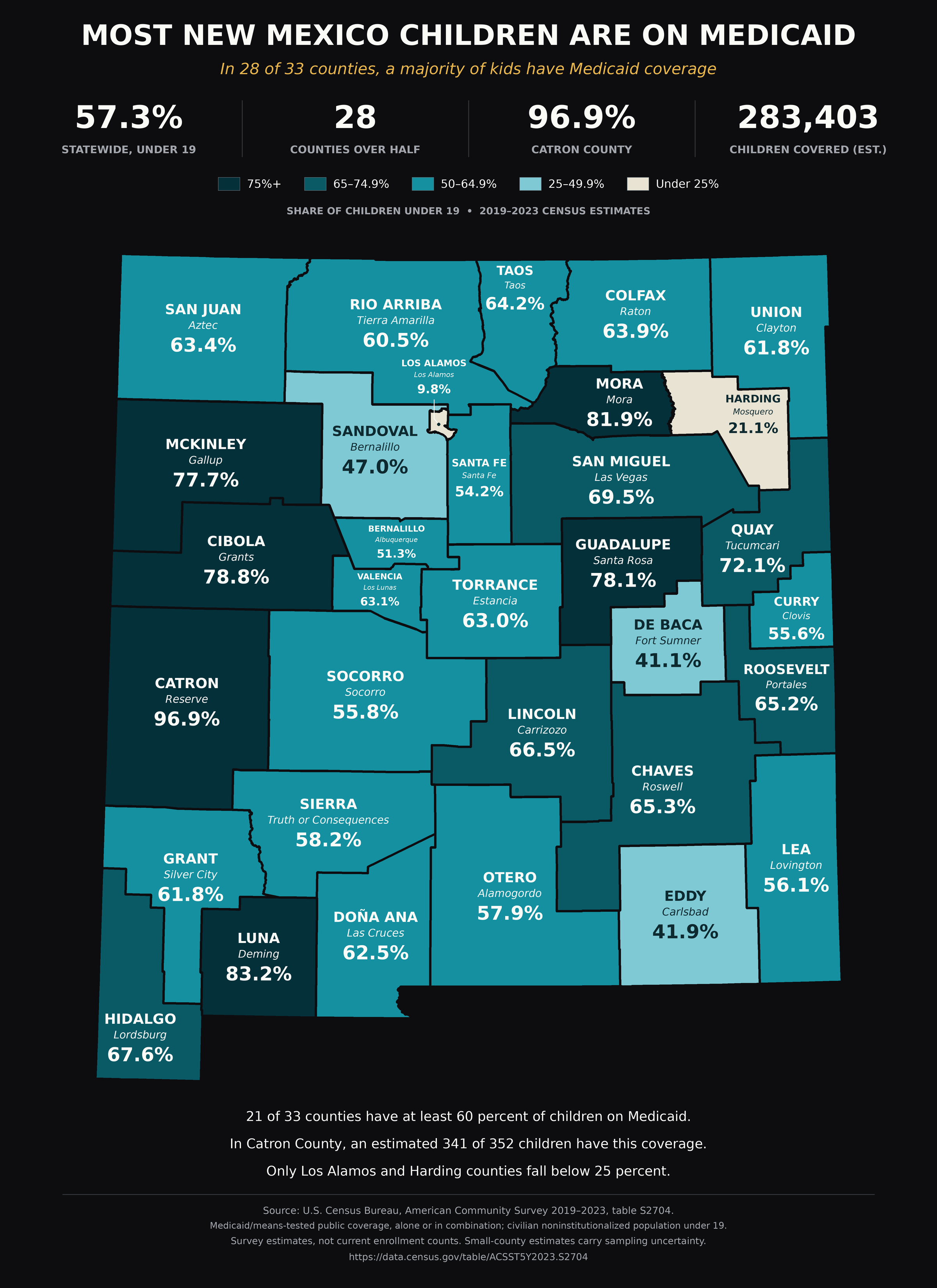
No state covers a bigger share of its people. Legislative analysts have called it the largest Medicaid program per capita in the country. Among children, 57.3 percent of New Mexicans under 19 are covered by Medicaid or similar public insurance. In 28 of 33 counties, most kids are on it.
When this much money moves through one system, some of it gets stolen. That's true in every state. What matters is how much of it gets caught.
The funnel
Every state has a Medicaid Fraud Control Unit. In New Mexico, it sits in the Attorney General's office. The unit investigates providers who bill for care they never gave, pad their claims or pay kickbacks.
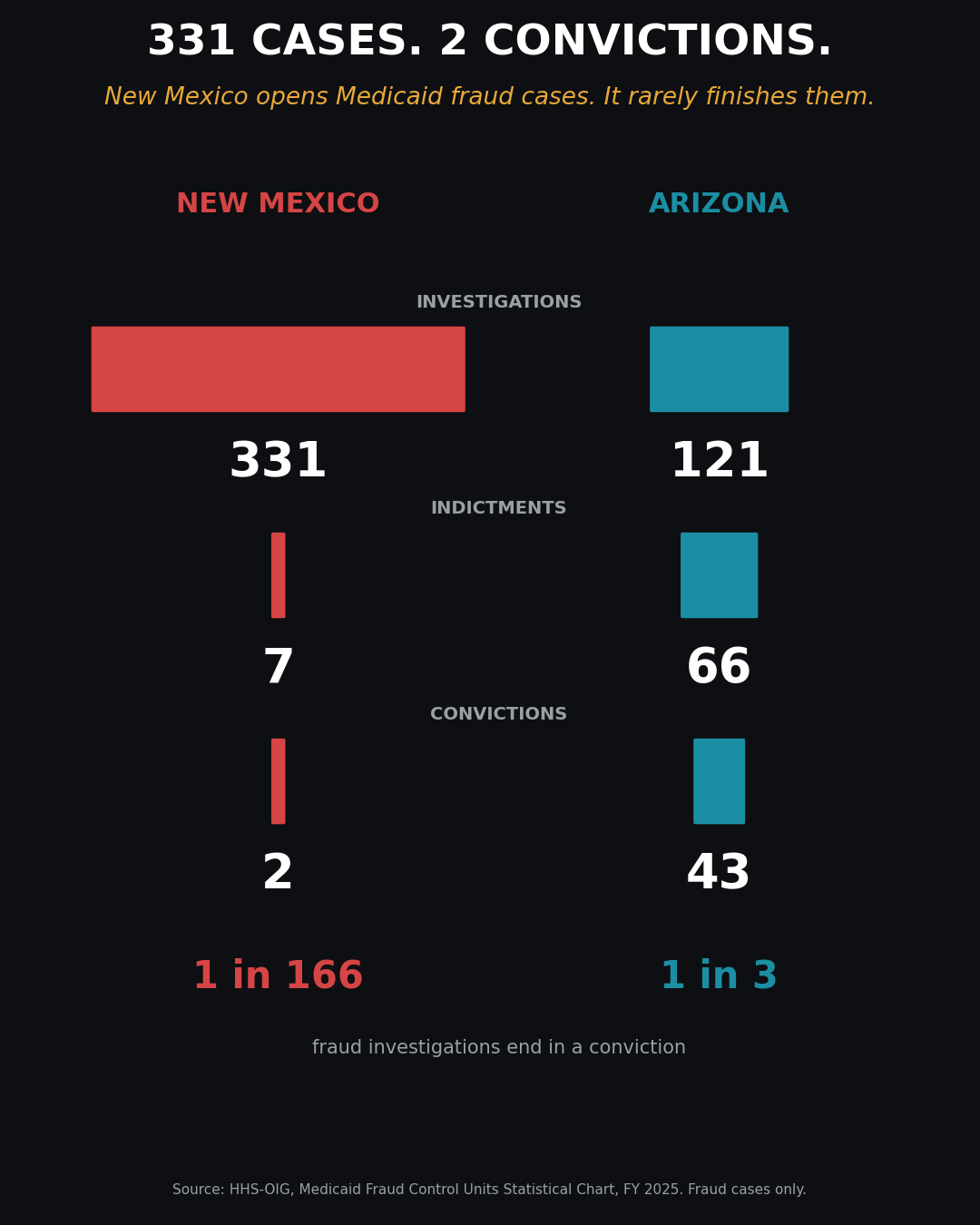
In FY2025, the New Mexico unit opened 331 fraud investigations. That's more than twice the national rate per dollar spent, so the unit is busy.
Here is where those cases ended up:
- 331 fraud investigations
- 7 fraud indictments
- 2 fraud convictions
That's 1 conviction for every 165 investigations. Nationally, about 1 in 15 fraud investigations ends in a conviction. New Mexico ranked 50th of 53 fraud units.
Next door, Arizona opened 121 fraud investigations and won 43 fraud convictions, about 1 in 3.
The four-hour year
New Mexico's fraud unit recovered $4.94 million in FY2025, counting criminal and civil cases together.
Stack that against daily spending ($28.7M/day) and a full year of recoveries equals about four hours of New Mexico Medicaid spending.
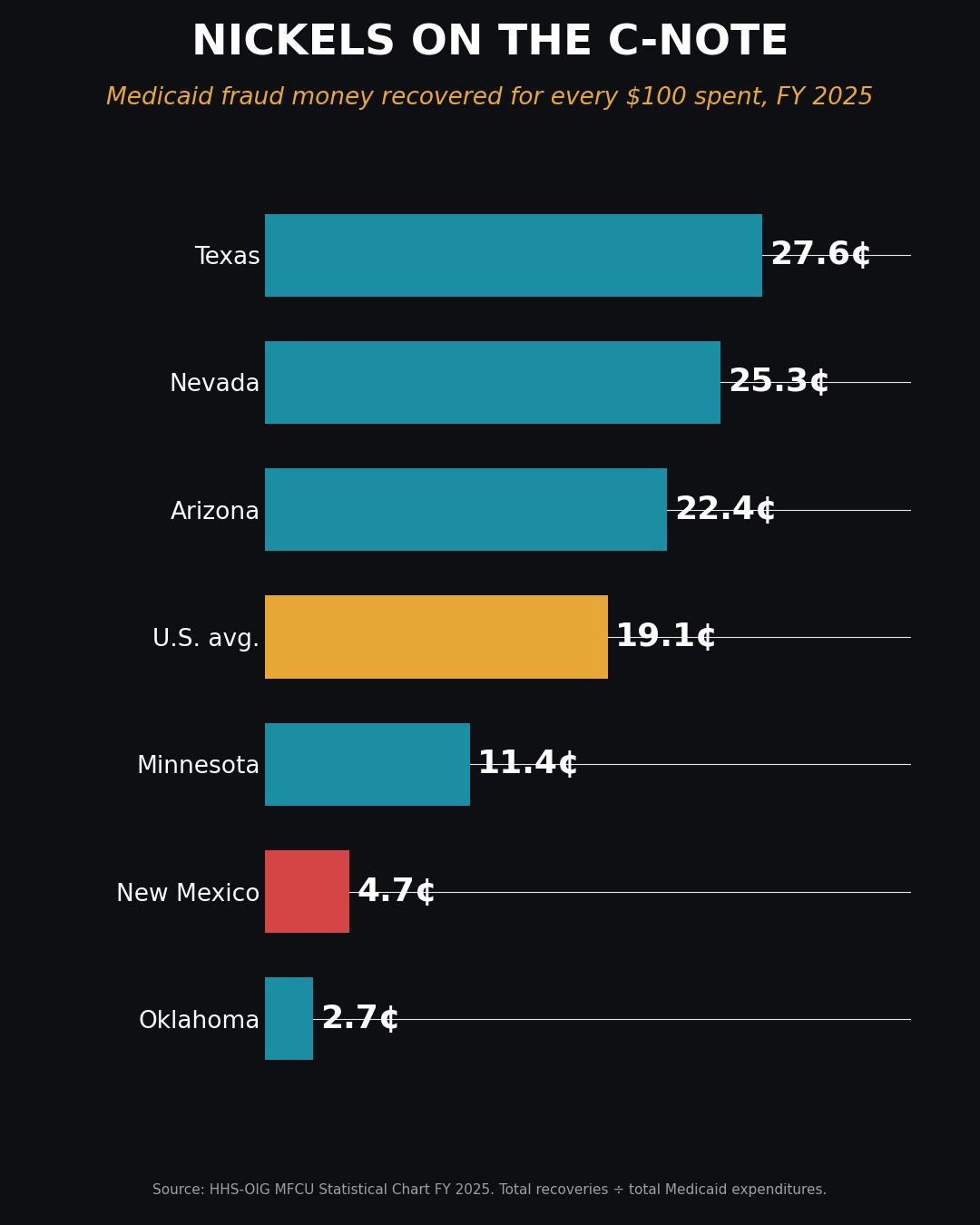
Put another way, for every $100 New Mexico spends on Medicaid, fraud enforcement brings back about 5 cents. The national average is 19 cents. Arizona gets back 22 cents and Texas 28.
Criminal recoveries, the money clawed back from people actually convicted, totaled $38,278 for the entire year. That's about the price of a new pickup truck, taken out of a $10.5 billion program.
The unit itself cost $4.33 million to run. It returned $1.14 for every dollar spent on it. Nationally, fraud units return $4.64.
The errors nobody calls fraud
A separate federal audit, the CMS error-rate study, estimates New Mexico made about $240 million in improper Medicaid payments, an error rate of 3.7 percent.
Not every improper payment is fraud. Many are paperwork failures. But the gap stands out: roughly $240 million in estimated bad payments against $4.9 million recovered by fraud enforcement.
It fits a pattern. In 2024, federal auditors found the state had failed to recoup $168.6 million it overpaid to its Medicaid managed-care companies. The state later covered that money in the budget instead of clawing it back. A 2019 federal review found the state wasn't independently checking the overpayment figures those companies reported. And in 2011, the Legislative Finance Committee called New Mexico's fraud oversight "fragmented" and said the state got a "poor return on its investment."
What happened next door
Arizona is the warning. Starting around 2019, fake sober-living homes recruited Native Americans, often straight off reservations, and billed Arizona Medicaid for treatment they never provided. Some billed more than $8,000 per patient per day. The losses are estimated at $2.8 billion. People died.
The same populations live on the New Mexico side of the line. McKinley, San Juan and Cibola counties combine heavy Medicaid enrollment with some of the highest poverty in the state. Child Medicaid coverage runs 77.7 percent in McKinley and 78.8 percent in Cibola.
Minnesota shows how fast it can happen. A housing program budgeted at about $2.5 million a year cost more than $104 million by 2024 before the state shut it down. Federal prosecutors have charged dozens of people in Minnesota autism and housing schemes.
Neither state caught its fraud early. Both were caught by outsiders.
What the numbers don't say
Low recoveries can mean two things: there's little fraud to find, or the state isn't finding it. The data alone can't prove which.
New Mexico isn't dead last on every measure. Oklahoma recovers less per dollar, and the median state isn't far ahead. One big case can swing a small state's totals from year to year.
New Mexico also has a history of getting this wrong in the other direction. In 2013, the state froze payments to 15 behavioral health providers over "credible allegations of fraud." The Attorney General later cleared them, and the state paid settlements.
But consider what New Mexico brings to the table: the largest per-capita program in America, a neighbor that just lost billions, documented failures to recover overpayments, and a fraud unit that turned 331 investigations into two convictions. Believing the problem is small takes a lot of faith.
The Vance task force is asking states to prove they're protecting Medicaid dollars. Going by the federal data, New Mexico would have a hard time making that case.
Where the numbers come from
- HHS-OIG, Medicaid Fraud Control Units Statistical Chart, FY 2025: investigations, indictments, convictions, recoveries, unit costs and total Medicaid expenditures for all 53 units (50 states, DC, Puerto Rico, U.S. Virgin Islands).
- CMS, 2025 PERM Medicaid Improper Payment Rates: New Mexico 3.7% (confidence interval 1.2%–6.2%).
- U.S. Census Bureau, ACS 2019–2023, table S2704: child Medicaid coverage by county.
- HHS-OIG audit (May 2024), LFC reports (2011, 2023), CMS program integrity review (2019).
The math
- Daily spending: $10,469,835,269 ÷ 365 = $28.7 million
- Recoveries in hours: $4,939,985 ÷ $28.7M × 24 = 4.1 hours
- Cents per $100: $4,939,985 ÷ $10,469,835,269 × $100 = 4.7 cents (national: 19.1 cents)
- Conviction rate: 2 ÷ 331 = 0.6%, or 1 in 165 (national: 6.6%)
- Return on the unit's cost: $4,939,985 ÷ $4,327,657 = $1.14 (national: $4.64)
- At the national recovery rate, New Mexico would have recovered about $20 million, roughly $15 million more than it did.
Limits
- Improper payments are not the same as fraud.
- These are one-year figures, and a single large case can move a small state's totals.
- The national average is pulled up by large settlements in big states. The median state recovers about 5.1 cents per $100.
- County Medicaid figures are survey estimates with sampling error, especially in small counties.
Endnotes
- HHS Office of Inspector General, "Medicaid Fraud Control Units Annual Report: Fiscal Year 2025," and FY2025 MFCU Statistical Chart (Excel), March 2026. Linkoig.hhs
- The White House, "Establishing the Task Force to Eliminate Fraud," March 16, 2026. Linkwhitehouse
- Georgetown University Center for Children and Families, "The White House Task Force to Eliminate Fraud: What's at Stake for Medicaid," March 27, 2026. Linkccf.georgetown
- The Wall Street Journal, "Vance to States: Address Fraud or Lose Federal Medicaid Funding," May 13, 2026. Linkwsj
- Centers for Medicare & Medicaid Services, "2025 PERM Medicaid Improper Payment Rates." Link
- HHS Office of Inspector General, "New Mexico Should Refund Almost $120 Million to the Federal Government for Medicaid Nursing Facility Level of Care Managed Care Capitated Payments," May 2024. Link
- CMS, "New Mexico FY2019 Program Integrity Review, Focused Report." Link
- New Mexico Legislative Finance Committee, "Progress Report: Medicaid Fraud and Abuse Control," July 2013, following up on its July 2011 evaluation. Link
- Rio Grande Foundation, "A decade in, LFC Medicaid report highlights program failures," January 2023 (on the LFC's per-capita and spending figures). Link
- U.S. Census Bureau, American Community Survey 2019–2023 5-year estimates, Table S2704. Link
- Native News Online, "42 Arrested in Arizona Sober Living Home Fraud Targeting Native Americans," June 2026. Linkcms
- Arizona Center for Investigative Reporting, "Medicaid fraud targeting Indigenous communities continues," February 26, 2026. Link
- NBC News, "Minnesota autism, disabled services providers among 15 charged," May 21, 2026. Link
- U.S. Attorney's Office, District of Minnesota, "Six Additional Defendants Charged, One Defendant Pleads Guilty in Ongoing Fraud Schemes," December 18, 2025. Link
- NM Political Report, "State settles with five more behavioral health providers over 2013 funding freeze," December 4, 2019. Linkoig.hhs
- Author's calculations from the FY2025 MFCU Statistical Chart: daily spending, hours of recoveries, cents per $100, conviction rate, return on unit cost and the recovery gap. Full math is in the "Where the numbers come from" box.


