

America’s official poverty rate has fallen to its lowest recorded level. New Mexico’s map still looks like a warning label.
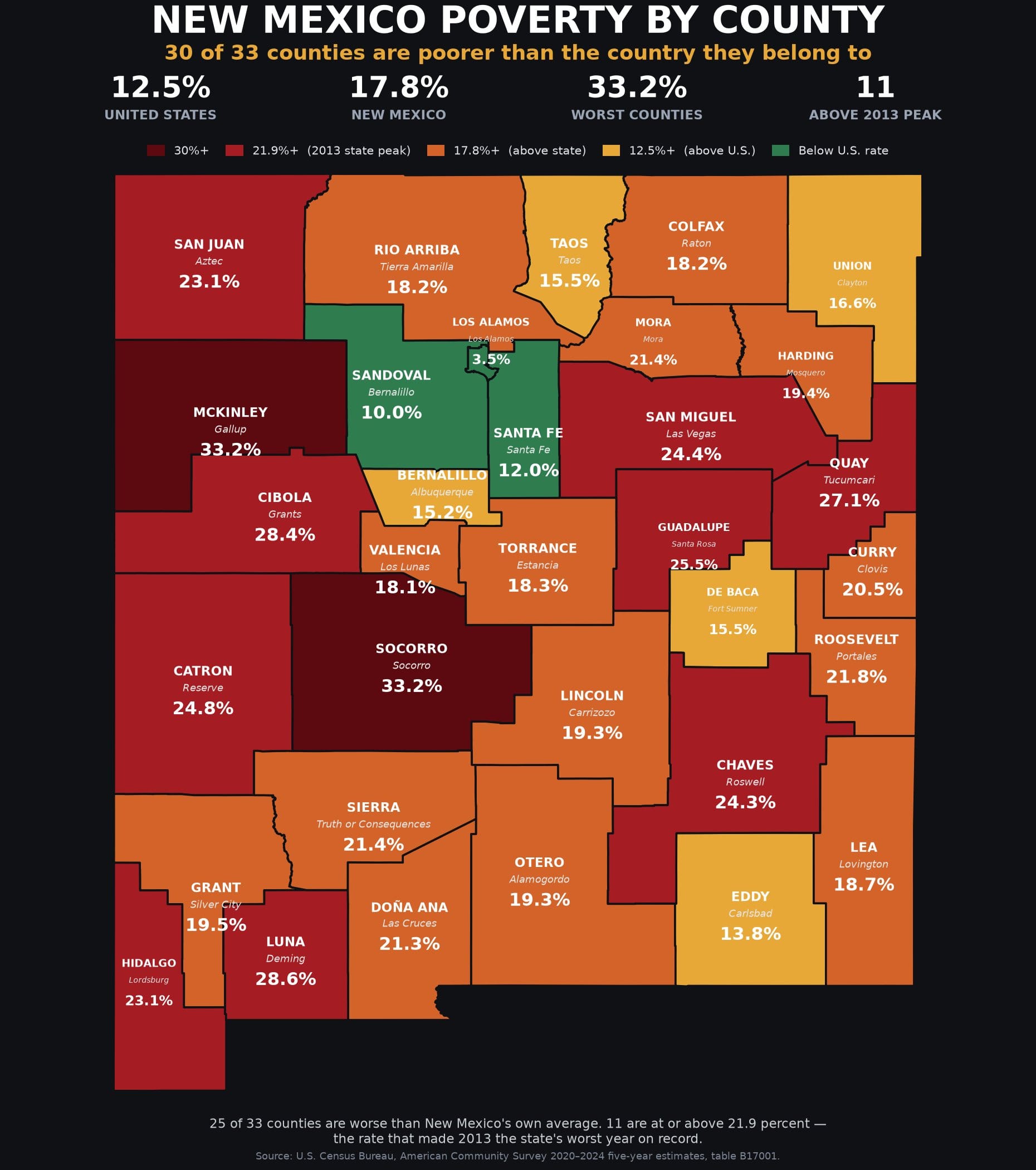
The U.S. official poverty rate fell to 10.2 percent in 2025—the lowest rate in the Census Bureau’s historical series. But Census data covering 2020 through 2024 show that 30 of New Mexico’s 33 counties had poverty rates above the national rate in the same American Community Survey data.
That is not a one-county problem. It is not a bad neighborhood problem. It is a statewide failure with a county-by-county footprint.
New Mexico can point to programs. It can point to funding increases. It can point to tax credits, rebates, task forces, press releases, pilot projects and occasional improvements in a single year.
But residents do not live inside a press release.
They live inside rent bills, grocery bills, long drives for care, child-care shortages, unreliable transportation, schools struggling to keep children on track, jobs that do not always cover the cost of raising a family, and emergency expenses that can turn one bad month into a crisis.
So the central question is simple:
If the country is progressing, why is New Mexico still so far behind?
The gap is the story
The country’s 10.2 percent official poverty figure and New Mexico’s county map are not the same Census series. The national 2025 number is the Census Bureau’s annual official-poverty measure; the county map uses 2020–2024 American Community Survey five-year estimates. That distinction matters, and it should be stated plainly.
But it is not an escape hatch.
The apples-to-apples county comparison is clear: the national ACS poverty rate was 12.5 percent in the 2020–2024 data used for the county map. Thirty of New Mexico’s 33 counties exceeded it.
That is the uncomfortable fact no political talking point can erase.
A state can show improvement and still be failing to close the gap. A rate can dip after a tax credit, a refund, a rebate or another temporary income boost and still leave the underlying conditions untouched. Families may get breathing room—and that matters—but breathing room is not the same as an exit ramp.
The question is not whether a state program helped someone buy groceries this month. The question is whether New Mexico has built a system that allows families to need emergency help less often next year.
The map is a report card
Poverty is not a moral failure by the people living in it.
It is not the fault of the mother stretching food until payday. It is not the fault of the worker trying to balance fuel, rent, child care and a medical bill. It is not the fault of a child growing up in a county where poverty is normal enough to become background noise.
The failure belongs higher up.
Governors set the executive agenda, appoint agency leadership, propose budgets and decide what outcomes matter. The Democratic majorities that have controlled Santa Fe’s legislative agenda decide what gets funded, expanded, changed or left alone. New Mexico’s federal delegation votes on national policy, advocates for federal resources and has the platform to demand better from the systems receiving those resources.
They do not control every decision in every household. Nobody serious is claiming that.
But they do control the policies, budgets, incentives and institutions that are supposed to give New Mexicans a path out of poverty. They claim credit when money arrives, programs expand or benefits go out. They cannot disappear when the statewide results remain stubbornly bad.
New Mexico’s own Legislative Finance Committee made the problem plain in a 2023 review: the state had remained among the nation’s poorest for decades, while agencies often failed to measure whether major income-support programs actually produced the intended outcome—reducing poverty and helping families become self-sufficient.
That should have been a five-alarm fire.
Instead, New Mexicans are still being asked to accept activity as achievement.
Stop grading effort
New Mexicans should no longer be asked to grade leaders on effort.
“Funds were appropriated” is not a result.
“More people enrolled” is not a result.
“A new office opened” is not a result.
“A task force met” is not a result.
The result is whether a child in Gallup, Grants, Las Vegas, Reserve, Roswell or rural eastern New Mexico has a better chance to finish school, find stable work, afford housing, get treatment when needed and raise a family without repeating the same poverty map.
That is the standard.
If a policy works, show the durable county-level improvement. If it does not, change course. If leaders cannot explain why 30 of 33 counties remain above the national benchmark, they should not be allowed to hide behind jurisdictional arguments, temporary statistical improvements or the size of the next appropriation.
The country is moving.
New Mexico’s leaders need to explain why so much of their state remains standing still.
Endnotes
- U.S. Census Bureau, Poverty in the United States: 2025. The Census Bureau reported an official poverty rate of 10.2 percent, or 34.5 million people, in 2025—the lowest rate in its historical official-poverty series. www2.census
- U.S. Census Bureau, Poverty in States and Metropolitan Areas: 2024, American Community Survey Briefs. The ACS provides a separate annual and multi-year survey-based poverty series used for state and county comparisons. census
- New Mexico Legislative Finance Committee, Progress Report: Costs and Stacking of Income Supports, December 2023. The report said New Mexico had persistently ranked among the nation’s poorest states and raised concerns about the absence or weakness of outcome measures for major income-support programs. nmlegis


