

New Mexico does not need California or Minnesota to understand what a public-benefits accountability problem looks like. The state already has its own record of federal audit findings, legislative warnings, weak recovery numbers, and unresolved control failures sitting in plain view.
The story begins with a simple question: how does a state move billions of public dollars through Medicaid and food assistance programs, receive repeated warnings from federal auditors and its own legislative watchdogs, and still leave so many obvious weaknesses in place?
This is not a story about one crooked provider or one mistaken payment. It is a story about a system that kept getting told where the holes were and too often responded with delay, partial fixes, soft public messaging, or arguments about process while the money kept moving.
That distinction is important. Big public programs will always have some waste, some error, and some abuse. The public test is not whether problems appear. The public test is whether leaders build a structure strong enough to detect them early, recover money when it is owed, refer suspicious activity quickly, and fix weaknesses before Washington does it for them.
On that test, New Mexico’s recent paper trail is hard to defend.
The warning shot
If one document should have jolted the Roundhouse and every taxpayer in the state, it was the 2024 audit from the U.S. Department of Health and Human Services Office of Inspector General.
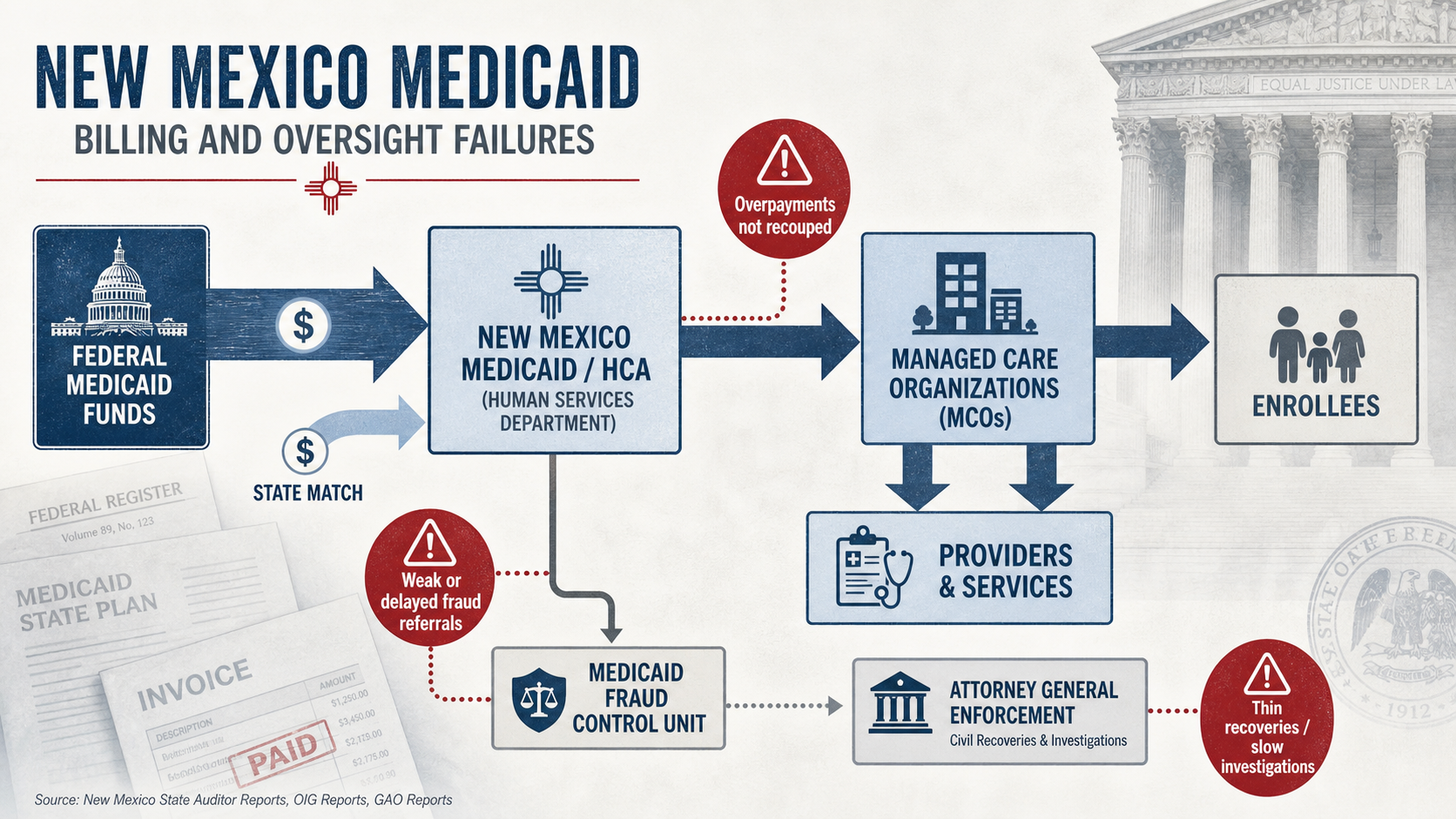
That audit concluded New Mexico should refund nearly $120 million to the federal government over Medicaid nursing-facility level-of-care and Community Benefit managed-care capitation payments. The finding was not vague. Federal auditors said New Mexico performed required reconciliations, identified overpayments, and then did not recoup the money from its managed care organizations the way the contracts contemplated.
In plain English, the state found the overpayments and still did not claw them back.
The total overpayment identified by the audit was even larger than the federal refund recommendation. According to the audit, New Mexico overpaid managed care organizations by about $168.6 million, with roughly $119.1 million representing the federal share recommended for refund. Those are not rounding errors. Those are major accountability failures inside one of the most expensive parts of state government.
What came next made the story worse, not better.
According to the audit record, New Mexico argued it had developed an alternative approach that met the “spirit of compliance” even though it had not followed the recoupment process outlined in its own contracts. Federal auditors rejected that defense and stood by their findings. Even after the report was issued, major recommendations remained open and unimplemented.
That should raise a larger question than whether the state can win a technical argument with Washington. Why was New Mexico more comfortable defending a softer approach than recovering money that federal auditors said should have been recovered?
Where the structure broke
The overpayment story is serious enough by itself. But it becomes far more revealing once it is placed inside the wider oversight structure that surrounded it.
New Mexico did not simply miss a number on a spreadsheet. It was operating inside a system where enormous sums flowed through managed care organizations while the fraud-detection and referral machinery remained weaker than it should have been.
A 2021 federal review of the New Mexico Medicaid Fraud Control Unit found low case outcomes compared with similarly sized units, heavy staff turnover, long investigative delays, and one especially striking fact: managed care organizations made zero fraud referrals to the unit during fiscal years 2017 through 2019.
Zero.
That number deserves to be read twice because managed care organizations sit close to the money. They process claims, administer benefits, and occupy the part of the pipeline where unusual billing patterns and questionable practices can often be seen first. If fraud concerns are not moving efficiently from that level into the law-enforcement pipeline, the state loses one of the clearest early-warning functions in the system.
Federal reviewers did not leave much mystery about why that happened. The memorandum of understanding between the state Medicaid agency and the Medicaid Fraud Control Unit lacked procedures for managed care referrals, and the review found that weak referral quality and investigative delays were directly affecting outcomes.
The 2022 Legislative Finance Committee progress report reinforced the same problem from the state side. It said the existing structure still did not include a mechanism for managed care organizations to refer suspected fraud directly to the Medicaid Fraud Control Unit and warned that routing those referrals through the agency could create delays that made full investigations difficult or impossible to complete within the statute of limitations.
That is not a paperwork quirk. That is structural weakness.
When billions of dollars pass through private contractors handling state Medicaid work, and the state’s own framework slows or blocks the quickest route for suspected fraud to reach investigators, the public does not have an enforcement system built for speed. It has an enforcement system built for drag.
Thin returns, large exposure
An office can exist on paper and still underperform in practice. A hotline can exist. A unit can exist. A fraud bureau can exist. None of that proves the system is producing meaningful protection for the public.
The more recent performance data make that problem difficult to ignore.
The 2025 Medicaid Fraud Control Units annual report, along with later New Mexico legislative material summarized in the recent dossier, showed the state’s fraud-control unit carrying hundreds of open investigations while producing very modest fraud-conviction and recovery numbers relative to the scale of the Medicaid program. New Mexico’s Medicaid program involved more than $10 billion in expenditures, yet the fraud-control outcomes described in the record remained thin enough to invite obvious questions about efficiency, prioritization, and return on enforcement effort.
That record also fits a broader pattern identified by both federal and state oversight documents. The weakness was not explained solely by one bad year or one staffing dip. The story included staff turnover, outdated statutory structure, poor referral pathways, limited recoveries, and prolonged delays in making the system line up with federal expectations.
The Legislative Finance Committee’s 2022 report added another damaging detail: New Mexico’s failure to align its False Claims Act framework with federal standards had already cost the state an estimated $4.7 million in forgone recoveries since federal fiscal year 2011. In other words, weak enforcement design was not just slowing cases down. It was costing the state money even when fraud recovery mechanisms should have been stronger.
That is the kind of failure that does not show up in a ribbon-cutting or a campaign mailer. It shows up later, when the public discovers the state built a system that did not just miss fraud fast enough, but also left money on the table by refusing to modernize the legal tools meant to recover it.
SNAP tells a second story
If Medicaid supplies one warning track, the Supplemental Nutrition Assistance Program supplies another.
In January 2026, the Legislative Finance Committee released an update showing New Mexico’s SNAP payment error rate had worsened dramatically over the last decade. The state ranked fifth highest in the nation in federal fiscal year 2024, and by the first quarter of federal fiscal year 2025, the rate had climbed even higher. The report warned that New Mexico could face additional state costs of up to about $173 million if the rate was not lowered in time under the new federal rules.
Precision matters here. Error rate is not the same thing as proven fraud. The Legislative Finance Committee was careful about that distinction, and the article should be too.
Still, a persistently high error rate in a billion-dollar program is not harmless. It points to weak verification, weak documentation, poor administrative follow-through, or some combination of all three. It means money is being awarded incorrectly often enough to place New Mexico among the worst-performing states in the country on this measure.
The same report also showed remarkably few criminal charges for unlawful SNAP use or dealing over a span of several years. That does not prove hidden fraud everywhere. It does, however, support an uncomfortable public question: was the state detecting and pursuing abuse aggressively enough in a program of this size?
The answer is not obvious from the numbers. What is obvious is that New Mexico was not operating a crisp, high-confidence system.
Federal data sharpened the point further. The official SNAP quality-control report for fiscal year 2024 confirmed New Mexico’s 14.61 percent payment error rate, placing it fifth worst nationally and well above the national average. That federal certification stripped away any temptation to dismiss the issue as partisan spin. New Mexico’s own watchdog had raised the alarm, and the federal numbers backed it up.
The politics of delayed repair
One of the clearest patterns in the record is not merely that New Mexico made corrections. It is that the corrections often arrived after the warning lights were already flashing.
In April 2026, the New Mexico Health Care Authority announced changes requiring SNAP applicants to provide documentation for shelter, utility, and dependent-care expenses starting May 1. The public-facing message framed the move as helping families receive the correct benefit amount. On its face, that sounds harmless enough.
Placed beside the legislative findings, though, the timing tells a different story.
By then, New Mexico had already been identified as one of the worst states in the country on SNAP payment error rate, and the state was facing substantial financial consequences if it did not improve. The policy shift therefore looks less like routine customer service and more like delayed corrective action under pressure.
The same contrast appears elsewhere in the benefits record. Public messaging often sounds calm, incremental, and administrative. The underlying documents are blunter. They speak of overpayments not recouped, open recommendations, delays in investigation, missing referral pathways, deteriorating error rates, and weak recoveries.
That mismatch matters because it shapes how long the public remains in the dark about the seriousness of the underlying problem.
New Mexicans can handle bad news. What they should not accept is polished language standing in for timely accountability.
A state that kept getting told
The most important point in this story is not that New Mexico’s public-benefits system has risk. Every state has risk.
The central point is that New Mexico kept getting told where its vulnerabilities were.
It was told by federal auditors that major Medicaid overpayments should be recouped and refunded.
It was told by federal reviewers that the fraud-control pipeline was weakened by delays, turnover, and poor referral structure.
It was told by state legislative evaluators that the managed-care referral pathway remained deficient and that the state’s fraud-recovery tools were not keeping pace with federal standards.
It was told by state and federal data that SNAP administration had drifted into one of the worst error-rate profiles in the country.
And after all of that, too much of the system still looks reactive rather than disciplined.
That is why this is more than a bureaucratic story. It is a story about governing habits. It is a story about whether state leaders treat oversight as a real obligation or as an annoyance to be managed with softer language and slower action. It is a story about whether New Mexico intends to run large public-benefit programs with enough rigor to protect honest recipients and taxpayers at the same time.
For years, the state’s answer has looked incomplete.
Part 2 turns to the other side of the same system: immigration-status verification, the reasonable-opportunity window, SAVE limitations, delayed implementation of new federal rules, state-funded substitutions, and the growing collision between New Mexico’s access-oriented structure and Washington’s harder enforcement posture.
Endnotes
-
HHS-OIG, “New Mexico Should Refund Almost $120 Million to the Federal Government for Medicaid Nursing Facility Level-of-Care Managed Care Capitated Payments”
https://oig.hhs.gov/reports/all/2024/new-mexico-should-refund-almost-120-million-to-the-federal-government-for-medicaid-nursing-facility-level-of-care-managed-care-capitated-payments/ oig.hhs -
HHS-OIG, “New Mexico Medicaid Fraud Control Unit: 2020 Review”
https://oig.hhs.gov/reports/all/2021/new-mexico-medicaid-fraud-control-unit-2020-review/ oig.hhs -
New Mexico Legislative Finance Committee, “Progress Report – Medicaid Fraud Recovery”
https://www.nmlegis.gov/Entity/LFC/Documents/Program_Evaluation_Reports/Progress Report - Medicaid Fraud Recovery.pdf ppl-ai-file-upload.s3.amazonaws -
HHS-OIG, “New Mexico Did Not Ensure Attendants Were Qualified To Provide Personal Care Services, Putting Medicaid Enrollees at Risk”
https://oig.hhs.gov/reports/all/2024/new-mexico-did-not-ensure-attendants-were-qualified-to-provide-personal-care-services-putting-medicaid-enrollees-at-risk/ oig.hhs -
New Mexico Legislative Finance Committee, “Status Update on LFC Program Evaluation of SNAP Administration and Performance”
https://www.nmlegis.gov/Entity/LFC/Documents/Program_Evaluation_Reports/Program Evaluation Update SNAP admin performance.pdf nmlegis -
USDA Food and Nutrition Service, “Fiscal Year 2024 SNAP Quality Control Payment Error Rates”
https://fns-prod.azureedge.us/sites/default/files/resource-files/snap-fy24QC-PER.pdf ppl-ai-file-upload.s3.amazonaws -
CMS, “2025 Medicaid & CHIP Supplemental Improper Payment Data”
https://www.cms.gov/files/document/2025-medicaid-chip-supplemental-improper-payment-data.pdf ppl-ai-file-upload.s3.amazonaws -
CMS, “Managed Care Fraud Referral Toolkit”
https://www.cms.gov/files/document/managed-care-fraud-referral.pdf ppl-ai-file-upload.s3.amazonaws -
HHS-OIG, “Medicaid Fraud Control Units Annual Report: Fiscal Year 2025”
https://oig.hhs.gov/reports/all/2026/medicaid-fraud-control-units-annual-report-fiscal-year-2025/ ppl-ai-file-upload.s3.amazonaws -
New Mexico Health Care Authority, “State Strengthens SNAP Process to Help Families”
https://www.hca.nm.gov/2026/04/16/state-strengthens-snap-process-to-help-families/ hca.nm -
New Mexico Health Care Authority, “New Federal SNAP Rules Prompt State-Funded Food Assistance”
https://www.hca.nm.gov/2026/02/04/new-federal-snap-rules-prompt-state-funded-food-assistance/ ppl-ai-file-upload.s3.amazonaws


