

New Mexico has the raw materials to become the most important state in America's AI buildout — energy, water, nuclear supply chain, and sunlight — yet the state's leadership keeps treating a generational opportunity like a zoning dispute. This piece is a companion to our earlier article, "A Leader's Blueprint for AI Growth in New Mexico," which argued the state needs leverage, not fear. Here's what that leverage actually looks like once you get past the press conferences and into the engineering.
What the Public Hears vs. What's Actually Happening
The mainstream narrative goes something like this: Big Tech shows up, drains the aquifers, chokes the power grid, and leaves counties holding the bag. That narrative isn't fabricated — it's just incomplete. State Reps. Cadena and Rubio, along with Rep. Chávez and Sen. Hamblen, are pushing a statewide moratorium bill directly in response to Project Jupiter, the $165 billion Oracle-OpenAI data center campus in Doña Ana County that became a lightning rod for transparency complaints.¹
What rarely makes the segment is that Oracle already responded to the backlash. In mid-2026, the company scrapped its original natural gas turbine plan for Project Jupiter and switched to Bloom Energy fuel cells, cutting projected emissions by roughly 92 percent and requiring only a minimal water fill rather than continuous consumption.² That's not a hypothetical fix — it's an example of the market correcting itself under public pressure, and it undercuts the idea that a blanket pause is the only tool available.
New Mexico's Actual Resource Inventory
If you strip away the politics and just look at the numbers, New Mexico has almost everything a hyperscale AI buildout needs sitting inside its own borders.
- Oil and gas revenue at scale. New Mexico is the nation's second-largest oil producer, and that industry has generated enough surplus that the governor is currently proposing $250 rebate checks to residents from a projected $825 million windfall.³
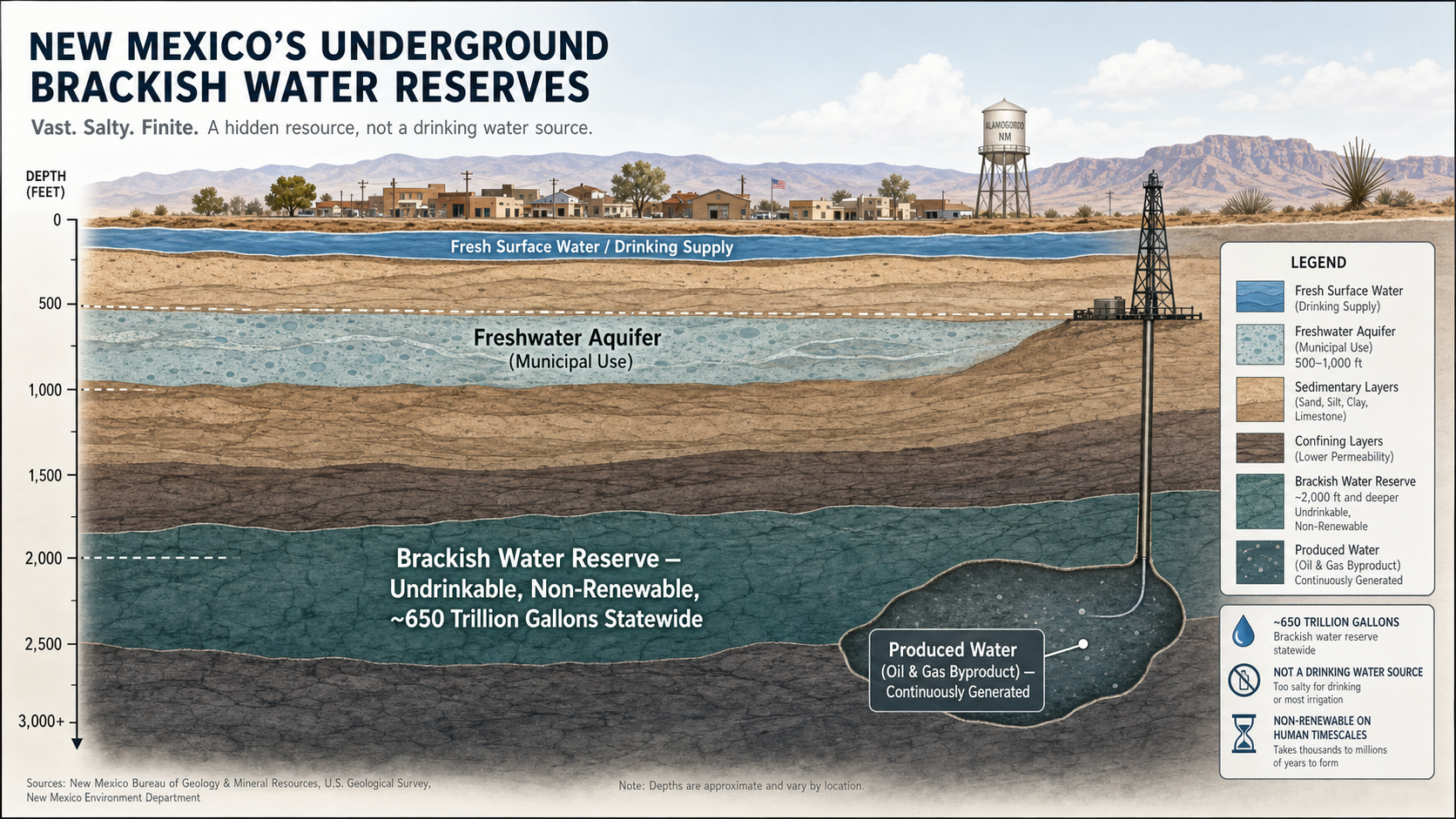
- Decades of brackish water in reserve. State geological surveys estimate the brackish aquifers beneath New Mexico hold roughly 650 trillion gallons, concentrated in basins like the Tularosa and the Roswell Artesian Basin, sitting mostly below 2,500 feet and completely unusable for drinking or farming.⁴
- A produced-water stream that outlasts the oil itself. Oilfield wastewater generation already exceeds 2 billion barrels a year in New Mexico, with most of it simply injected back underground for disposal. That volume will keep flowing roughly as long as Permian Basin production continues, which most industry timelines put at well over a century.⁵
- Year-round solar potential, for anyone who wants the green-grid argument alongside everything else.
- A domestic nuclear supply chain already under construction. Kairos Power broke ground on its Hermes 2 demonstration reactor in June 2026, fabricating components at its Albuquerque manufacturing campus before shipping them for assembly. Separately, Oklo announced a partnership with Nvidia and Los Alamos National Laboratory in June 2026 to develop AI-focused advanced nuclear infrastructure, with its Aurora Powerhouse reactor targeting deployment as early as 2027.⁶ NM could be a global leader in Small Modular Reactors (SMR).
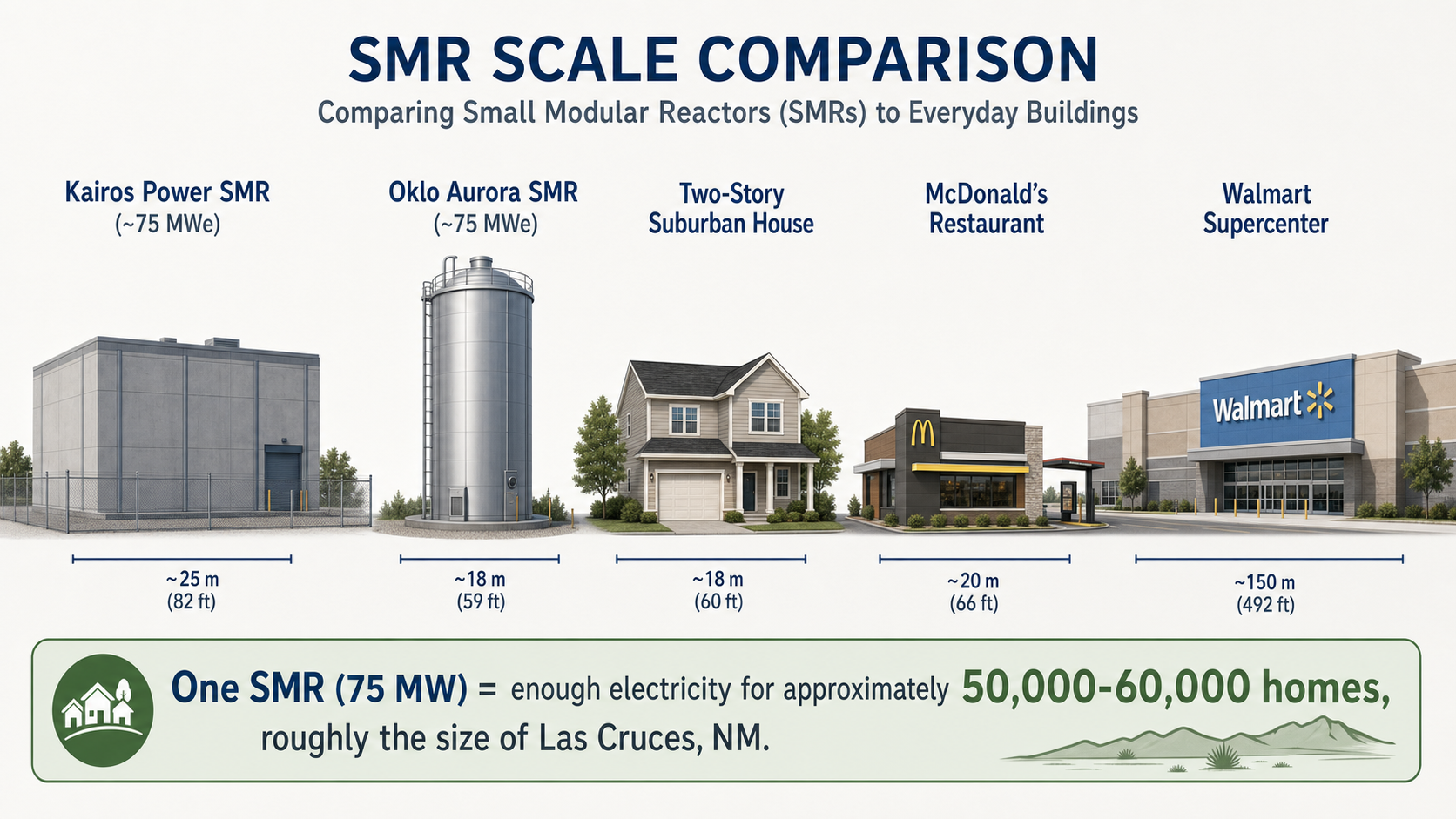
And consider this: in parts of NM, brackish groundwater occurs at depths that can include roughly 2,000 feet. If a site-specific hydrogeologic study shows that the source is sufficiently isolated from freshwater aquifers and existing water-right holders, a data center could potentially use it instead of potable water. The water would still require treatment, then used for the cooling-system.
That's not a sales pitch. That's a resource map most CEOs would kill for, and it makes the current hesitation look less like caution and more like an inventory nobody bothered to check.
What the State Actually Tried — Credit Where Due
New Mexico did not sit on its hands entirely, and the record deserves an honest accounting. The Strategic Water Supply Act, signed into law in April 2025, created a real legal and financial framework letting the state contract with private companies to build brackish water treatment infrastructure, with a public dashboard tracking progress toward a 100,000 acre-foot delivery goal by 2028.⁷ That's a genuine, funded, trackable effort — not a talking point.
Where it fell short is instructive. The original proposal asked for $500 million; it passed at $75 million, and the produced-water component — the larger, faster-replenishing resource — was stripped out entirely after environmental advocacy pressure over unresolved toxicity concerns.⁸ The state built half a bridge and let political pressure talk it out of finishing the more useful half.
Beyond that, some things haven't even been attempted. No state agency has issued a formal contract offer to a major water infrastructure company to build a dedicated industrial treatment plant tied to data center demand — the concept remains stuck in legislative handouts rather than procurement documents. And despite Kairos and Oklo both building real infrastructure inside state lines, no formal state policy exists connecting either company to a required transition plan for data center power. The tools are sitting on the workbench. Nobody picked them up.
The County-Level Split Tells the Real Story
If this were purely about water scarcity or grid capacity, you'd expect a consistent response across the state. Instead, you get a patchwork that tracks almost perfectly with local political posture rather than local resource stress.
Lea County, home to Hobbs, passed data center regulations in early 2026 requiring closed-loop cooling, behind-the-meter power generation, and PILOT payments benefiting local schools and hospitals — a negotiated yes, with real conditions attached.⁹ Chaves County approved a data center project south of Roswell in 2025 without a moratorium fight at all.¹⁰ Meanwhile, Socorro County passed a full one-year moratorium in June 2026 after backlash over an unproven developer's proposal, and Santa Fe County followed with an 18-month moratorium just days before this piece was written, lowering its review threshold to just one megawatt.¹¹
Two counties negotiated. Two counties froze. The difference isn't water tables or grid capacity — both exist statewide under the same physical constraints. The difference is whether local leadership chose to build a contract or reach for a pause button.
The Rebate Check vs. The Real Investment
Here's a comparison worth sitting with. The governor's proposed $250 rebate, drawn from the state's oil windfall, would cost roughly $250 million or more once distributed across a million-plus taxpayers.³ That money lands in bank accounts, gets spent on groceries and gas, and generates no lasting infrastructure. That same capital, directed differently, could seed a produced-water or brackish treatment facility, generate permanent construction and operations jobs, and create an industry New Mexico could own for decades. One option is a check. The other is a foundation. New Mexico currently chooses the check.
This isn't a knock on giving people relief — high gas prices are real and the impulse is understandable. It's a question of sequencing. A state that can afford to hand out windfall cash can also afford to seed infrastructure that pays dividends for thirty years instead of thirty days.
New Mexico Can Afford to Take Risks Most States Can't
Here's the part of this conversation that almost never gets said out loud: New Mexico is not a state that has to bet the farm to make a bold move. The state's Severance Tax Permanent Fund has grown from roughly $8.2 billion toward a projected $30 billion by 2035, built almost entirely on oil and gas royalties.¹² Combined with a persistent revenue windfall large enough to fund rebate checks with money left over, New Mexico occupies an unusual paradox: a state that ranks near the bottom nationally on poverty and unemployment, sitting on more discretionary capital than most of the states above it.¹³
That paradox should change how leadership thinks about risk. New Mexico's unemployment rate climbed to 4.9 percent in May 2026, up from 4.0 percent a year earlier, even as the state has been flush with oil and gas revenue for years.¹⁴ A November 2025 state report confirmed the obvious: the boom hasn't translated into broad prosperity or higher workforce participation.¹⁵ That's the real scandal in this story — not that a data center might use brackish water nobody can drink anyway, but that a resource-rich state keeps failing to convert windfalls into structural improvement.

The Real Failure Is a Leadership Failure
CEOs get paid enormous salaries for one reason: they're required to absorb uncertainty across regulatory risk, capital exposure, community trust, and technical complexity, then make a decisive call anyway. That's the job. Inhale every input, exhale a decision, own the outcome.
What's happening in Santa Fe and several county commissions is closer to the opposite skill. "Pause and study" requires no judgment call at all — it's the governance equivalent of never picking a stock because every stock carries risk. For a state with New Mexico's fiscal cushion, that risk-aversion isn't prudent. It's arguably the more reckless choice, because standing still guarantees today's poverty numbers stay put while a calculated yes at least buys the state genuine optionality.
And here's the part that should reframe the entire debate: New Mexico can afford to get some of these deals wrong. No human life hangs in the balance if a data center underperforms its job projections or a treatment plant costs more than projected. This is not a nuclear safety decision or a public health emergency. It's a business decision, backed by a state with a growing permanent fund and windfall revenue to spare, facing counterparties — Oracle, OpenAI, Meta, Google, Amazon — with virtually unlimited capital and a documented willingness to fix problems (see: Bloom Energy) when pushed to.
That's about as low-risk a high-reward bet as government ever gets to make. New Mexico has the water, the power pathway, the nuclear supply chain, the sunlight, and now, thanks to oil and gas, the cash reserves to absorb a few bad bets along the way. What it doesn't have, at least not yet, is leadership willing to make the call instead of postponing it. The state doesn't need another study. It needs an executive decision — and someone in Santa Fe willing to own it.
Endnotes
-
Yahoo News, "New Mexico lawmakers announce proposed statewide moratorium on data centers," July 2, 2026. https://www.yahoo.com/news/politics/articles/mexico-lawmakers-announce-proposed-statewide-171912356.html
-
Oracle, "Public Review Opens for Updated Project Jupiter Power Plan," June 2, 2026. https://www.oracle.com/news/announcement/public-review-opens-for-updated-project-jupiter-power-plan-2026-06-03/
-
KOB, "New Mexico governor proposes $250 tax rebate from projected $825M oil windfall," June 28, 2026. https://www.kob.com/news/top-news/new-mexico-governor-proposes-250-tax-rebate-from-projected-825m-oil-windfall/
-
New Mexico Bureau of Geology and Mineral Resources, "Overview of Fresh and Brackish Water Quality in New Mexico." https://geoinfo.nmt.edu/publications/openfile/details.cfml?Volume=583
-
New Mexico Legislature, Water and Natural Resources Committee handout, "Overview of the Strategic Water Supply," August 26, 2024. https://www.nmlegis.gov/handouts/WNR 082624 Item 4 Strategic Water Supply GO NMED.pdf
-
Kairos Power, "Kairos Power Breaks Ground on Hermes 2 Demonstration Plant," June 11, 2026. https://www.kairospower.com/updates/kairos-power-breaks-ground-on-hermes-2-demonstration-plant; DataCenterDynamics, "Oklo partners with Nvidia & Los Alamos on AI-driven advanced nuclear infrastructure," June 30, 2026. https://www.datacenterdynamics.com/en/news/oklo-partners-with-nvidia-los-alamos-on-ai-driven-advanced-nuclear-infrastructure-dev
-
New Mexico Environment Department, "Strategic Water Supply History." https://www.env.nm.gov/strategic-water-supply/strategic-water-supply-history/
-
Office of the Governor, "Strategic Water Supply Act becomes brackish-only bill, water reuse efforts continue," February 20, 2025. https://www.governor.state.nm.us/2025/02/21/strategic-water-supply-act-becomes-brackish-only-bill-water-reuse-efforts-continue-t
-
Hobbs News, "County sets regs for potential data centers," March 18, 2026. https://www.hobbsnews.com/county-sets-regs-for-potential-data-centers/
-
PR Newswire, "Zenith Volts Corp. Secures County Approval for Scalable Data Center 20 Miles South of Roswell, NM," August 25, 2025. https://www.prnewswire.com/news-releases/zenith-volts-corp-secures-county-approval-for-scalable-data-center-20-miles-south-of-roswell
-
KOB, "New Mexico county approves 1-year data center moratorium," June 9, 2026. https://www.kob.com/news/top-news/new-mexico-county-approves-1-year-data-center-moratorium/
-
Office of the Governor, "Governor signs bill to bolster state's financial stability," March 17, 2023. https://www.governor.state.nm.us/2023/03/18/governor-signs-bill-to-bolster-states-financial-stabilitysenate-bill-26-redirects-ex
-
World Population Review, "Poverty Rate by State 2026." https://worldpopulationreview.com/state-rankings/poverty-rate-by-state
-
New Mexico Department of Workforce Solutions, News Archive 2026. https://www.dws.nm.gov/en-us/News/Latest-News/acat/2/yeararchive/2026
-
Yahoo News, "Report: Poverty rates in New Mexico remain high while job participation rates remain low," November 17, 2025. https://www.yahoo.com/news/articles/report-poverty-rates-mexico-remain-045900526.html


