

Chapter 2: Crisis Capital and the Supply-Chain Siphon
To the average citizen navigating the inflated rental markets of the middle Rio Grande valley, the housing crisis is framed as an organic tragedy—a predictable byproduct of macroeconomic inflation, sluggish municipal zoning, and high interest rates. The public is told that the state is desperately fighting on their behalf, pointing to the Legislature’s massive, highly publicized $80 million emergency housing allocation for the Greater Albuquerque area from House Bill 2 (HB2) as definitive proof of administrative benevolence.
The financial ledger tells an entirely different story. Capital does not disappear; it is intentionally redirected to mask a structural failure. What the state has engineered in Albuquerque is an aggressive, multi-layered Taxpayer Double-Tap.
When tracking the deployment of these multi-million-dollar emergency housing funds, the paper trail bypasses traditional municipal housing authorities and lands directly within a centralized capital pipeline overseen by the state. Under this mechanism, the government did not break ground on new, scalable affordable housing developments. Instead, on September 30, 2025, Bernalillo County executed an immediate, unsealed $17,850,000 buyout of Poblana Place—a brand-new, 4-story luxury apartment complex at 2818 Fourth St. NW—purchasing the asset directly from corporate builder Dreskin Development.
The raw mechanics of this transaction expose the first half of the double-tap. Instead of utilizing public funds to expand the city's housing supply by constructing cost-effective units from the ground up, the government used taxpayer cash to bail out a private developer, overpaying at a staggering premium of $212,500 per unit for an 84-unit luxury building that was already standing.
The government paid this massive premium because its political leadership made it physically impossible to build new affordable housing from scratch. The raw materials required to lay residential foundations—concrete, rebar, structural steel, and aggregate—have been systematically siphoned away from New Mexico’s urban centers.
This is where the urban housing crisis collides directly with the $11 billion SunZia Wind and Transmission corridor.
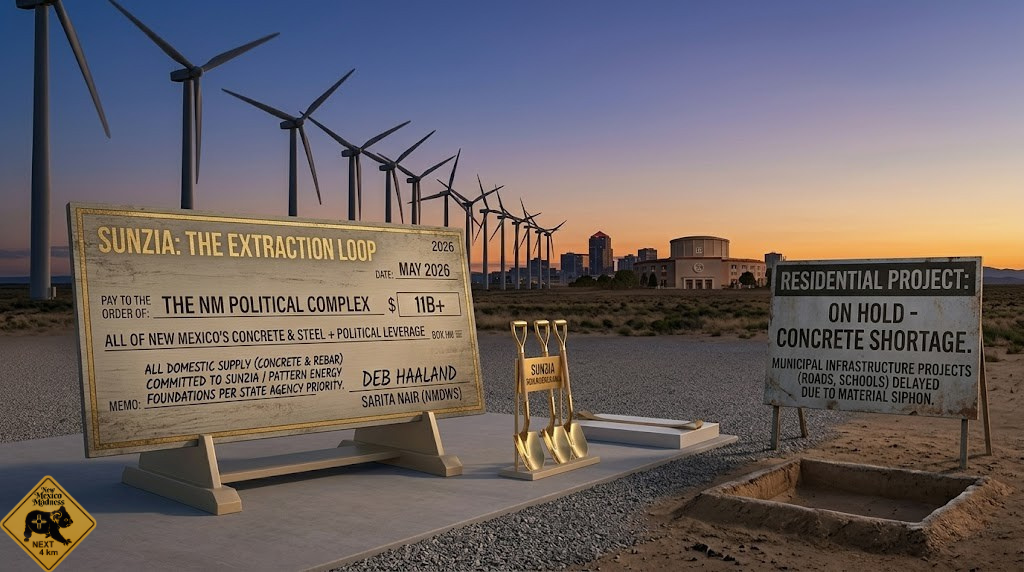
A forensic audit of regional material allocations reveals a stark case of Resource Arbitrage. While local, working-class housing developments are stalled in perpetual gridlock due to engineered "supply shortages," hundreds of thousands of metric tons of high-grade industrial concrete and structural steel are being actively diverted eastward into the plains of Torrance and Lincoln counties.
Each of the hundreds of massive wind turbines cutting across the heart of the state requires an astronomical volume of industrial material just to anchor it to the desert floor—consuming roughly 40 to 50 truckloads of ready-mix concrete and up to 40 tons of steel rebar per individual turbine base. By allowing an out-of-state, multi-billion-dollar private energy syndicate to monopolize New Mexico's domestic heavy industrial supply lines, the state's political apparatus effectively priced its own public housing initiatives out of the construction market.
The economic wreckage of this resource arbitrage does not stop at the municipal ledger; it rolls directly downhill to the everyday consumer. When mega-scale utility corridors lock down regional ready-mix batch plants and aggregate lines, the domestic market is systematically starved. For the average New Mexican walking into a local hardware store, this engineered scarcity manifests as inflated material costs, delayed residential permits, and skyrocketing contractor quotes. The citizen is subjected to a systemic economic chokehold: their neighborhood supply lines are stripped bare to anchor out-of-state infrastructure, while their local tax dollars are simultaneously devalued by the very inflation the state permitted.
This is the completion of the Taxpayer Double-Tap. New Mexico taxpayers are squeezed on both ends of the extraction loop: their domestic supply chain is vacuumed clean to anchor a coastal power grid, and their emergency housing dollars are then used to bail out private developers with $212,500 per-unit premiums just to change the sign on a pre-existing door. The $17.85 million buyout of Poblana Place was never an innovative triumph for workforce equity. It was a multi-million-dollar structural band-aid, purchased at an inflated luxury premium to mask a simple, devastating reality: the state's political leadership has already traded away the physical concrete and steel required to build New Mexico's future.
SOURCING & EVIDENCE LEDGER
I. Financial Procurement & Public Registries
- Transaction Record: Real estate buyout execution data for Poblana Place Apartments, 2818 Fourth St. NW, Albuquerque, NM 87107. Asset profiles are cataloged via Bernalillo County Property Details.
- Legislative Funding Appropriations: State funding tracks directly to the 2025 New Mexico Legislative Session under House Bill 2 (HB2), authorizing a multi-million dollar statewide emergency housing allocation. The framework and local allocations are detailed via the New Mexico Department of Workforce Solutions (NMDWS) State Allocation Portal.
- Municipal Implementation Strategy: The structural project pipeline is managed under the official "BernCo Builds Communities" capital deployment portfolio. Full strategic blueprints, targeting a $212,500.00 per-unit acquisition tier for luxury preservation over raw construction, can be cross-verified through the Bernalillo County Housing Initiative Hub.
II. Industrial Supply Chain Metrics (Resource Arbitrage)
- Energy Corridor Infrastructure Matrix: Structural metrics for high-voltage direct-current (HVDC) utility paths and centralized regional wind arrays are maintained via the New Mexico Renewable Energy Transmission Authority (RETA).
- Federal Supply Allocations: Material priorities, batch plant delivery logistics, and raw resource consumption formulas for utility-scale tower foundations are cross-referenced with regional transmission maps filed under the U.S. Department of Energy (DOE) Office of Electricity.


