

A legislative report counted the disconnected youth, priced the damage, and even named the fix. The missing ingredient is the one New Mexico never seems to supply: follow-through.
New Mexico has a talent for naming its own wounds. This spring, the Legislative Finance Committee delivered another precise diagnosis: roughly 32,000 New Mexicans between 16 and 24 are neither working, in school, nor in training — a population the state's own analysts say costs more than $600 million a year and forfeits up to $1.2 billion in lifetime earnings. The report is thorough. It is also, in the most important sense, late — and it lands in a state that has proven again and again that it can identify a problem in granular detail and then decline to fix it.
That is the real story buried inside the 32,000. Not that New Mexico doesn't know what's wrong. It knows exactly what's wrong. The failure is one of execution, targeting, and accountability — which is to say, a failure of leadership.
The Race Starts at 16, and We're Already in Last Place
The first flaw is structural, and it's fatal. The disconnected-youth study measures the outcome — a young person adrift at 16 to 24 — without seriously modeling the fifteen years that produced it. By the time the state starts counting, the damage is largely done.
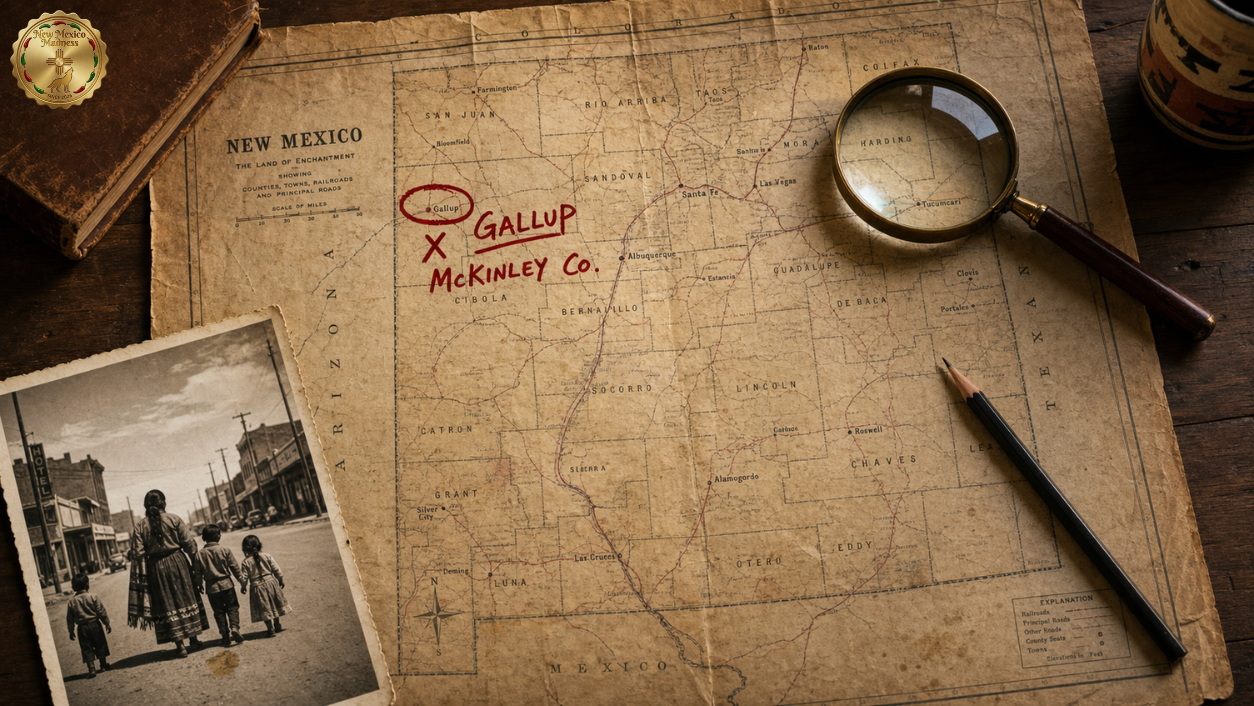
Consider what those years look like in McKinley County, home to Gallup and the heart of the state's worst disconnection zone at nearly 30 percent. There, 41.8 percent of children grow up in poverty — close to double the statewide rate. A child born into that reality is not "at risk" at 16; the risk was assigned at birth. The report's own survey found that 44 percent of disconnected youth never finished high school, meaning the decisive break happens in the K-12 years, upstream of the window the study examines.
The parenting dimension is treated the same way — gestured at, never measured. The report notes that young women disconnect at higher rates and attributes it to pregnancy and unpaid caregiving, but it never quantifies teen parenthood or childcare access. New Mexico's teen birth rate remains among the worst in the nation, and it runs highest for American Indian and Hispanic girls — McKinley sits at 24.3 births per 1,000. State health data is blunt about the loop: children born to teens are more likely to grow up in poverty themselves. National research on family structure and childhood conditions is real and worth acknowledging, but the point here is narrower and harder to dodge — New Mexico isn't measuring the 0-15 pipeline at all, so it cannot target it.
A state ranked dead last in child well-being is studying its 16-to-24-year-olds while ignoring the years that made them. That is starting the race in last place and timing it from the second lap.
The Money Exists. The Aim Does Not.
The second flaw is that New Mexico is already spending the money — it simply isn't pointed at the people who need it. The LFC mapped $88.6 million across six agencies aimed at this age group. The problem is not the size of the pot. It's that the dollars scatter.
The clearest case study is the Public Education Department's NextGen CTE pilot — roughly $38.5 million, the largest single line. On paper it is exactly what a struggling state should want: career and technical education, industry credentials, and paid internships, an approach that research consistently links to higher graduation and earnings. The concept is sound. The execution is the problem.
When the LFC examined it, the findings were damning for a program built to prove its own worth. Evaluators reported "little to no reporting on outcomes" — a multimillion-dollar pilot, now expiring in 2026, whose effectiveness is essentially unknown. Nearly a third of one year's awards went to salaries and benefits rather than students. Overlapping programs run across PED, Higher Education, Economic Development, and Workforce Solutions "independently of each other," with no coordination. And the pilot was outspending the very federal benchmark it was modeled on, with weaker accountability.
The pattern repeats at the other end of the spending map. The state's flagship federal youth-workforce vehicle, WIOA Youth, was tracked as reaching just 28 young people specifically counted as out of school — a rounding error against 32,000. Meanwhile, the LFC's own prior work has shown that economic-development investment concentrates in Bernalillo County, while the worst outcomes sit in McKinley, San Juan, and the western counties. The money doesn't follow the need. No one ever required it to.
We Audit the Failure. Then We Re-Fund It.
Here is the part that should sting. New Mexico is not missing an inspector. The Legislative Finance Committee is the inspector — and these reports are the audits. The disconnected-youth study, the NextGen brief, the earlier "Despite Benefits, Poverty Persists" evaluation: the state diagnoses itself, on schedule, in public, with rigor.
And then nothing happens. The $38.5 million program with no outcome reporting keeps its appropriation. The 28-youth program retains its purpose statement. The findings are filed, and the next cycle begins. New Mexico has built a sophisticated machine for identifying its problems and bolted it to a government with no mechanism for fixing them.
That is the accountability gap in a sentence: oversight produces findings, but the findings have no teeth. Funding is never conditioned on whether a program reaches its target population or reports a result. Until that changes, a state can spend lavishly and still finish 50th — because spending was never the metric anyone was held to.
They Are New Mexicans. Govern Like It.
Nowhere is this clearer than in the Gallup area. McKinley County is roughly three-quarters Native American, carries the highest poverty and child-poverty rates in the state, the highest teen birth rates, and the deepest youth disconnection. These are not abstractions. They are American citizens and New Mexicans, owed the same deliberate investment as any constituency in Santa Fe or the Northeast Heights.
Too often the resources meant for these communities are treated as discretionary or fragile rather than as obligations. Federal commitments to tribal communities — water rights, education, health — flow from treaty and trust duties, not generosity, yet they are perennially the first exposed to freezes and delay. A leadership class that internalized that these are simply New Mexicans, nothing more and nothing less, would stop governing the western counties as an afterthought and start aiming resources where the data says the need is greatest.
The Continuity Nobody Names
If the same governing coalition presides over the worst outcomes in the nation, term after term, that is itself a leadership trend. The point is not that any single local official is to blame — Gallup just elected a new mayor, and McKinley County has seen real turnover at the commission level. The point is structural: the budget choices, the program designs, and the decision not to enforce the audits flow from a durable, one-party governing coalition that has held the governorship, the relevant congressional seat, and the legislature for years. Continuity of power without continuity of results is not a coincidence to be excused. It is a record to be examined.
What Deliberate Leadership Would Actually Do
The encouraging truth is that this is solvable, because New Mexico has already proven it can move these numbers when it aims. Recent tax-credit expansions cut the state's deep-poverty rate by more than a third. Concentrated, place-based health programs drove teen births down 53 percent among American Indian youth. Targeted execution works here. It just isn't the default.
A serious response would:
- Measure and invest in the 0-15 pipeline, not just the 16-24 endpoint — funding early childhood, K-12 attendance, and the foster and juvenile-justice feeders before young people disconnect.
- Target existing dollars like NextGen and WIOA Youth at the 32,000 disconnected and the highest-need counties, instead of spreading them thin and calling it equity.
- Condition funding on outcomes — give the LFC's audits binding force through a public, quarterly accountability dashboard for every education and welfare program, and pause money where outcomes go unreported.
- Treat the western counties as a priority, not a footnote, aligning resources with where the data says the crisis is deepest.
New Mexico does not have a knowledge problem. The 32,000 are counted, the costs are priced, the failures are audited, and the fixes are named. What it has is a follow-through problem — and follow-through is not a budget line. It is a leadership decision.
Endnotes
- New Mexico Legislative Finance Committee, "Reconnecting Disconnected Youth" (Program Evaluation/Action Plan), April 2026. (Internal LFC document — cited, not linked.)
- McKinley County child poverty (41.8%) and poverty (33.2%), U.S. Census ACS 2020–2024 5-year estimates: https://usafacts.org/answers/what-is-the-us-poverty-rate/county/mckinley-county-nm/
- McKinley County poverty trend, FRED (St. Louis Fed), ACS 5-year: https://fred.stlouisfed.org/series/S1701ACS035031
- New Mexico child poverty and school-age poverty rates, NM-IBIS (NM Dept. of Health): https://ibis.doh.nm.gov/indicator/summary/PopDemoChildPov.html
- Teen birth rate by county, girls 15–19 (McKinley 24.3/1,000), NM-IBIS: https://ibis.doh.nm.gov/indicator/view/BirthTeen.15_19.Cnty.html
- Teen birth disparities and intergenerational poverty, NM-IBIS Teen Birth summary: https://ibis.doh.nm.gov/indicator/summary/BirthTeen.html
- New Mexico Legislative Finance Committee, "Hearing Brief on Best Practices in CTE," September 23, 2025. (Internal LFC document — cited, not linked.)
- NextGen CTE pilot authorization and structure, NM Public Education Department: https://web.ped.nm.gov/bureaus/college-and-career-readiness-bureau/career-technical-education/nextgen/
- National evidence on CTE outcomes, Penn State Evidence-to-Impact: https://evidence2impact.psu.edu/resources/strengthening-career-and-technical-education-to-improve-equity-and-maximize-return-on-investment/
- New Mexico Legislative Finance Committee, "Despite Benefits, Poverty Persists," 2023. (Internal LFC document — cited, not linked.)
- ALICE (working-poverty) household data, United For ALICE, New Mexico 2024: https://www.unitedforalice.org/state-overview/new-mexico
- Poverty reduction via tax-credit changes, KUNM, January 2025: https://www.kunm.org/local-news/2025-01-14/poverty-fell-more-than-a-third-in-new-mexico-due-to-tax-changes-but-theres-more-to-do
- New Mexico Class of 2023 graduation rates, NM Education/NMPED: https://nmeducation.org/graduation-rates-for-the-class-of-2023-stagnant/
- Federal grant freeze and tribal funding obligations ($24B), Brookings, 2025: https://www.brookings.edu/articles/a-federal-grant-freeze-could-disrupt-over-24-billion-to-native-american-communities-and-undermine-us-obligations-to-tribes/
- Navajo-Gallup Water Supply Project and Navajo water rights, Utton Center (UNM): https://uttoncenter.unm.edu/resources/research-resources/navajo-gallup-water-supply-project-.pdf
- Gallup mayoral election (Marc DePauli, Nov. 2025), City of Gallup: https://www.gallupnm.gov/27/Mayor-Marc-DePauli
- Gallup 2025 election results, Gallup Sun: https://gallupsunweekly.com/2025/11/14/ringing-in-a-new-chapter-for-gallup/
- McKinley County election results, NM Secretary of State: https://electionresults.sos.nm.gov/resultsSW.aspx?type=CTYSPEC&map=CTY&cty=13+&name=McKinley
- Teresa Leger Fernández, NM 3rd Congressional District (incumbent since 2021): https://ballotpedia.org/New_Mexico's_3rd_Congressional_District


