

New Mexico sits on the busiest stretch of America's immigration story, and the data finally lets us say something honest about it — without the hysteria from either side. The enforcement is real. The prevention is real. And the strain on a state that was already running on fumes is the part nobody wants to talk about.
Give the Professionals Their Due
Start with what's working. In calendar year 2025, the U.S. Attorney's Office for the District of New Mexico charged more than 7,000 border and immigration-enforcement cases — placing our district third or fourth in the nation for immigration prosecutions. These aren't abstractions. They include named defendants with prior violent records: a man with a prior aggravated sexual assault on a child, another tied to a Santa Fe double-homicide indictment, a third with a record of firing from a vehicle. ICE's March 2025 statewide operation arrested 48 people, 20 of whom had criminal records. By December 2025, the DHS "Worst of the Worst" database listed 94 New Mexico entries.
For those specific individuals, the math is simple and uncomfortable for the critics: every future offense they would have committed here was prevented. That's not a statistic about a population. It's a person who is no longer in your child's school, your church parking lot, or your gas station at midnight. Credit where it's due — federal prosecutors and DHS personnel removed people who were demonstrably dangerous.
But Be Honest About the Caseload
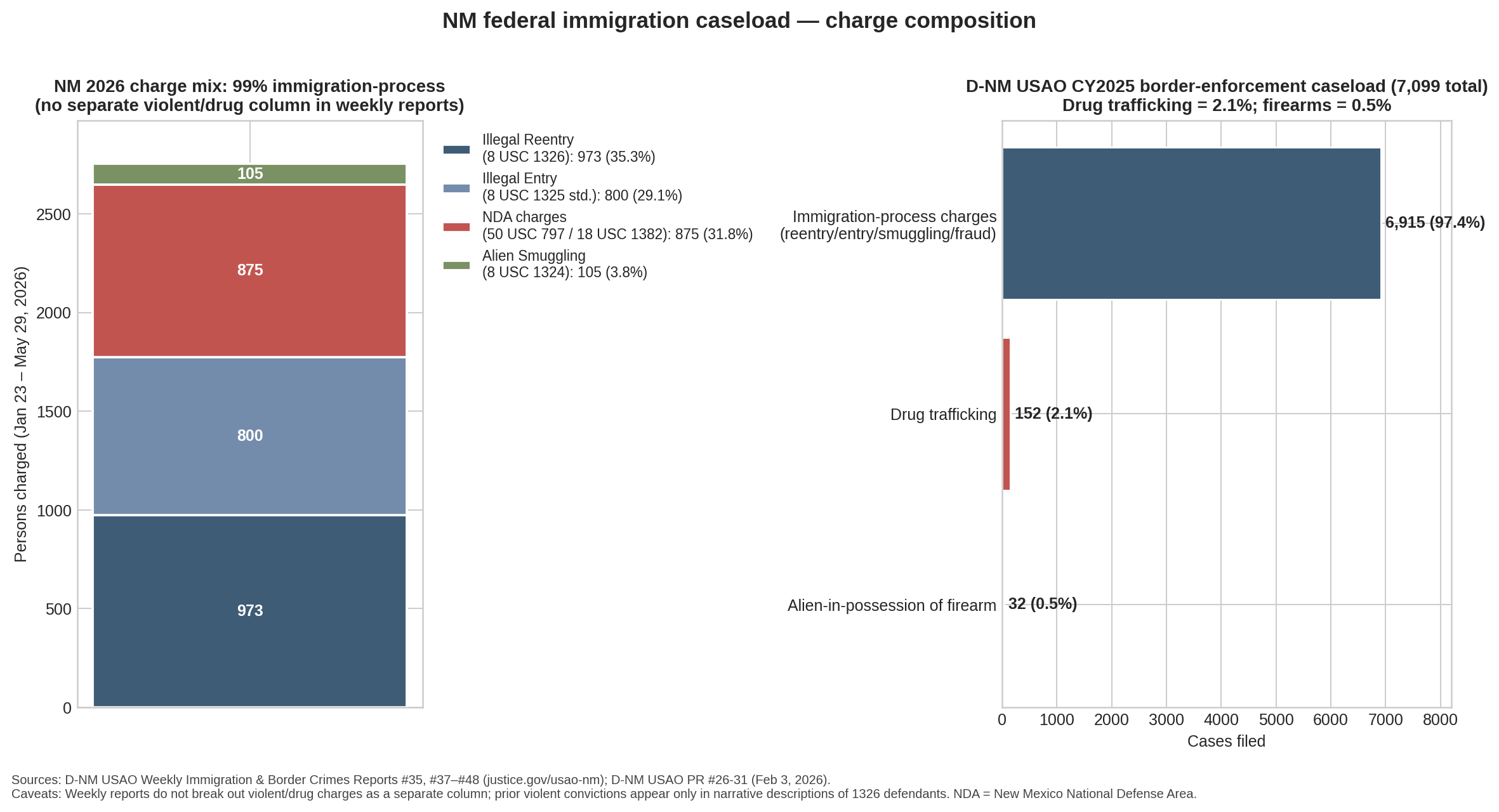
Here's where most coverage overreaches, and where we won't. The overwhelming majority of that caseload is immigration-process crime, not violence. Of the 7,099 cases, drug trafficking was 2.1 percent and firearms charges were half a percent. The rest were illegal reentry, illegal entry, smuggling, and a newer category — charges under the New Mexico National Defense Area, the military zone established along the border in April 2025.
Those National Defense Area charges deserve a flashing caution light. Roughly 60 percent of them have been dismissed by federal magistrates, and they should be described as charges filed, not convictions earned. Even dismissed, they consume real court resources — at one point a single judge carried more than 400 of them in a month. We report the volume and the violent-prior subset, but we don't inflate either. The honest takeaway: New Mexico is a genuine front-line district, but most of what crosses these dockets is people processed at the line, not a resident crime wave.
What Was Potentially Avoided
Here's the angle that actually matters for New Mexicans: prevention is invisible by design. The crime that never happens generates no headline. The ER bed that doesn't fill, the classroom that doesn't overflow — none of it makes the news, because it didn't happen.
And the scale of what could have happened is not hypothetical. Southwest border encounters peaked at over 2.2 million in fiscal 2022 and collapsed to 237,538 in fiscal 2025 — the lowest level since 1970. The first half of fiscal 2026 is on pace for the lowest annual figure since 1967. Yes, Title 42 inflated the early numbers with repeat crossings; even after adjusting for that, the decline exceeds 90 percent. Four forces drove the reversal: executive orders in January 2025, the elimination of asylum pathways, the National Defense Area, and Mexico-side enforcement cooperation that began under the prior administration in April 2024 and continued.
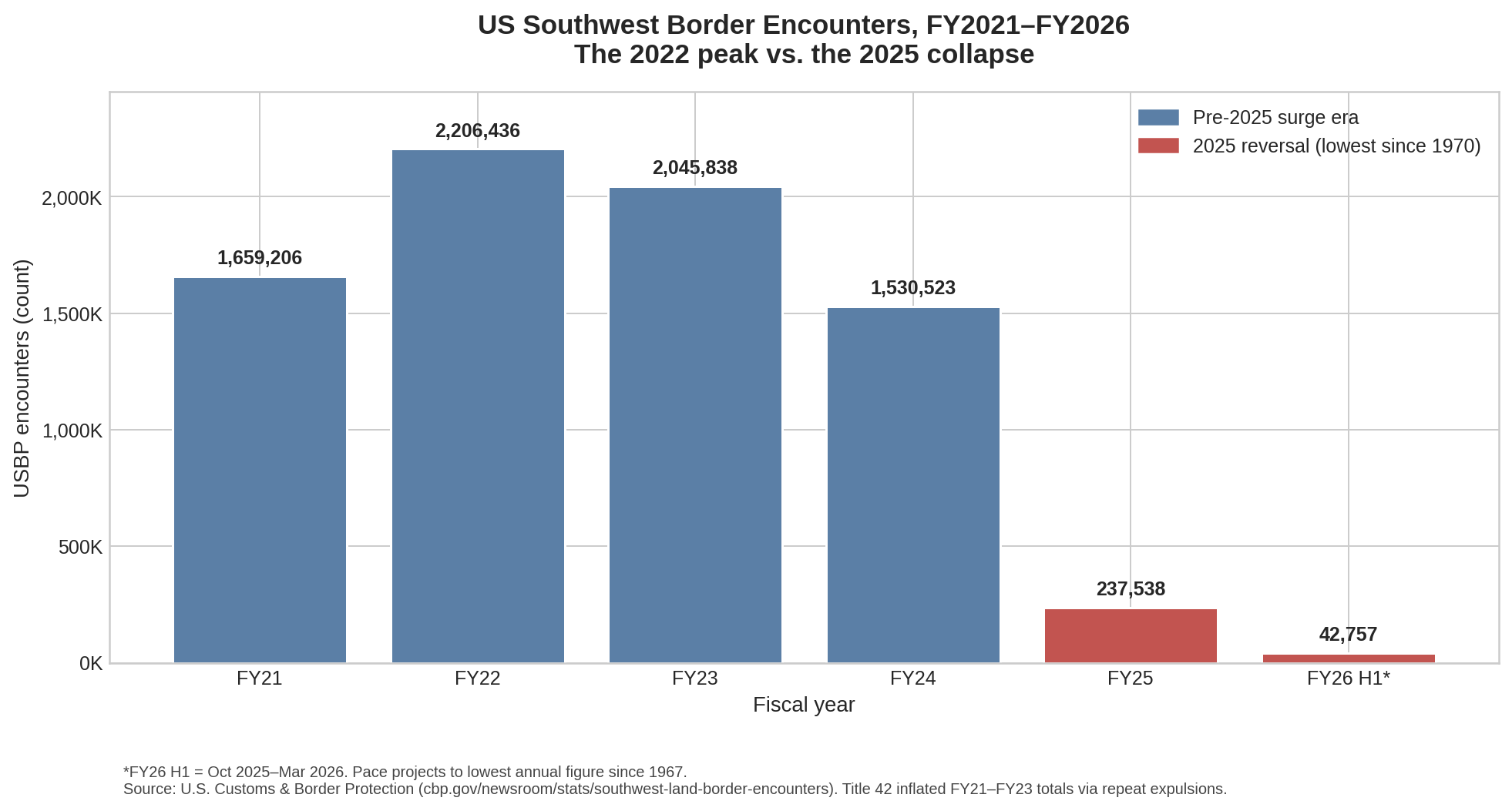
The point isn't that enforcement "saved" New Mexico from any specific person. It's that the wave of population pressure that absorbs into schools, hospitals, and assistance programs was sharply curtailed — and in this state, that mattered more than almost anywhere else. Because we start from behind.
The Fragile Baseline
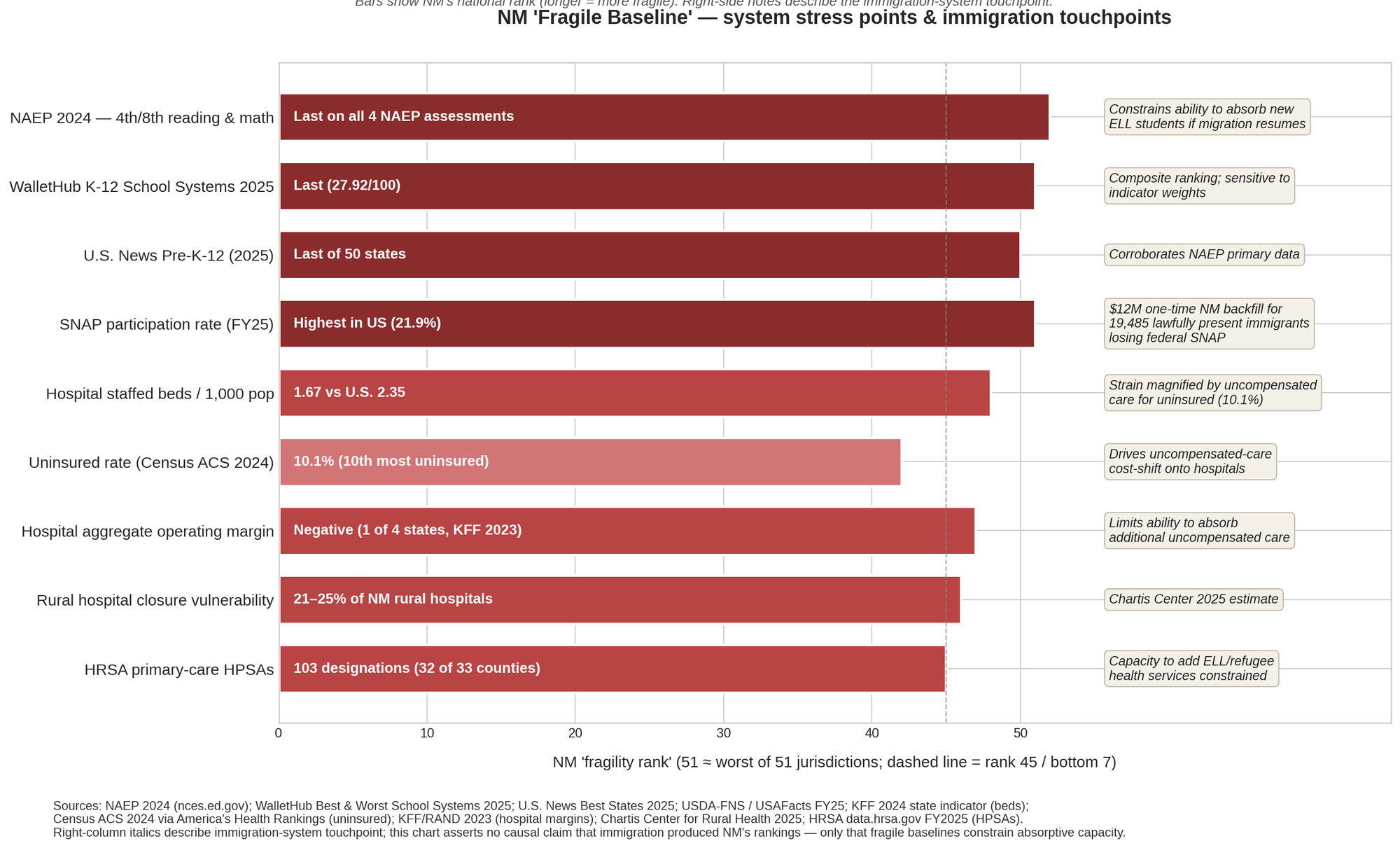
This is the New Mexico flavor, and it's the part that makes the stakes local. We are not claiming immigration caused any of these problems. We are saying New Mexico has no cushion, so any added load lands harder here than in a state with slack.
- Education: New Mexico ranked last in the nation on the 2024 NAEP — the federal government's own test — across fourth- and eighth-grade reading and math. Composite rankings from WalletHub and U.S. News corroborate it.
- Food assistance: We have the highest SNAP participation in the country — about 21.9 percent of residents. That's not a state with room to absorb more; it's a state already at maximum load.
- Hospitals: New Mexico had a negative aggregate hospital operating margin — one of only four states in that position in 2023 — with roughly 1.67 staffed beds per 1,000 residents against a national 2.35. Federal HRSA data designate 103 primary-care shortage areas, touching 32 of our 33 counties.
- Insurance: Our uninsured rate sits at 10.1 percent, among the ten worst in the nation, which drives uncompensated-care costs that hospitals shift onto everyone's premiums.
When that uninsured population needs care, hospitals don't simply eat the loss — they shift it. A rough, order-of-magnitude estimate puts what New Mexico's uninsured leave on hospital books at somewhere between $298 million and $384 million a year. That figure is illustrative, not precise, and it makes no claim about anyone's immigration status — but it shows the size of the bill that quietly lands back on insured New Mexicans through their premiums.
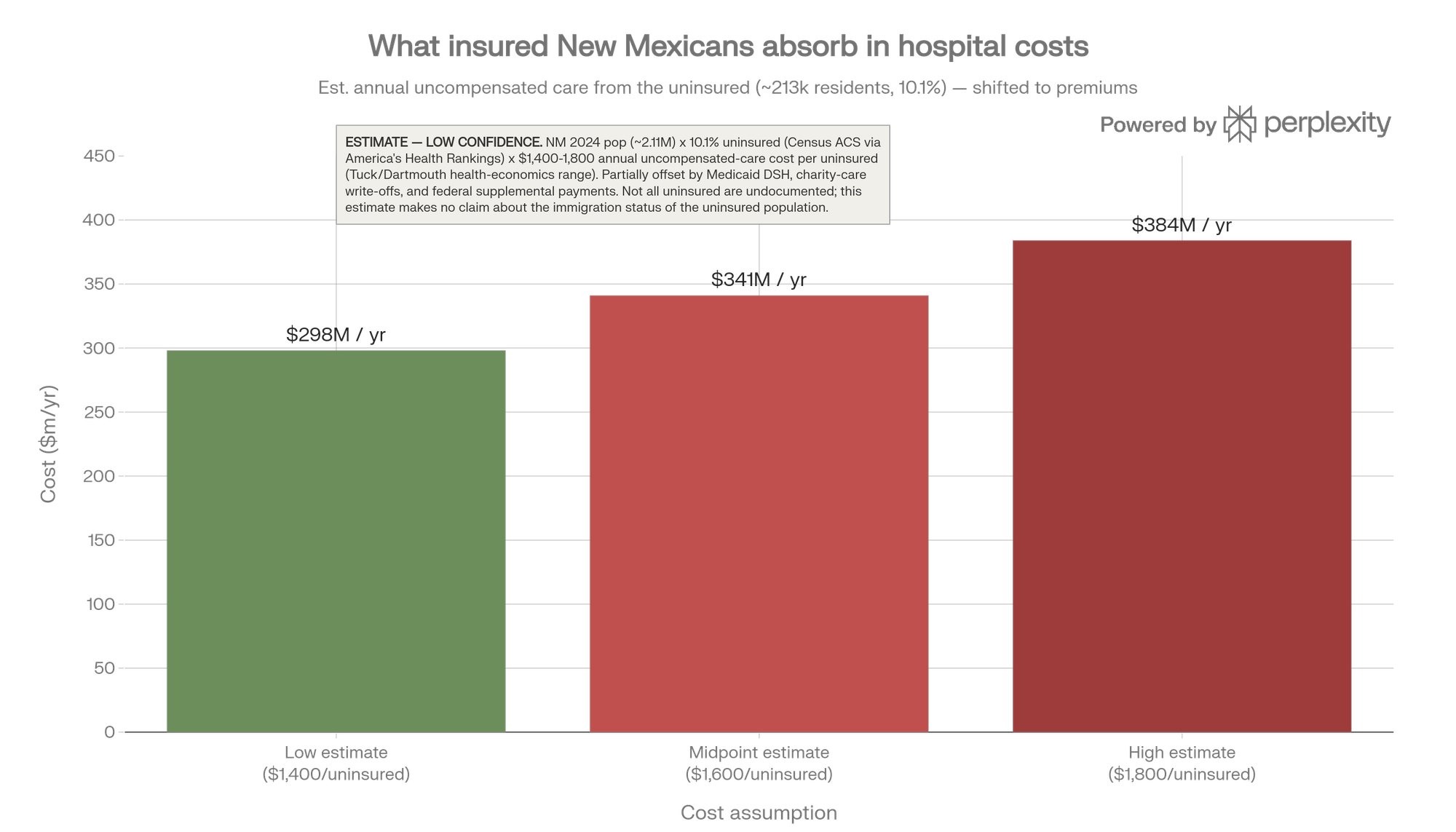
Each of these is a pre-existing condition. Immigration doesn't have to cause them to strain them. A system that's already failing has nothing left to give when demand rises — and that's true whether the new pressure comes from migration, an aging population, or anything else. The difference is that the migration variable is one we can actually control, and in 2025 we did.
The Bill Taxpayers Didn't Have to Pay
Then there's the spending — the part where New Mexico chose to override a federal decision with its own taxpayers' money.
When Congress passed H.R. 1 in July 2025, it stripped federal SNAP eligibility from categories of lawfully present immigrants — refugees, asylees, parolees, trafficking survivors, and others — who had qualified since the 1996 welfare reform. The state Health Care Authority projected that 19,485 lawfully present immigrants in New Mexico would lose federal food benefits as their cases came up for renewal. Note the words lawfully present — these are not undocumented immigrants, who were never eligible for federal SNAP in the first place.
New Mexico's response was to spend. The Legislature appropriated $12 million in a one-time, state-funded backfill during the 2025 special session, delivered through existing EBT cards, to keep feeding people Washington had just cut. Then, in the 2026 regular session, lawmakers added a separate $40 million to backfill Medicaid for the same lawful-immigrant population.
That's $52 million in state expenditures that federal law did not require — money New Mexico taxpayers are footing to maintain benefits the federal government deliberately ended. And the $12 million SNAP fix is exactly that: a stopgap. It's one-time money. When it runs out, the cliff returns, and lawmakers will face the same bill again in the next budget cycle.
New Mexicans deserve a plain accounting. This was discretionary money — not a federal mandate — and every dollar spent maintaining benefits Washington ended is a dollar that didn't reach a last-in-the-nation school system, a hospital running in the red, or a family already on the edge. That's not an argument against compassion. It's an argument for transparency. When the state chooses to backfill a federal cut with our money, residents are owed an honest ledger of what it cost and what it displaced — not a quiet line item buried in a special-session bill.
The Honest Bottom Line
None of this is a blame piece. New Mexico's struggles were here long before the border surge, and they'll outlast it. But three things are true at once, and you rarely hear all three together: federal professionals removed genuinely dangerous people and deserve credit for it; the broader enforcement reversal spared a state that has no capacity to absorb added strain; and New Mexico is quietly spending tens of millions of its own dollars to soften a federal course correction. When you're already running on empty, every extra mile costs more — and every dollar spent papering over a cliff is a dollar not spent on the schools, hospitals, and families already at the edge.
References
- U.S. Customs and Border Protection — Southwest Land Border Encounters: https://www.cbp.gov/newsroom/stats/southwest-land-border-encounters
- U.S. Sentencing Commission — Federally Sentenced Non-U.S. Citizens (FY2025): https://www.ussc.gov/research/quick-facts/federally-sentenced-non-us-citizens
- U.S. Attorney's Office, District of New Mexico — Weekly Immigration & Border Crimes Reports: https://www.justice.gov/usao-nm
- NAEP / The Nation's Report Card — State Profiles: https://www.nationsreportcard.gov/profiles/
- USAFacts — SNAP participation, New Mexico: https://usafacts.org/answers/how-many-people-receive-snap-benefits-in-the-us-every-month/state/new-mexico/
- America's Health Rankings — Uninsured, New Mexico: https://www.americashealthrankings.org/explore/measures/HealthInsurance/NM
- HRSA — Health Professional Shortage Areas, New Mexico (FY2025): https://data.hrsa.gov
- NM Health Care Authority — New federal SNAP rules prompt state-funded food assistance: https://www.hca.nm.gov/2026/02/04/new-federal-snap-rules-prompt-state-funded-food-assistance/
- Congress.gov — H.R. 1 (119th Congress): https://www.congress.gov/bill/119th-congress/house-bill/1
- Pew Research Center — U.S. unauthorized immigrant population estimates: https://www.pewresearch.org


