

New Mexicans deserve to understand just how brazen this mess has become.
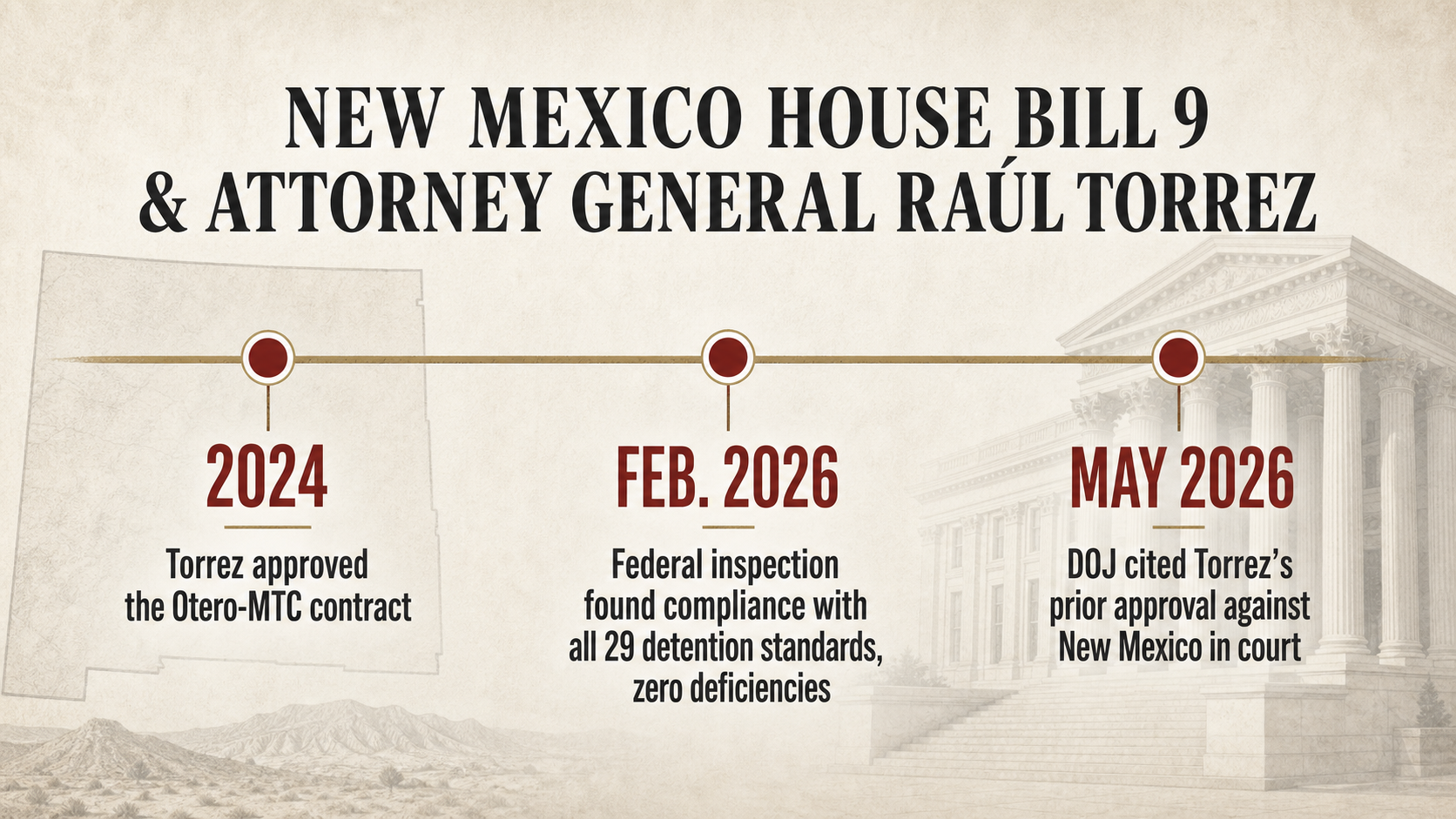
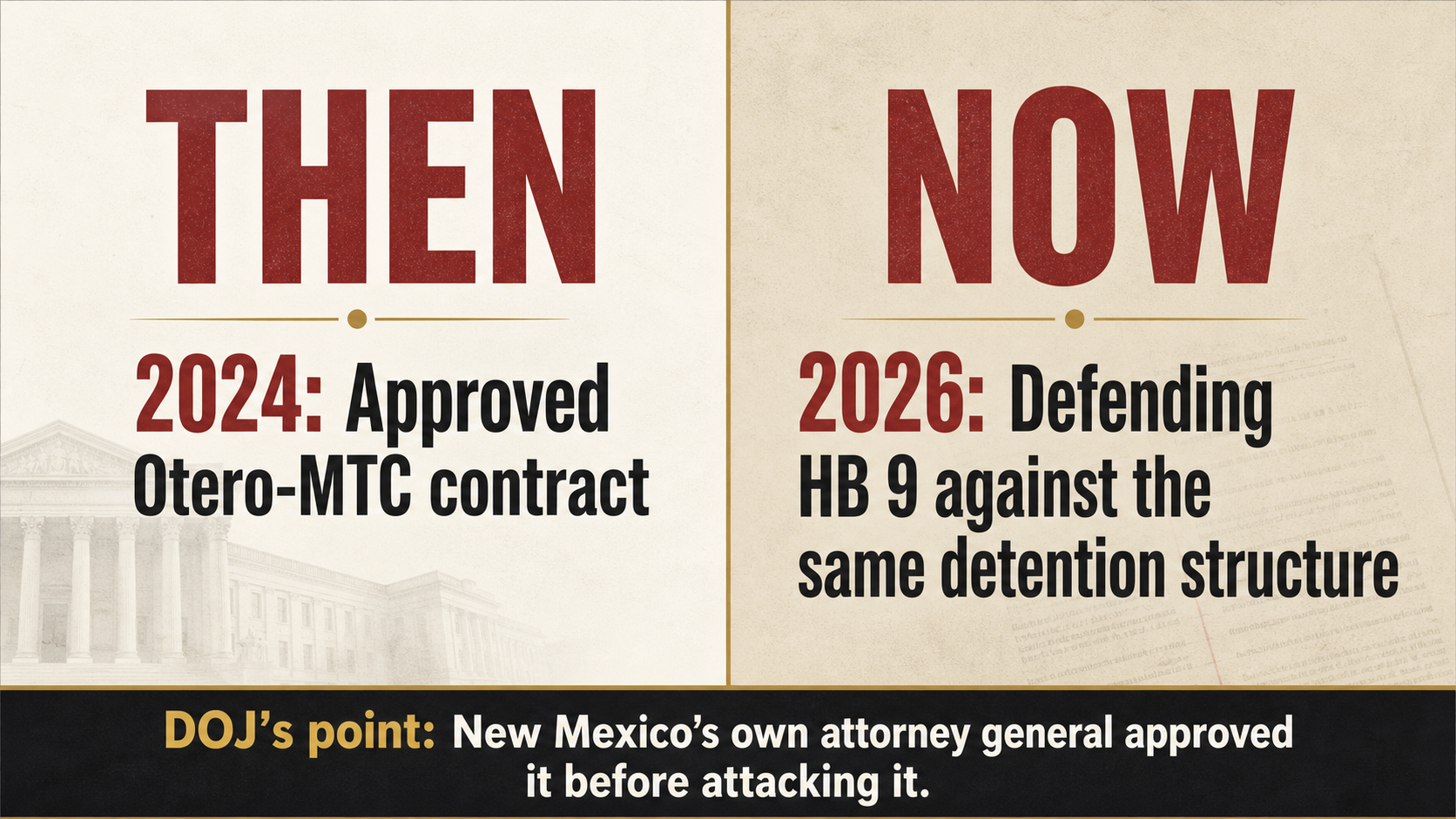
Attorney General Raúl Torrez, the state’s top lawyer, approved the Otero County Processing Center contract in 2024, a federal immigration detention facility in southern New Mexico run by private contractor Management & Training Corporation (MTC) under contract with ICE. Then, less than two years later, he stood in court defending House Bill 9, the law used to attack the same detention structure his office had already signed off on.
That is not spin. That is not partisan interpretation. That is not a social media theory wrapped in activist language. It is now sitting in a federal court filing, in black and white, with the U.S. Department of Justice using Torrez’s own prior approval as evidence that New Mexico’s case does not hold together.
For months, New Mexicans were told House Bill 9 was a moral necessity. They were told the state had to move because detention facilities were unsafe, abusive, or outside the bounds of legitimate public policy.
But the public record tells a harder story.
The same attorney general now defending House Bill 9 previously approved the Otero-MTC contract under New Mexico law. And a federal inspection in February 2026 found the Otero County Processing Center compliant with all 29 federal detention standards, with zero deficiencies and no abuse allegations across 34 detainee interviews.
That does not mean every immigration detention policy is wise. It does mean the legal and factual foundation sold to the public looks a lot weaker than advertised.
The document that changes everything
The most damaging sentence in this entire fight did not come from a political opponent. It came from the federal government’s own court filing.
In its May 8, 2026 motion for a preliminary injunction, the Department of Justice said New Mexico law requires oversight from the attorney general and other state entities, and that those agreements had been blessed without issue, "including the current Attorney General, who approved of the Otero-MTC Contract in 2024. No issues were raised before."
That line matters because it strips away the easy excuses.
If Torrez believed the detention arrangement was unlawful, abusive, or beyond the pale, why did his office approve it in 2024. If the arrangement was acceptable under state law then, what exactly changed besides the politics.
Those are not minor questions. They go straight to whether House Bill 9 was a serious legal remedy or a political weapon in search of a justification.
The state’s story starts to crack
The contradiction would be bad enough on its own. It gets worse when paired with the inspection record.
According to the federal filings, a February 2026 inspection found the Otero County Processing Center in compliance with all 29 federal detention standards. The inspection reportedly found zero deficiencies. It also recorded 34 detainee interviews without abuse allegations.
That does not sound like the nightmare picture sold to the public as justification for emergency moral action. It sounds like a state trying to bulldoze a facility after its own top lawyer had already approved the contract and after federal inspectors found no documented collapse in standards.
In plain English, the state’s argument starts looking less like urgent public protection and more like a policy crusade wrapped in selective outrage.
A law built on a contradiction
House Bill 9, the Immigrant Safety Act, was sold as a clean break from immigration detention partnerships in New Mexico.
But the problem for Torrez and the state is that the federal government is not arguing over rhetoric. It is pointing to documented conduct. The same official now aligned with the law previously approved the very arrangement the law was used to target.
That is why this story matters beyond one facility.
Once the state’s own paper trail shows prior approval, the public is entitled to ask whether House Bill 9 was really built on documented harm or whether it was built on ideology first, with facts gathered later to support the conclusion.
That question becomes even sharper because Torrez did not charge into court from a position of strength. In May 2026, he agreed to pause enforcement of House Bill 9 against the Otero facility while the federal case moved forward.
That stipulation looked less like confidence and more like retreat.
What New Mexicans were not told
What New Mexicans were largely not told is that this was never just a moral showdown between good people and bad people.
It was also a test of whether state officials could survive their own record.
The Department of Justice did not need to invent a contradiction. New Mexico handed it one. The state did not need to be trapped by hostile messaging. It trapped itself when its own attorney general approved the detention contract in 2024 and later helped defend a law used to attack that same arrangement.
That is the kind of contradiction that destroys trust, because normal people can understand it instantly. If a thing was lawful and acceptable when you approved it, the burden is on you to explain why it became intolerable only after the politics changed.
New Mexicans have every right to demand that explanation.
The next question
This is where the House Bill 9 story gets bigger than AG Raúl Torrez.
Because once the legal case starts cracking, the next question is obvious: who built the political machine behind this law, who benefited from it, and how closely did the same advocacy network overlap with the politicians who carried it.
That is where this series goes next.
Part 2 follows the coalition structure behind House Bill 9: the advocacy groups, political committees, independent expenditures, and national donor pipelines that helped build the machine now standing behind the law.
Endnotes
- U.S. Department of Justice, Motion for Preliminary Injunction, United States v. New Mexico, Case 1:26-cv-01471, Doc. 2, filed May 8, 2026, pages 5-6, stating that the current attorney general approved the Otero-MTC contract in 2024. https://www.justice.gov/usao-nm/media/1440126/dl?inline
- Phase 2 Evidence Harvest, June 6, 2026, summarizing the DOJ filing and the February 2026 inspection findings regarding the Otero County Processing Center.
- New Mexico Political Report, May 13, 2026, reporting that Torrez agreed to pause enforcement of HB 9 against the Otero County Processing Center while litigation continued. https://nmpoliticalreport.com/2026/05/13/torrez-gives-in-to-doj-demands-agreeing-to-pause-enforcement-of-hb9-and-keep-otero-ice-center-open/
- House Bill 9, 2026 regular session, New Mexico Legislature. https://www.nmlegis.gov/Legislation/Legislation?Chamber=H&LegType=B&LegNo=9&year=26
- Phase 3 Politician-Beneficiary Network Map, June 6, 2026, final assessment describing the next-story lane as the electoral and advocacy machine behind HB 9.


