

Chapter 4: The Baseline Deception and the SMR Footprint
The ultimate justification for transforming New Mexico’s rural landscapes into an out-of-state utility pipeline has always been a lack of structural alternatives. The state's political apparatus, led by senior legislative architects like Senator Martin Heinrich, has consistently repeated a singular premise to the public: that massive, utility-scale wind corridors represent the only viable path to rapid decarbonization. To achieve this vision, the public was told that sacrificing massive geographic regions of the state’s high desert interior was an unavoidable consequence of progress.
The comparative structural math and hidden state regulatory dockets expose this narrative as an engineered baseline deception. While federal and state agencies actively fast-track Pattern Energy Group’s $11 billion SunZia project, they are locking New Mexico into the most land-inefficient energy model available. The 916 massive wind turbines and their sprawling high-voltage direct current (HVDC) transmission lines carve a destructive physical footprint across Lincoln, Torrance, San Miguel, and Guadalupe counties—sacrificing hundreds of thousands of acres of contiguous ranching land and pristine wildlife corridors just to transmit intermittent power directly to the California Independent System Operator grid.
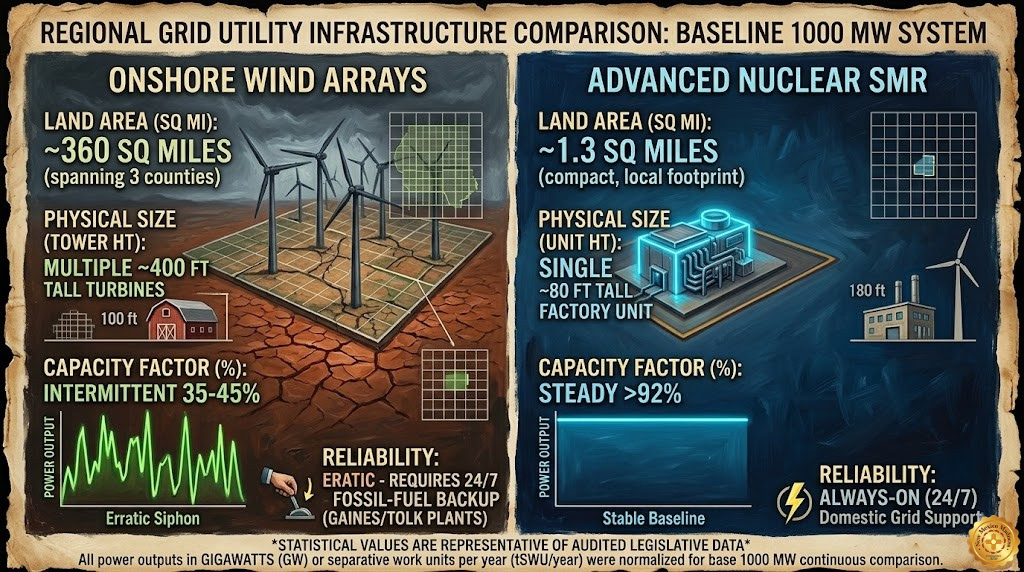
This staggering destruction of land-use sovereignty is a direct choice, not an environmental necessity. When evaluated against the cold physics of energy density, the alternative is clear: next-generation nuclear Small Modular Reactors (SMRs). According to standard industrial lifecycle data compiled by the Nuclear Energy Institute, a conventional utility-scale wind farm requires up to 360 times more land area to generate the exact same annual electrical output as a localized nuclear facility.
The true casualty of this geographic choice is local land sovereignty. To squeeze an intermittent 3,021 MW capacity from wind, the SunZia project requires a sprawling, invasive industrial web stretching across hundreds of square miles. Had the state prioritized compact, continuous nuclear SMR technology, that identical power output could have been safely generated on a consolidated site footprint of less than four square miles.
By deliberately deploying the most land-intensive infrastructure possible, the political machine guaranteed maximum friction with active cultural and ancestral boundaries. The choice to build a 552-mile interstate export line is what directly forced corporate bulldozers into the sacred San Pedro Valley. This spatial over-expansion triggered intense National Historic Preservation Act litigation from the Tohono O’odham Nation and the San Carlos Apache Tribe against Deb Haaland’s Department of the Interior. This battle culminated in a major federal appellate reversal lambasting the Bureau of Land Management for ignoring the valley’s historical value. The state chose a geographically invasive export siphon over a compact, localized nuclear footprint, ensuring tribal sovereignty would be legally run roughshod over to satisfy out-of-state corporate procurement contracts.
The irony of this extraction loop is that while the public is fed a continuous marketing campaign about the virtues of wind, the political class is quietly preparing for the exact nuclear future they denied local communities. In Washington, the very architects championing New Mexico's exported wind corridor joined a bipartisan coalition to pass the federal ADVANCE Act. This law fundamentally restructures the Nuclear Regulatory Commission (NRC), slashing regulatory fees and establishing fast-track licensing pathways specifically designed to accelerate the commercial deployment of advanced nuclear SMR technology.
Furthermore, global utility networks are already abandoning intermittent renewables in favor of these exact systems, actively signing landmark procurement contracts—such as the recent state-backed agreements with Rolls-Royce SMR in Europe—to anchor high-density industrial operations with dedicated modular fleets. The political complex is fully aware that intermittent wind is structurally incapable of supporting long-term, high-density load growth. They are aggressively building a fast-track nuclear framework on the federal level, all while continuing to utilize New Mexico's rural interior as a temporary landfill for non-recyclable fiberglass wind waste.
New Mexico is not being bypassed by this next-generation nuclear pivot; it is being actively exploited to fuel it from behind a curtain. The premier commercial enrichment facility driving the Western world’s domestic fuel supply for advanced nuclear SMRs is the Urenco facility located in Eunice, New Mexico. The high desert of Lea County actively processes the specialized uranium required to run next-generation reactors worldwide. Urenco recently finalized a massive centrifuge facility expansion, scaling up its total output to 4,650 tons of separative work units per year—a massive metric confirming the plant can now manufacture enough advanced, mid-enriched nuclear fuel (traditionally classified as LEU+ or uranium enriched up to 10%) to break Western dependence on foreign energy supplies. This makes the small community of Eunice the literal bedrock of the global advanced nuclear renaissance.
Simultaneously, the state's urban core acts as the advanced manufacturing engine for these identical modular fleets. At Mesa del Sol in Albuquerque, Kairos Power LLC is running a massive, 32-acre engineering and manufacturing development campus backed by a $125 million capital investment and state funding allocations. For the broader nuclear industry, this specialized industrial facility is actively fabricating, machining, and testing first-of-a-kind hardware components, heavy-duty structural steel reactor vessels, and full-scale modular systems. In plain terms, the Albuquerque workforce is building the massive metal containers, custom plumbing loops, and protective structural casings that hold the fuel and regulate the temperatures for tomorrow's nuclear grid.
The political machine's master stroke is executed through a sophisticated tax and legislative sleight of hand. During recent legislative sessions, state architects quietly pushed measures like Senate Bill 78 to officially redefine advanced nuclear generation as a qualified "renewable resource" to meet the state's Clean Electricity Standard. Concurrently, they passed House Bill 154 to rewrite advanced energy product tax credits. This ensures that the political complex reaps immense economic development accolades, corporate tax revenue, and elite green-energy compliance credits for hosting the production pipeline, while the domestic grid receives absolutely zero drops of the clean, 24/7 baseline nuclear power generated by our local workforce.
Instead, New Mexicans are stuck paying a devastating premium to clean up the operational failure of the wind export model. Because intermittent wind cannot support real industrial load growth, the state’s local grid is facing a catastrophic capacity deficit. To keep up with massive Permian Basin oil-field electrification and skyrocketing data center demands, the New Mexico Public Regulation Commission (NMPRC) issued a final order approving a massive $9.3 billion resource expansion plan for Southwestern Public Service Company (Xcel Energy).
To keep the lights from going out when the wind stops blowing, this $9.3 billion emergency mandate forces the utility to construct multiple traditional fossil-fuel natural gas plants alongside expensive, high-capacity battery storage patches just to act as a baseline stabilizer. This includes building out the Gaines natural gas plant near Denver City just across the eastern corridor, the Tolk natural gas plant in Lamb County, and tracking multi-million-dollar battery storage patches directly at the Sagamore wind site near Roosevelt County and Plant X near Earth, Texas to buffer the local grid. This astronomical bill is not being paid by the California tech hubs sucking away our wind power; it is being phased directly into local New Mexico customer utility bills as these facilities come online.
The baseline deception of the energy-political complex is complete. The political establishment forces everyday New Mexicans to live with ruined rural views, desecrated tribal landscapes, and an un-bonded, 21-football-field graveyard of rotting wind blades under the guise of "environmental necessity." Meanwhile, they quietly leverage the state's deep nuclear infrastructure in Eunice and Albuquerque to manufacture the global SMR future from our soil, exporting the real baseline solutions to the highest out-of-state bidders while forcing local residents to pay billions in fossil-fuel surcharges just to keep their own homes running.
SOURCING & EVIDENCE LEDGER
I. Nuclear Procurement & SMR Deployment Records
- Federal Advanced Nuclear Siting Dockets: Statutory text, fee reduction structures, and accelerated licensing pathways for advanced modular reactors are maintained via the U.S. Congress GovInfo Registry for the ADVANCE Act.
- Advanced Reactor Manufacturing Infrastructure: Industrial Revenue Bond filings, LEDA funding allocations, and component manufacturing specifications for the Mesa del Sol campus are cataloged via the City of Albuquerque Economic Development Project Registry for Kairos Power.
- State Clean Energy Expansion Records: Industrial project extensions, advanced fuel development laboratory briefs, and local capital investment tracking sheets are maintained under the New Mexico Economic Development Department Kairos Project Archive.
- Commercial SMR Fleet Contracts: International utility-scale SMR site design agreements, supply chain component orders, and data center power matching contracts are archived under the Rolls-Royce SMR Global Deployment Registry.
- Domestic Nuclear Fuel Enrichment Dockets: Centrifuge capacity metrics, civil nuclear supply logs, and advanced fuel enrichment dockets are managed via the Urenco USA Lea County Facility Operating Ledger.
II. Industrial Siting & Grid Capacity Metrics
- Comparative Land Use Intensity Data: Lifecycle land-footprint assessments, spatial density formulas, and capacity-factor comparisons between nuclear facilities and onshore wind arrays are maintained via the Nuclear Energy Institute Resource Repository.
- Regional Utility Capacity Authorizations: Resource plan dockets, industrial load growth forecasts, and Permian Basin electrification dockets are compiled under the New Mexico Public Regulation Commission Case Records under Docket No. 24-00123-UT.
- Appellate Siting Litigation Records: National Historic Preservation Act compliance filings, tribal injunction motions, and construction authorization appeals regarding the San Pedro Valley transmission corridor are maintained under the United States Court of Appeals for the Ninth Circuit Opinion Database (Tohono O’odham Nation et al. v. U.S. Department of the Interior, Docket No. 24-3659).
- State Legislative Tax Code Redlines: Roll call votes, statutory definitions, and manufacturing tax credit amendments regarding Senate Bill 78 and House Bill 154 are indexed via the New Mexico Legislature Bill Tracking Portal.


