

On July 4, 1776, fifty-six men signed a document that was, by every legal standard of their day, a confession of treason. They knew it. They signed anyway. That single act of nerve — declaring that a people had the right to govern themselves and the willingness to bleed for it — is the thing we are actually celebrating 250 years later. Not fireworks. Not a birthday. A declaration of intent that this country has been backing up with action ever since.
Because here is the part the parades tend to skip: independence was not won on July 4. It was declared on July 4. Winning it took eight years of war, and keeping it has taken every generation since. The Founders did not hand us a finished country. They handed us an attitude — that freedom is worth fighting for — and that attitude is now baked into the national DNA.
The Declaration Was the Easy Part
We romanticize 1776 as a clean break. It wasn't. The signing opened a long and brutal fight for survival against the most powerful empire on earth, and the outcome was never guaranteed. Independence on paper meant nothing until it was defended on the ground.
That pattern — declare, then defend — repeats across two and a half centuries. The War of 1812 proved the young republic could survive a second round with Britain and hold its sovereignty. Each early conflict was about the same thing the Declaration was about: the right to exist on our own terms, beholden to no crown.
This is the through-line. America has never been a passive country. From the first shot, it has been a nation willing to drop the gloves when its way of life was on the line.
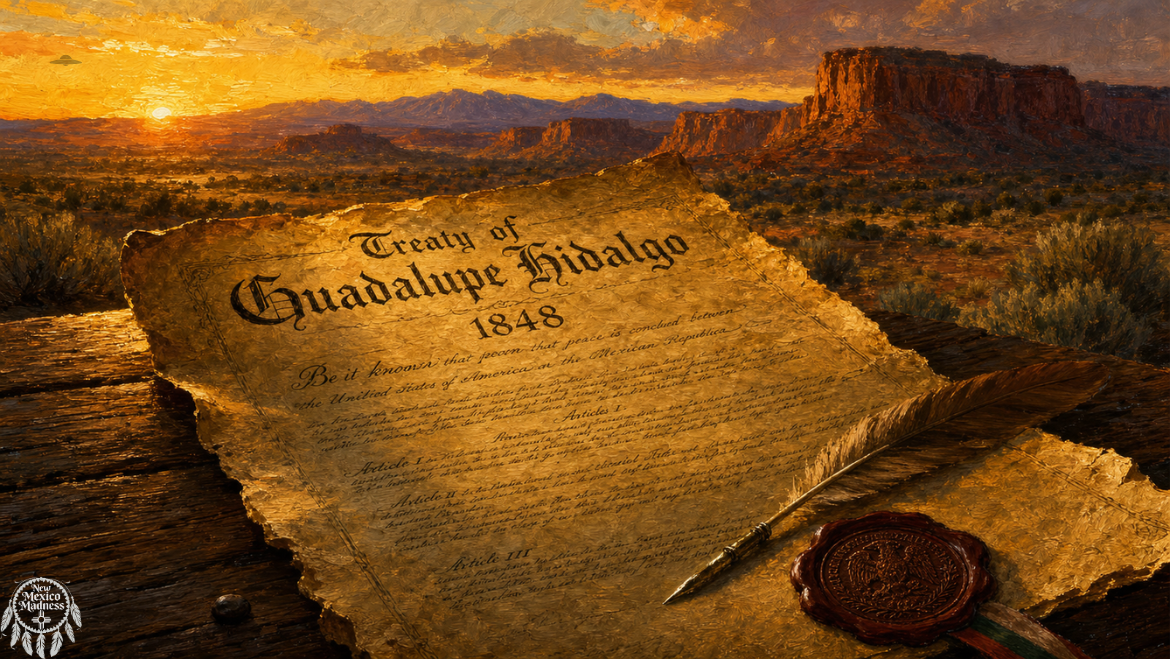
Won by the Sword: How New Mexico Became American
If you want to understand what this country was willing to do to become what it is, look at the ground under your feet here in New Mexico.
This land did not join the Union by invitation. The United States fought the Mexican-American War, and in 1848 the Treaty of Guadalupe Hidalgo ceded New Mexico and the broader Southwest to the United States. Read that plainly: the Union wanted this territory badly enough to spill blood for it. New Mexico was earned, not inherited.
There is something honest in that. We can dress up the founding of nations in noble language, but the older countries lecturing anyone about how borders should be drawn were not exactly kittens when they drew their own. Every great nation was forged in conflict. The difference is whether you own it. New Mexico became American because America fought for it — and a century later, this same hard-won ground would repay the debt by handing the nation the most decisive weapon in human history.
The Ground That Forged a Superpower
By the early twentieth century, America was no longer fighting just to survive. It was learning that it could shape the entire world.
World War I and World War II were the hinge. They transformed a divided agrarian republic into the central economic, financial, and military power on the planet. By the eve of the Second World War, America had made a deliberate choice — not an accident of history, but a decision — to stop standing on the sidelines and lead. The dollar, the navy, the industrial base, the alliances: all of it was built in that fire.
And the war that ended the largest conflict in human history ended here. On July 16, 1945, in the Jornada del Muerto desert of New Mexico, Manhattan Project scientists detonated the first atomic device ever built — code-named Trinity — atop a 100-foot steel tower. The blast vaporized the tower, fused desert sand into glass, and sent a mushroom cloud nearly seven miles into the sky. The atomic age began on soil the nation had won at gunpoint a century earlier.
From that moment, New Mexico was not a backwater. It was the engine room of American deterrence, home to Los Alamos and later White Sands, the place where the Cold War was quietly kept won decade after decade by Americans most of the country will never meet. The peace this nation has enjoyed since was never free or automatic — it was maintained, every single day, by people working in the shadows of that machinery. The arc is almost poetic: New Mexico was taken by the sword and later forged the ultimate one.
Two Wars, One Conviction: Korea and Vietnam
The Cold War produced two generational conflicts that deserve more room in this story than they usually get, because both were fought under the same conviction, even though history judged their outcomes very differently.
Korea is the clean case. In June 1950, North Korean troops crossed the 38th parallel in a coordinated invasion of the South. The United Nations condemned it as a breach of the peace, and America led the response to defend a young, free nation against an unprovoked communist invasion. The war ended in stalemate rather than victory, but the fight held the line. Look at a satellite photo of the Korean Peninsula today and the case makes itself: one half is lit up with prosperity and self-government, the other is dark, starved, and ruled by a dictatorship into its third generation. That contrast exists because America decided a free people's right to exist was worth defending.
Vietnam is the harder case, and it deserves honesty rather than spin. The strategic logic was containment — the belief that if South Vietnam fell to communism, its neighbors would fall next, and that American blood and treasure were the price of stopping that spread. America went in to defend South Vietnamese self-determination, the same founding conviction behind every other fight in this story. The domino theory itself did not hold up the way its architects predicted, and even the men who built that strategy came to say so later. The war did not end the way Korea did, and the scars it left on this country, at home and abroad, are real and still felt.
But the instinct underneath both wars was identical: a belief that tyranny spreading unchecked was worse than the cost of resisting it. One fight held the line. The other did not go the way anyone hoped. Both were fought by the same nation, with the same founding conviction, and both belong in this story precisely because we are not interested in telling only the parts that make us look flawless.
From Survival to Conscience
Somewhere in the back half of the twentieth century, the character of American power shifted again. The early wars were about existence and expansion. Korea and Vietnam were about containment. The wars that followed, increasingly, were about something else entirely: stopping evil and standing up for people who could not stand up for themselves.
When Iraq invaded Kuwait in 1990, America led a coalition to throw the invader back out. That was not about territory. That was about an ally and a principle. And then came the operations that prove the point better than any others.
In 1995, American airpower helped end a genocide in the heart of Europe, breaking the siege and forcing peace in Bosnia. In 1999, the same resolve halted ethnic cleansing in Kosovo. In Somalia, Americans went in to feed a starving population and stayed to fight when the mission turned. These were not wars of conquest. There was no land to gain, no empire to build. America showed up because something genuinely evil was happening and someone with the power to stop it decided to.
That is the distinction worth celebrating. Not glory for the sake of glory. Glory because America stopped something bad, or helped someone who needed it. The humanitarian and security operations of this era are almost endless once you start counting — and that volume is not a stain. It is a résumé.
The Long Road We Didn't Plan to Walk
And then there is the morning that changed the trajectory of the nation.
For an entire generation, September 11, 2001, is what Pearl Harbor was to their grandparents — a wound so deep it does not need embellishment. America was attacked at home, and the country responded the way it always has: by fighting back. What followed was a twenty-year road through Afghanistan and Iraq that no one had planned to walk and that reshaped a generation of American life.
We won't dwell on it here, because the emotion is too heavy and the cost too personal for too many families to reduce to a paragraph. But it belongs in this story, because it is the clearest modern proof of the founding attitude. Hit America, and America does not retreat into itself. It answers. The road was long, the scars are real, and the debate over it will continue. None of that changes the instinct underneath it — the same instinct that signed a treasonous document in 1776.
Freedom Isn't Free, and It Never Was
So here we are at 250 years. Let's be clear about what this piece is and is not.
This is not a celebration of war. War is ugly, and anyone who has stood near the machinery of it knows that better than the people who cheer for it from a distance. This is a celebration of America — and the honest truth is that celebrating America sometimes means acknowledging the times it had to drop the gloves, and even the times it swung and did not land the way it hoped.
We are not justifying bloodshed in the name of greatness. We are saying something simpler and harder: this is a nation of fighters. When our way of life is threatened, or when our friends are, we throw down. That is not a flaw in the American character. It is the American character. It was there at the signing table, it was there at Guadalupe Hidalgo, it was there at Trinity, it was there on the 38th parallel and in the jungles of Vietnam, and it was there over the Balkans.
The Founders had the guts to declare independence when it could have cost them everything, and they bet that the idea would stick. They were right. Two hundred and fifty years later, the conviction that freedom is worth fighting for is still in all of our DNA. The scars are part of the story, and there are no regrets in any of it — because the alternative was never freedom.
Celebrate your independence this Fourth. And remember that the only reason you can is that, for 250 years, Americans were willing to fight to keep it.
Endnotes
- The White House — America 250: https://www.whitehouse.gov/america250/
- GovInfo — America's 250th Anniversary (Semiquincentennial): https://www.govinfo.gov/features/america-250
- Wikipedia — Lists of Wars Involving the United States (Mexican-American War, War of 1812, Gulf War, Bosnia, Kosovo, Afghanistan, Iraq): https://en.wikipedia.org/wiki/Lists_of_wars_involving_the_United_States
- National Park Service — Trinity Site, NM: https://www.nps.gov/places/000/trinity-site.htm
- Atomic Archive — Trinity Site, Manhattan Project Signature Facilities: https://www.atomicarchive.com/history/sites/trinity-site.html
- National Archives — US Enters the Korean Conflict: https://www.archives.gov/education/lessons/korean-conflict
- GlobalSecurity.org — Vietnam War: The Domino Theory: https://www.globalsecurity.org/military/ops/vietnam2-domino-theory.htm
- LSE — How the United States Decided to Dominate the World: https://www.lse.ac.uk/International-History/Events/2020/how-the-us-decided-to-dominate-the-world
- BBC — America at 250: independence as "a protracted struggle that ultimately resulted in self-rule": https://www.bbc.co.uk/newsround/articles/cj37eemz13zo


