

A targeted recruitment package for certain professions may be legitimate. Calling taxpayer help with selected workers’ mortgages an affordability plan is not. Especially when New Mexico is short nearly 40,000 affordable rentals, not homes.
Deb Haaland’s affordability agenda includes a promise to provide housing help to workers filling job shortages. The proposal would help with mortgage payments, down payments, and related costs to recruit and retain health-care professionals, educators, law-enforcement officers, and social workers.
Housing matters. A rural hospital without a physician, a school without a teacher, and a community without enough law-enforcement personnel all have real problems. New Mexico should not pretend otherwise.
But a state housing strategy must begin with an equally basic question: who is experiencing the housing emergency right now?
The answer is not found in the list of favored professions. It is found in the families who cannot secure a rental, the workers spending half their paycheck on housing, and the people one missed check away from an eviction notice.
New Mexico is short 39,780 rental homes affordable and available to extremely low-income households—people at or below the poverty guideline or 30% of area median income. Nearly half of renters statewide are cost-burdened, paying more than 30% of income on housing. About one in five homeowners are in the same position.
That is the affordability crisis. A public mortgage subsidy for a selected professional may help an employer recruit. It does not create a home for the people priced out of the market.
A recruitment subsidy is not a housing plan
Haaland’s proposal combines two distinct problems under one friendly label.
One problem is workforce recruitment. New Mexico has genuine shortages of physicians, behavioral-health professionals, teachers, law-enforcement officers, and social workers—especially in rural areas. The state’s health-workforce analysis warns that its primary-care physician workforce is aging and that upcoming retirements could deepen access problems.
The other problem is housing affordability. That is measured by rents, vacancy, housing units, evictions, homelessness, and whether ordinary households can afford to live near their work.
Those are not the same problem and they should not be judged by the same metric.
If a hospital needs a trauma surgeon or an isolated community cannot recruit an OB-GYN, an employer-backed incentive may be justified. The public should know the vacancy, the local need, the cost of leaving it vacant, the compensation package, and the length of the worker’s commitment.
But when a candidate describes mortgage assistance for selected professionals as an affordability policy, she is making a different claim: that helping some buyers compete for homes will make housing affordable for everyone else. It will not.
It may solve the employer’s recruiting problem. It does not add one unit to New Mexico’s housing stock.
Who pays—and who qualifies?
The missing details matter more than the slogan.
Haaland’s bullet does not identify an income cap, a home-price cap, a maximum subsidy, eligible counties, an employer match, a service requirement, a repayment trigger, or a total annual cost.
Without those limits, taxpayers have no way to know whether the assistance goes to a modestly paid social worker in a high-cost rural community—or to a highly compensated specialist buying a high-end home in Santa Fe.
That is not a hypothetical concern. Santa Fe’s typical home value is about $581,000, while its median list price has approached $750,000 to $819,000 depending on the market source. A plan with no stated price cap could put public money behind a purchase most New Mexicans could never imagine making.
A working family in Roswell, Clovis, Gallup, Farmington, Deming, or Las Cruces should be allowed to ask: why should my tax dollars help make a mortgage payment for a professional buyer when my family is competing for a basic apartment, a starter home, or a trailer space?
The question is not whether doctors, teachers, deputies, or social workers deserve decent places to live. They do.
The question is why the plan names them but leaves out the paramedic, firefighter, teacher’s aide, bus driver, custodian, restaurant worker, grocery clerk, truck driver, lineman, mechanic, construction worker, and young family struggling to buy a first home.
If essential work is the standard, the list becomes arbitrary fast.
The data points in another direction
New Mexico’s affordability emergency is concentrated among people with the least ability to absorb higher housing costs.
The poverty map tells the broader story: 30 of New Mexico’s 33 counties have poverty rates above the national rate. McKinley and Socorro are each at 33.2%; Cibola is 28.4%; Quay 27.1%; Guadalupe 25.5%; Catron 24.8%; and Chaves 24.3%.
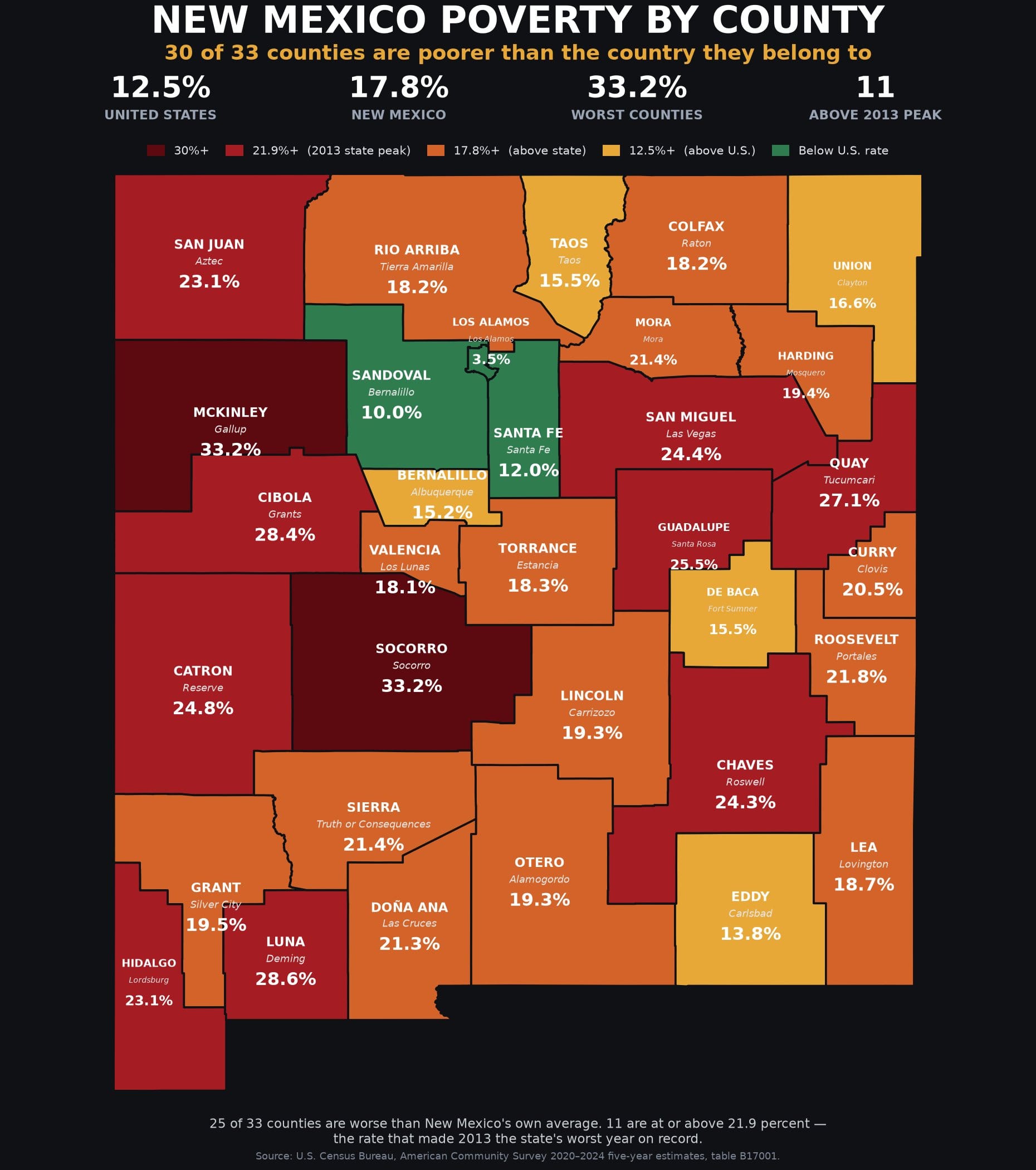
This is not an argument that a rural clinic should lose its doctor. It is an argument about order of operations. Leaders do not look at the above poverty map and stats and then ask residents to help pay for private mortgages for new residents to move here.
When a state confronts an affordability crisis, its first instinct should be to get a roof over as many residents as possible who do not have one—not to improve the purchasing power of people already able to qualify for professional employment and a mortgage.
A state subsidy that helps a selected worker buy in a tight market may simply give that buyer an advantage over another buyer. It does not lower the price of homes. It does not make an apartment available to a family paying more than half its income in rent. It does not reduce the number of New Mexicans sleeping outdoors.
The public deserves a return
There is a narrow version of this idea that could be defensible.
A targeted package for a documented shortage area should require the employer—hospital, school district, local government, or clinic—to match state dollars. It should have a reasonable income limit and home-price cap. It should require the worker to live and serve in the community for a defined period, perhaps five years. And the subsidy should be repaid on a sliding scale if the worker leaves early, sells, refinances, or changes jobs.
That is a contract. Taxpayers pay for a measurable public return: a filled vacancy and continuous service in a community that needs it.
Haaland’s plan gives voters none of those terms. It offers a benefit with no disclosed price, no stated guardrails, and no measurable return.
New Mexico does need doctors, teachers, deputies, and social workers. It also needs homes affordable to the people already here—the workers who keep hospitals, schools, roads, restaurants, stores, farms, and oilfields running.
Those workers deserve more than watching the state create a special mortgage lane for someone else.
Before taxpayers are asked to help pay selected professionals’ housing costs, Haaland should answer five questions:
What occupations, income levels, communities, and home prices qualify?
What is the maximum public subsidy per worker and its annual statewide cost?
What must an employer contribute?
How long must a recipient remain in the community, and when is the money repaid?
How many additional affordable rental and starter-home units will this program create?
Until those numbers are public, this is not an affordability plan. It is a selective compensation package paid for by New Mexicans who may never qualify for it.
Sources
Haaland campaign, An Affordable New Mexico — workforce-housing pledge for shortage occupations.
National Low Income Housing Coalition, The Gap: New Mexico (2025) — 39,780 shortage of rental homes affordable and available to extremely low-income households.
Source New Mexico, “NM housing authority finds nearly half of renters statewide are cost-burdened,” May 18, 2026.
New Mexico Legislative Health and Human Services Committee, New Mexico’s Healthcare Workforce: Sources and Trends, June 25, 2025.
Zillow, Santa Fe market data, July 2026; Santa Fe market listings, August 2026.
U.S. Census Bureau, American Community Survey 2020–2024 five-year estimates, table B17001; New Mexico poverty-by-county map supplied by New Mexico Madness.


