

New Mexico told workers to take a COVID vaccine or risk their jobs. Federal guidance now says that for most people the decision belongs to the patient and their clinician.
Both of those cannot have been settled science. One was policy wearing science as a uniform, and New Mexico has never gone back to determine which.
We forced. We paid. We closed businesses. We masked children. We did all of it on information that was openly fluid at the time and has since been rewritten by the same federal agencies that supplied it. New Mexico Madness put six questions about that record to Gov. Michelle Lujan Grisham and Attorney General Raúl Torrez in a public memorandum. The central one was narrow: does the attorney general see any basis for a legal or civil-rights review of how the state handled lockdowns, mandates, closures, school restrictions and vaccine incentives?
Nothing has come back. Not a denial, not a referral, not a jurisdictional objection.
The federal record moved. Twice.
The guidance changed first. CDC now recommends the COVID vaccine for people six months and older on the basis of individual-based decision-making — a conversation with a clinician, not a universal directive. For everyone from six months through 64 years, the agency states that the risk-benefit balance is most favorable for those at increased risk of severe disease and lowest for those who are not. Pfizer-BioNTech is no longer authorized for children six months through four years. CDC's January 2026 schedule restructuring moved COVID out of the universally recommended category, cutting that list to 11.
The safety record shows the same motion. Surveillance found myocarditis in ages 12 to 39 at roughly 38 cases per million doses after the second original dose and about 25 per million after monovalent boosters, concentrated in teenage males. That signal was real and regulators acted on it. It has also resolved: every formulation since the 2022 bivalents has landed at or near the background rate for that age group, and none has shown a statistically significant excess. The early calculus likely favored vaccination. That is exactly why the revisions that followed deserve an explanation rather than silence.
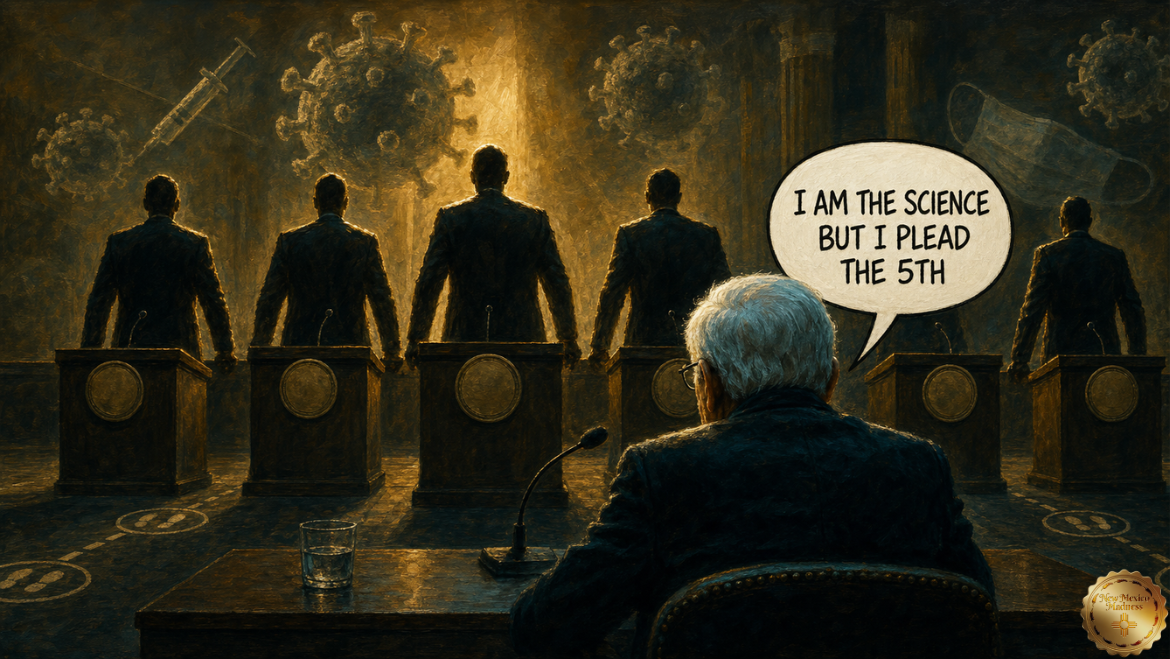
Then the paper trail moved. Health and Human Services Secretary Robert F. Kennedy Jr. said it took eight months to recover Dr. Anthony Fauci's pandemic-era journals from 11 separate servers where they had been, in his words, sequestered. Sen. Rand Paul released more than 1,100 pages covering December 2019 through 2022, plus a 465-page collection of earlier records. Summoned under subpoena on July 29, Fauci invoked his Fifth Amendment right 111 times across a three-hour hearing, reciting the same sentence each time. He now faces a contempt of Congress vote and a criminal referral.
Why the pardon points at Santa Fe
President Biden pardoned Fauci on his last day in office for federal offenses connected to his government service from January 2014 forward. Note what that does and does not do.
For pardoned conduct, federal criminal exposure is gone — which ordinarily makes a Fifth Amendment claim weaker, not stronger, because there is no longer a federal prosecution to fear. The pardon leaves two things untouched. It does not cover conduct after it was issued, including sworn testimony. And it does not reach state law.
That is the part New Mexico officials should sit with. A federal pardon closes the federal door. It does not close a state's. The most sweeping act of clemency in modern pandemic politics has no effect whatsoever on a state attorney general's authority to examine what happened inside his own borders.
And New Mexico's officials never needed a pardon. No one ever asked them for anything.
What New Mexico did with that certainty
The state did not merely encourage vaccination. It attached consequences to refusal and cash to compliance.
New Mexico spent $10 million in federal stimulus funds on the Vax 2 the Max sweepstakes — weekly $250,000 regional prizes, a $5 million grand prize, prize-wheel giveaways, and $100 payments tied to specific vaccination windows. It tied employment to vaccination for health care and state workers. It closed businesses deemed nonessential while liquor outlets and cannabis dispensaries stayed open, and it backed public health orders with civil penalties reaching $5,000 per violation per day.
Paying financially strained people to accept a medical product is not a minor administrative choice. Neither is making a paycheck contingent on one. Both demand more justification as the evidence behind them grows more qualified — not less scrutiny because the emergency ended.
Torrez has options short of prosecution
The standard defense is that officials acted on the best available information. Accept it entirely. It still leaves the question standing, and the question is no longer whether an attorney general may look.
Texas's attorney general has used state consumer-protection law to sue a manufacturer over vaccine efficacy claims and opened an investigation into financial incentives tied to vaccine recommendations. Maryland's attorney general convened a task force and published 59 recommendations on pandemic-era harms — a report, not an indictment. Eleven attorneys general, one of them a Democrat, went to court over the legality of an employer mandate.
Torrez has spent 2026 demonstrating the same instinct in every direction but this one. He sued the U.S. Department of Justice for unredacted Epstein files after ten requests went unanswered. He challenged a federal records denial in his DEA fentanyl investigation. He sued New Mexico's own Children, Youth and Families Department over what he called a shroud of secrecy.
The honest distinctions are real: Epstein involves alleged crimes and identifiable victims, CYFD involves statutory duties, and pandemic policy involved executive judgment under genuine danger. Those differences are why the answer might legitimately be no.
But no is an answer. So is: this belongs to the Legislature, the State Auditor, or an independent commission. What is not an answer is silence from an office that made records access its signature issue.
The federal foundation this state built on is being pulled apart on the record, page by page, plea by plea. New Mexico enforced it with fines, closures and conditional paychecks. Every other party to that arrangement is being asked to account for it.
We wrote the governor. We wrote the attorney general. The buildings reopened, the orders expired, and the state has said nothing.
Endnotes
- CDC, 2025–2026 COVID-19 Vaccination Guidance (individual-based decision-making; risk-benefit framing). cdc.gov/covid/hcp/vaccine-considerations/routine-guidance.html
- CDC, Interim Clinical Considerations (Pfizer-BioNTech no longer authorized, ages 6 months–4 years). cdc.gov/covid/hcp/vaccine-considerations/index.html
- HHS, "ACIP Recommends COVID-19 Vaccination Based on Individual Decision-Making," Sept. 19, 2025. hhs.gov
- CDC, "CDC Acts on Presidential Memorandum to Update Childhood Immunization Schedule," Jan. 5, 2026. cdc.gov
- CIDRAP, "The COVID vaccine myocarditis signal was real but is now resolved," March 3, 2026. cidrap.umn.edu
- ACIP, "Use of 2025–2026 COVID-19 Vaccines" (myocarditis rates by formulation and age). cdc.gov/acip
- NPR, "Anthony Fauci invokes Fifth Amendment in Rand Paul Senate hearing," July 29, 2026 (1,100+ pages; 465-page prequel). npr.org
- ABC News, "4 takeaways from Dr. Anthony Fauci's journals ahead of his Senate testimony," July 29, 2026 (Kennedy: eight months, 11 servers). abc7ny.com
- Fox News, "Why Fauci's 111 Fifth Amendment pleas could end up before the courts," Aug. 1, 2026 (111 invocations; contempt resolution; criminal referral). foxnews.com
- Senate Homeland Security and Governmental Affairs Committee, "Testimony of Anthony Fauci," July 29, 2026. hsgac.senate.gov
- NPR, "Biden pardons Fauci, Milley and members of Jan. 6 panel," Jan. 20, 2025. npr.org
- K. Wehle, "Biden's Pardon Didn't Erase Fauci's Constitutional Rights," Aug. 10, 2026 (pardon covers Jan. 1, 2014 to Jan. 19, 2025; does not reach post-pardon conduct or state law). kimwehle.substack.com
- New York Times, "Fauci's Pardon From Biden Would Not Shield Him From New Offenses," July 29, 2026. nytimes.com
- Texas Attorney General, "Paxton Sues Pfizer for Misrepresenting COVID-19 Vaccine Efficacy," Nov. 30, 2023. texasattorneygeneral.gov
- CIDRAP, "Texas attorney general takes aim at pediatricians who vaccinate," Jan. 22, 2026 (investigation into financial incentives). cidrap.umn.edu
- PBS NewsHour, "11 states file suit against Biden's business vaccine mandate," Nov. 5, 2021. pbs.org
- Maryland Attorney General COVID-19 Access to Justice Task Force report, Jan. 11, 2021 (59 recommendations). consumerfinancialserviceslawmonitor.com
- Office of the Governor, "N.M. hits 'reset,'" Nov. 13, 2020 ($5,000 per day civil penalties). governor.state.nm.us
- Office of the Governor, "New Mexico Launches 'Vax 2 the Max' Sweepstakes," May 31, 2021. tax.newmexico.gov
- ABC News, "New Mexico attorney general sues DOJ over Epstein files," Aug. 5, 2026. abcnews.com
- Politico, "New Mexico sues Justice Department over Epstein files," Aug. 5, 2026. politico.com
- NMDOJ, "Torrez Challenges U.S. DOJ Denial of Records Request in DEA Fentanyl Investigation," Aug. 3, 2026. nmdoj.gov
- Searchlight New Mexico, "New Mexico AG sues CYFD over 'shroud of secrecy,'" April 9, 2026. searchlightnm.org
- New Mexico Madness, "New Mexico COVID Accountability Silence," August 2026.


