

Long before flight became ordinary, it seemed almost mythic. For centuries, human beings looked upward with the same mix of wonder and frustration, imagining what it would mean to leave the ground under our own control. Then, on a cold December day in 1903, two bicycle mechanics from Dayton, Ohio, did something that changed not only transportation, but the shape of modern civilization itself.
Wilbur and Orville Wright did more than build a machine that could rise into the air. They solved one of the great problems in human history: how to make powered flight controllable, repeatable, and real. In twelve famous seconds at Kitty Hawk, they gave the United States one of its defining acts of modern ingenuity. And in the 120-plus years since, the nation has been building on that achievement ever since.
As America approaches its 250th anniversary, the Wright brothers deserve to be remembered not merely as pioneers of a remarkable first flight, but as the architects of a new age. Their breakthrough did not end at the dunes of North Carolina. It opened the sky to commerce, defense, science, communication, exploration, and imagination. It is not an exaggeration to say that the modern world above our heads — the jets, drones, rockets, satellites, and vast aerospace networks of daily life — begins with them.
Two brothers, one breakthrough
The Wright brothers were not the only people in the world trying to fly. By the end of the nineteenth century, inventors and dreamers on both sides of the Atlantic had built gliders, studied birds, and experimented with the mechanics of lift and propulsion. But most were still struggling with the hardest part of the problem: control.
That is where the Wrights changed history.
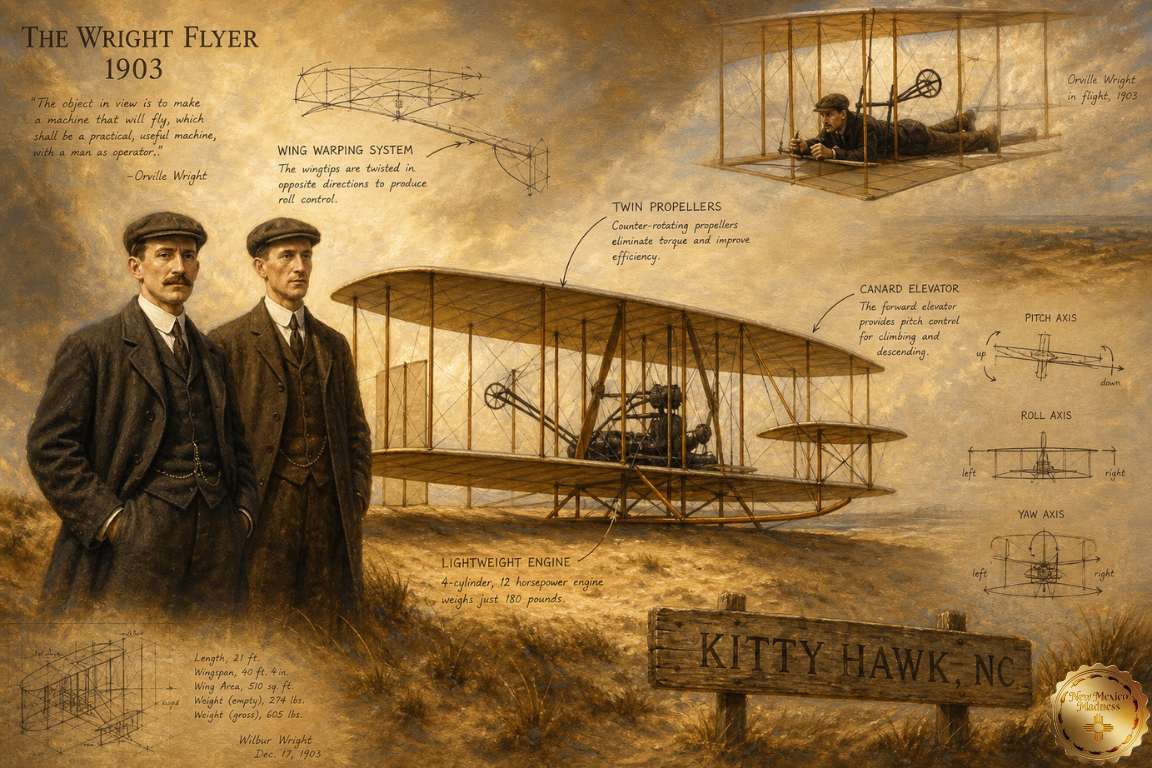
They approached flight not as hobbyists chasing spectacle, but as disciplined experimenters solving an engineering problem. They studied earlier failures. They built and tested gliders. They conducted their own wind-tunnel experiments. Most importantly, they developed a workable system of three-axis control that allowed a pilot to manage roll, pitch, and yaw. That achievement was every bit as important as the engine itself. The real genius of the Wright brothers was not simply that they got into the air, but that they learned how to stay in command once they were there.
On December 17, 1903, near Kitty Hawk, North Carolina, that effort finally culminated in history. Orville Wright made the first successful powered flight of a heavier-than-air aircraft, traveling 120 feet in 12 seconds. Later that same day, Wilbur flew farther still. Those flights were brief, fragile, and easy to underestimate in hindsight. But they were enough. The threshold had been crossed.
Why 1903 still matters
The Wright brothers’ achievement remains one of the most important moments in American history because it transformed a dream into a system. Flight was no longer a fantasy, a stunt, or a lucky leap. It had become a discipline.
That distinction matters. Once controlled flight became possible, the consequences spread quickly and permanently. Aircraft would shrink distance, redraw commerce, alter warfare, accelerate mail and freight, transform tourism, and create entire industries that had not existed before. The twentieth century became, in no small measure, an age of movement through the air.
And the United States did not merely participate in that age. It helped define it.
The Wright brothers gave America more than a machine. They gave the nation a proof of concept for something larger: that careful observation, practical tinkering, and relentless testing could unlock a frontier that had mocked humanity for generations. That spirit became part of the American identity in the century that followed. It showed up in factories, laboratories, airfields, launchpads, and control rooms. It showed up wherever the nation chose to take hard problems seriously.
From Kitty Hawk to the jet age
The long-term impact of the Wright brothers is easiest to see when looking at the air age they set in motion. Within a few decades, airplanes evolved from fragile wood-and-fabric machines into military assets, passenger carriers, and commercial workhorses. The airplane became part of daily life, then part of global strategy, then part of the structure of the world economy.
Once nations recognized that flight was practical, aeronautics became a national priority. In the United States, that momentum helped lead to the creation of the National Advisory Committee for Aeronautics in 1915, just over a decade after Kitty Hawk. NACA was founded because aviation had become too important to leave to scattered private experiments alone. Aeronautical research needed institutions, facilities, standards, and scale.
That, too, is part of the Wright legacy.
Their success helped move aviation from the realm of lone inventors into the realm of national capability. Over time, the work of NACA fed directly into the creation of NASA, linking the early age of flight to the later age of space. In that sense, the path from Kitty Hawk to the moon is not symbolic. It is real.
The sky we live under now
It is easy to think of the Wright brothers only in sepia tones: a sandy field, a skeletal flyer, a black-and-white photograph. But the true measure of their importance is not nostalgia. It is the world we live in now.
Commercial jets cross continents and oceans in hours. Drones survey land, inspect infrastructure, deliver goods, and support emergency response. Satellites orbit above the Earth, helping run communication systems, navigation, weather forecasting, agriculture, and defense. Rockets carry instruments, supplies, and people beyond the atmosphere. Even the most advanced aerospace systems of the present still belong to the same broad story that began when the Wrights showed that controlled powered flight was possible.
The technology has changed beyond anything Wilbur and Orville could have imagined. The principle has not.
Their work proved that the sky was not a barrier. It was a domain. Once America and the world accepted that truth, the horizon moved forever.
American ingenuity, then and now
There is something especially fitting about telling this story as part of America 250. The Wright brothers embody a national style of innovation that still resonates: practical rather than theatrical, experimental rather than abstract, ambitious without waiting for permission.
They were not operating from a royal laboratory or a giant industrial empire. They were working men with technical curiosity, mechanical skill, and unusual patience. They tested, failed, revised, and tested again. They paid attention to details others missed. And when they succeeded, they changed the world.
That remains one of the most powerful American ideas: that ingenuity is not only the property of elites or institutions. It can begin in a workshop. It can begin with persistence. It can begin with two people willing to take a difficult problem seriously.
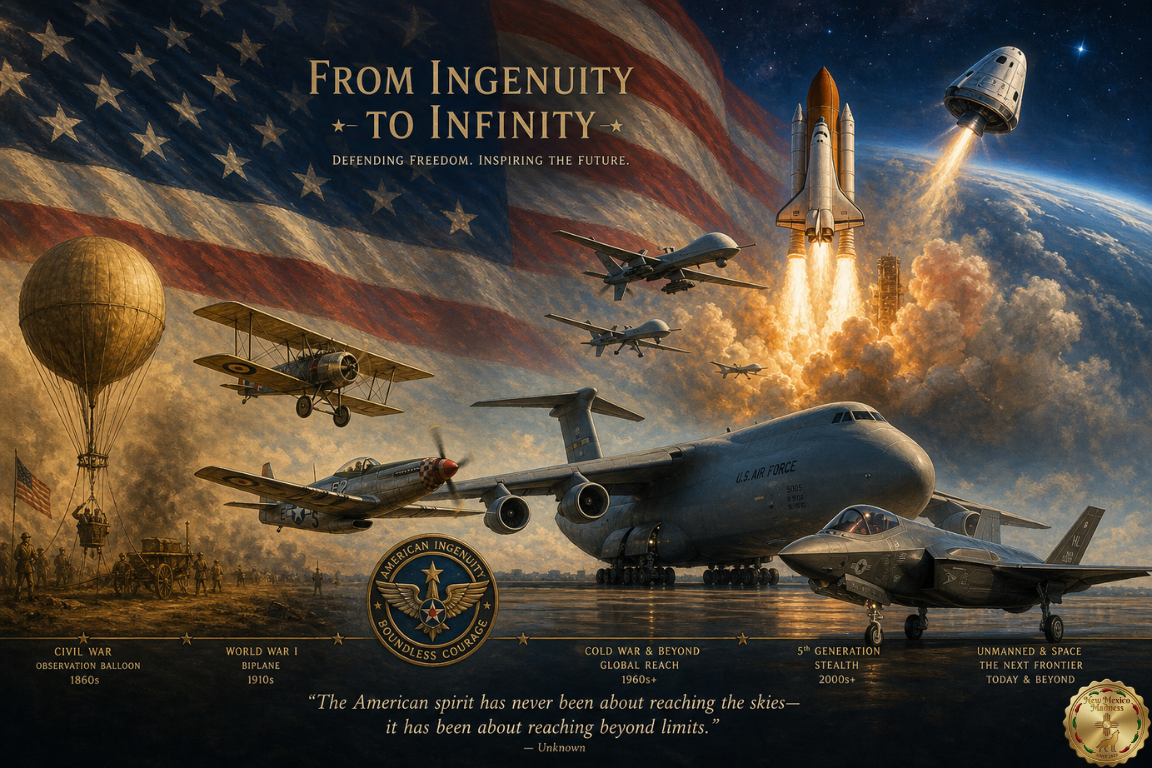
The country has been living inside the consequences of that lesson ever since. For more than 120 years, American flight has continued to evolve — through war and peace, through commerce and exploration, through aviation, rocketry, and aerospace engineering of every kind. Each new generation has carried the original achievement forward, expanding it into new systems, new industries, and new frontiers.
Why the story still lands
The Wright brothers matter not only because they were first, but because they were foundational. They did not simply claim a moment. They created a platform on which the future could be built.
That is what makes their story so compelling for a national anniversary. America 250 should not only celebrate founding documents and battlefield victories. It should also celebrate the breakthroughs that altered how human beings live on the planet. The first controlled powered flight belongs in that company.
The next time a passenger jet crosses the country, a drone hovers over a wildfire, a satellite supports navigation from orbit, or a rocket climbs into the dark, there is a line — sometimes visible, sometimes not — back to two brothers who refused to accept that flight was impossible.
Their machine was small. Their impact was not.
Endnotes
- Encyclopaedia Britannica, “Wright brothers.”
- National Air and Space Museum, Smithsonian Institution, “The Wright Brothers.”
- Alfred Gollin, “The Origins of the First Powered, Man-carrying Airplane,” Technology and Culture 45, no. 1 (2004), JSTOR.
- J. D. Anderson Jr., “The birth of flight control: An engineering analysis of the Wright brothers’ 1902 glider,” The Aeronautical Journal 107, no. 1078 (2003), Cambridge University Press.
- NASA History Office, “115 Years Ago: Wright Brothers Make History at Kitty Hawk.”
- National Air and Space Museum, Smithsonian Institution, “1903 Wright Flyer.”
- NASA History Office, “110 Years Ago: The National Advisory Committee for Aeronautics Founded.”
- NASA History Office, “NACA Overview.”
- EBSCO Research Starters, “Wright brothers.”
- Peter L. Jakab, Visions of a Flying Machine: The Wright Brothers and the Process of Invention.


